Showing posts with label William Symington. Show all posts

Tuesday, March 17, 2015

Jesus' Authority as God and Jesus' Authority as Mediator: Symington

For several years I have been trying to understand the history of the doctrine of the Mediatorial Kingship of Christ. One issue that continues to crop of in the literature is how to understand Christ in relation to the Church and Christ in relation to the created order.

This distinction was important during the time of the Westminster Assembly (1643-1653), the killing times in Scotland (1660-1688), and in the Reformed Presbyterian Church's witness though writers such as William Symington.

I hope in a future post to address this distinction as the Westminster Assembly was confronted with the issue.

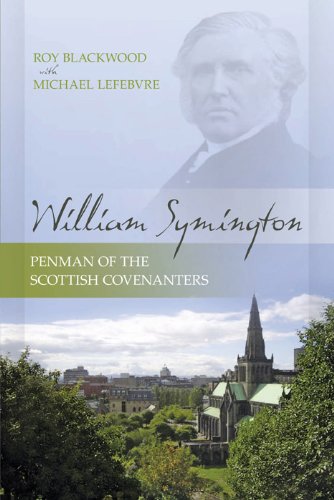
More recently, this distinction has appeared, throughout the years, in the debate over Two Kingdom theology. Dr. Darryl Hart and Dr. R. Scott Clark have been redirecting any opposition at Two Kingdom theology to an essay written by Dr. David McKay in The Faith Once Delivered: Essays in Honor of Dr. Wayne R. Spear. I intend to write a future post about how to understand Dr. McKay's essay in the future, but for now I want to highlight a very helpful, modern day explanation of this distinction that Drs. Blackwood and LeFebvre give in their book William Symington: Penman of the Scottish Covenanters on pages 210-212:
Before examining the main content of Symington's work, one important clarification should be made. It is a matter of clarification which Symington sought to establish in the opening pages of his book [ed., Messiah the Prince]. Specifically, we must have clearly fixed in mind a distinction between Jesus' authority as God—an authority which He always enjoyed over all things—and His authority as our Savior. By His very nature, Jesus always was God. To bring about our salvation, however, Jesus had to become a man. It is in Jesus' becoming a man that He took up the responsibilities and prerogatives of a Priest, a Prophet, and a King. We should have it clearly in mind that Symington was writing, in this book, about the royal authority Jesus obtained as our Incarnate Savior. This is an aspect of His authority distinct from that which He always enjoyed as the Creator God.
This might seem a confusing distinction to make, but it is a biblical distinction that needs to be upheld.Just as it is hard to comprehend how Jesus can be both God and man, similarly it is difficult to comprehend how Jesus can be at once both eternally sovereign (as Creator) and yet also to have needed to obtain sovereignty (as Savior). Yet such distinctions are taught to us by Scripture, and are important to have in mind as we approach Symington's book. ...
[T]he same Jesus, who as Creator always held sovereignty over us, now takes on mediatorial kingship as well for the purposes of our salvation.
In the case of Jesus, we might speak of the first kind of authority—His eternal sovereignty as God—as His natural dominion. It was Jesus who made all things, and having made everything, Jesus naturally owns all things. Simply because of who Jesus is (His nature), He has sovereign authority over everything. Paul wrote about this kind of authority held by Jesus in his epistle to the Colossians:
For by him were all things created, that are in heaven, and that are in earth, visible and invisible, whether they be thrones, or dominions, or principalities, or powers: all things were created by him, and for him: and he is before all things, and by him all things consist (Col.1:16-17; cf. Ps. 24:1-2).
As the Creator God, Jesus always had absolute authority over all things. Just as there was never a time when He was not God, there was never a time when Jesus was not King, in this sense. Symington refers to this authority of Jesus the Creator God as His essential, or what we here have termed His natural dominion.
The second king of authority Jesus held, however, is something which He had to obtain as part of His work of salvation. It is what Symington calls His mediatorial dominion. As a man, Jesus took "the form of a servant" (Phil. 2:7). In respect to His humanity, Jesus was not (at first) revealed as a king, but a servant. Nevertheless, from that position of servanthood, Jesus went on to be exalted to a throne: "Wherefore God also hath highly exalted him, and given him a name which is above every name" (Phil. 2:9).
Peter also preached about this authority Jesus received as our incarnate Savior in Acts 2. Using one of David's Psalms (Ps. 110) as a preaching text, Peter proclaimed,
Therefore being a prophet, and knowing that God had sworn with an oath to him, that of the fruit of his loins, according to the flesh, he would raise up Christ to sit on his throne...David...saith himself [of Jesus], The Lord said unto my Lord, Sit thou on my right hand, until I make thy foes thy footstool. Therefore let all the house of Israel know assuredly, that God hath made the same Jesus, whom ye have crucified, both Lord and Christ (Acts 2:30-36; cf., Isa. 9:6).
Jesus was exalted to a throne and endowed with titles of sovereignty. Peter is clear to indicate these privileges as being "new" acquisitions—authority ascribed to Jesus at a specific point in time and in specific connection with His work as our Savior. This is a second kind of authority obtained by Jesus in specific connection with His work of salvation. [A]lthough Jesus already held natural authority over the creation, in His love He went further to obtain for Himself mediatorial authority for the specific purpose of guaranteeing the effectiveness of our redemption.
Drs. Blackwood and LeFebvre's reference to Symington's establishment of this distinction in the opening pages of Messiah the Prince must be a reference to pages 4-5:
The sovereign authority of Christ may be viewed either as necessary, or as official. Viewing him as God, it is necessary, inherent, and underived: viewing him as Mediator, it is official and delegated. It is the latter of these we are now to contemplate. The subject of our present inquiry is, the MEDIATORIAL DOMINION of the Son; not that which essentially belongs to him as God, but that with which, by the authoritative act of the Father, he has been officially invested as the Messiah. It is that government, in short, which was laid upon his shoulders—that power which was given unto him in heaven and in earth.
It is also helpful, when addressing this distinction, to note that Symington had to defend Christ's mediatorial authority (as Drs. Blackwood and LeFebvre use "authority" instead of Symington older term "dominion") over the Nations against contemporaries in Symington's time who contended that Christ only had natural dominion over the Nations. Symington's lengthy defense of his position can be found on pages 192-230 of the edition of Messiah the Prince that I have linked to earlier in this post.

Sunday, March 8, 2015

The Importance Of Reading William Symington in Order

Around the years 2008-2010 Dr. Roy Blackwood began and completed teaching his final church history classes at Second RPC in Indianapolis, Indiana. I did not participate in all those final classes, but I did attend most of them and I had family members and friends who completed the entire course work.

Dr. Blackwood was/is a pastor who earned his Ph.D. by studying an important man in the history of the Reformed Presbyterian Church named William Symington (1795-1862). I have occasionally quoted Symington's works in older posts, and am working on some posts in the future that will be about bringing Dr. Symington's teachings in the 19th century into debates going on currently in the Reformed church in the 21st century.

Occasionally Dr. Blackwood would bring Symington's writings into his earlier lectures. Dr. Symington wrote two books: On the Atonement and Intercession of Jesus Christ (1834); and Messiah the Prince, or On the Mediatorial Dominion of Jesus Christ (1839). One of the observations that Dr. Blackwood would made during class was that if people had heard of William Symington and read anything by Symington it was typically Messiah the Prince and then they would not read anymore. The reason why they read Messiah the Prince is to understand the Mediatorial Kingship of Christ over Nations, which is still the teaching of the Reformed Presbyterian Church all over the world.

However, Dr. Blackwood made attempts in his class to help students understand that people should also read Symington's earlier work in order to understand Symington's later work. While Dr. Blackwood was teaching a book came out by him and Dr. Michael LeFebvre in 2009 titled William Symington: Penman of the Scottish Covenanters. This book is based on Dr. Blackwood's thesis paper for his Ph.D. One half of the book is a biography of Symington's life and ministry and the second half is a modern summary of Symington's two books.

On pages 153-156, an argument is presented for reading both works, which is what Dr. Blackwood would present in his classes.I would like to quote two sections of Drs. Blackwood and LeFebvre argument to help those who might try to read only Symington's second book consider reading Symington's first book. The first quote is from page 153:
    Jesus by His blood, resttores us to God's favor. He makes us "at one" again with the Father. He washes away the sins that placed us outside of divine blessing. In a sense, His atonement restores us to the status of Adam before his fall. The positive task incumbent upon us remains, nonetheless. We not only need Jesus to restore us to God's favor, but we also need Him (as the Second Adam) to lead us into fulfillment of all God's purposes for us. It is in Jesus' obedience to the law, as our new Head, that this further need is also accomplished.
    Why is this distinction important? Because it is central to granting Christ full esteem as both our Priest and our King. In making the distinction, Symington is preparing the way for his later work on the kingship of Christ. It is as our Priest that Jesus offered the atoning sacrifice that reconciles men to God. We rightly ascribe the atonement to His labors for us as our sacrificing Priest. It is as our King, moreover, that Jesus fulfills the righteousness of the law for us. When we fail to carefully ascribe the sufferings alone to Jesus' priestly atonement, and suppose that His obedience also belongs to this priestly work, we are in danger of diminishing the kingly work of Jesus.
As a concluding remark, on page 156, Drs. Blackwood and LeFebvre conclude by saying:
    It was in the so-called "Second Reformation" in Scotland that Christ's mediatorial reign came to be more fully explored .... In Symington's handling of the "Substance of Christ's Atonement," we find one of his particular contributions as penman of the Scottish Covenanters. By restricting the atonement to that which was accomplished by Christ's sufferings, Symington is opening the way for a full appreciation of His law-fulfilling, kingdom-building work as Messiah the Prince.
I have omitted the content in-between these two quotes, which shows that this distinction is from the Bible. I would recommend the book as a good companion guide to reading Symington's two works. My point, in this post, is to urge Christians who should be interested in William Symington to recognize that both of Symington's works were written to be read together.

If both books seem intimating I would suggest reading a chapter a week starting with the 1934 book and then moving on to the second volume. Depending on your reading speed, you will finish both books within a year.

Sunday, July 20, 2014

The Reason for the Ceremonial Law

I just finished reading the first part of William Symington's book On the Atonement and Intercession of Jesus Christ. This book is made up of two parts: part one, the Atonement; part two, the Intercession. Both parts are united because Jesus was the Atonement for the members of his Church and Jesus is now providing Intercession for the members of his Church on the basis of finished Atonement on the cross.

Near the end of the final section of part one, Symington writes about the Results of Christ's Atonement under seven points. Point number six is on pages 248 - 254, and is basically:
The atonement more or less affects all the divine dispensations toward our world.
Where Symington goes with explaining this short sentence is very exciting! On pages 249 - 251 Symington summarizes his entire argument up to this point that is breathtaking:
The dispensation of providence regards the atonement as its centre. Redemption is the grand central point of providence, and atonement is the central point of redemption. The whole apparatus of redemption owes its being and its efficacy to the death of Christ; and every movement of the complicated wheels of providence derives its impulse from redemption. Preceding events look forward, succeeding events point backward, and meet as in a common centre in the cross. The course of providence, for four thousand
years before the advent of the Son of God, prepared the way for this stupendous event; and the train of occurrences since only serves to follow up the great design of his coming. "The Lord reigneth — the government is upon his shoulders." " The world is. therefore, not a wandering star, abandoned in wrath, discarded from use, rushing to destruction, but is still held for a design, and turned to an account the most glorious. Its Maker has not denounced nor disowned his property. It may be a rebel, but he is still its sovereign : it may be a recusant, but he is still its Lord."*
The dispensation of mercy, in all its several stages, stands, of course, in intimate connection with the cross of Christ. Revelation, the record of these progressive dispensations, is everywhere sprinkled with the blood of atonement. History, type, prophecy, song, epistle, all breathe the sweet-smelling savor of this one theme; and their varied contents derive a character of unity from this pervading circumstance.
From Adam to Moses, the practice of sacrificing, we have seen, existed. Adam, Abel, Noah, Lot, Abraham, all presented their burnt-offerings, which, from the substance of which they consisted, and the language in which they were spoken of. appear to have been both designed and understood to prefigure the great Christian Expiation. Without this they have no meaning, no worth; but are a cruel mockery of man's misery, and a deception of human hopes.
The Mosaic economy had innumerable rites and institutions, calculated to convey distinct ideas of propitiation and vicarious suffering. But, without the atonement of Christ, they were meaningless, useless, hurtful all. The whole system was nothing better than a pompous parade of gaudy ceremonies: a criminal waste of valuable property; a wanton infliction of unnecessary pain on sentient unoffending creatures. The atonement of Christ is what gives it all its significancy, utility, and consistency.
The peculiarity of the New Testament dispensation consists in a free, full, unhampered proclamation of mercy and salvation in the Lord Jesus Christ, to all men. It is an offer of eternal life and every spiritual blessing to them that believe. "Holding forth the words of eternal life." "Come unto me, and be ye saved, all ye ends of the earth, for I am God, and besides me there is no Saviour." But on what ground do these universal proffers proceed? Whence derive they their consistency, and their power, but from the perfect all-sufficient atonement of the Son of God? "We preach Christ crucified." "I determined not to know anything among you save Jesus Christ and him crucified." "God forbid that I should glory save in the cross of our Lord Jesus Christ." This is the language held by its ministers; and, indeed, every individual benefit it bestows, they are accustomed to speak of in language which marks the same connection. Is it redemption? We have redemption through his blood, even the forgiveness of sins." Is it reconciliation? "God hath reconciled us to himself by Jesus Christ." Is it peace? "We have peace with God through our Lord Jesus Christ." Is it justification? "Being justified freely by his grace through the redemption that is in Christ Jesus." The Gospel minister's commission is sealed with the blood and stamped with the cross of Emmanuel; nor can he ever execute it, in consistency with the character and glory of God, unless he exhibit the sacrifice of Christ as the chief article of his message, the burden of his doctrine, the central orb of the Christian system which gives to every part its living energy, and binds the whole together in sweet and indissoluble union.
At one point early in the quote, Symington used an asterisk character (*) after a quote. The source of the quote is given as "Hamilton's Sermons". I have though it would be interesting to try to track down all the other works that Symington references and try to get those republished as a way to better understand Symington. But, that will have to be for another day.

There are a few interesting points to make about this long quote, so here's a few that standout to me:
  • The relationship between Redemption and Providence, and then the Atonement to Redemption
  • The idea of "[p]receding events look[ing] forward, succeeding events point[ing] backward, and meet as in a common centre in the cross."
  • "Revelation, the record of these progressive dispensations, is everywhere sprinkled with the blood of atonement. History, type, prophecy, song, epistle, all breathe the sweet-smelling savor of this one theme; and their varied contents derive a character of unity from this pervading circumstance."
  • The explanation of the sacrifices from Adam to Moses as having no meaning, no worth; but are mockeries of man's misery, and a deception of human hopes unless they were both designed and understood to prefigure the great Christian Expiation.
  • Then what Symington has to say about the Mosaic economy is also helpful "... innumerable rites and institutions, calculated to convey distinct ideas of propitiation and vicarious suffering. But, without the atonement of Christ, they were meaningless, useless, hurtful all. The whole system was nothing better than a pompous parade of gaudy ceremonies: a criminal waste of valuable property; a wanton infliction of unnecessary pain on sentient unoffending creatures. The atonement of Christ is what gives it all its significancy, utility, and consistency."
It all pointed to Christ, and now we are looking back to Christ as the meaning for all the " ...  several typical ordinances, partly of worship, prefiguring Christ, His graces, actions, sufferings, and benefits; and partly, holding forth divers instructions of moral duties." We now believe that, "[a]ll which ceremonial laws are now abrogated, under the New Testament" (WCF 19.3).

Monday, July 14, 2014

The Ground of the Universality of the Gospel Offer

I have been reading through the works of William Symington and have found it to be a very helpful study. Most people who have heard of Symington skip his first book, On the Atonement and Intercession of Jesus Christ, to read his second book, Messiah the Prince or the Mediatorial Dominion of Jesus Christ. However, there is a lot of good content in Symington's first book that would be missed if readers just assume that William is repeating and expanding his prior work.

In fact, Symington was probably on his way to write a trilogy of books on the Three Offices of Jesus Christ: Prophet, Priest, and King. Dr. Symington, however, was first and foremost a pastor to himself, his family, and his church. Therefore, in the memoir written by his son, Alexander Symington, we learn that the only way he was able to write these two books was because his whole family was bedridden - On the Atonement - and he was sick - Messiah the Prince. Therefore, we should be glad with what he was able to write during quite a bit of duress in his life.

I was reading through section 11 - about the 'Extent of Christ's Atonement' - when I came to a part where Symington writes about one objection to a definite atonement being that the universal offer made of Christ in the Gospel. Symington writes about this objection on pages 209 - 214. I found a great few summary sentences that I really thought were well put on page 213:
The ground on which the universality of the Gospel offer proceeds, is the all-sufficiency of Christ's atonement.  This the universal Gospel message supposes and affirms.  It is not said in the Gospel, that Christ died with the intention that all should be saved, but that his atonement is a sufficient ground of salvation to all, and that all who rest on this ground of salvation shall be saved.
I think this is a wonderful summary of the Gospel Offer. I will probably have more on Symington as I continue to read. Let it never be said that the Reformed Presbyterian Church has a problem with the Free, or Universal, Offer of the Gospel. Furthermore, let us always remember the reason for that offer: the all-sufficiency of Christ's atonement not the duty of all men to believe in Christ for salvation (page 211).