Showing posts with label Matthew. Show all posts

Sunday, May 3, 2015

Is Christ as the 'last Adam' a Theological Peccadillo?

Even though it's not apparent on the comments section of my previous post about Jesus Christ being the 'last Adam' as opposed to the 'second Adam' my Google+ post has generated some comments that basically ask if the distinction is so obscure that it really has little or no actual meaning.

While I'm not going to post that entire discussion in the current post, I though that a few additional comments that came out of that discussion would be helpful on this matter.

First, Professor Donnelly's statement that I quoted in the previous post is a conclusion to Donnelly writing about Paul's use of the term 'one man' in Romans 5:12-21. The statement I quoted from is on page 20, and the actual topic begins on page 17 and ends on page 20. It maybe helpful to highlight some of Donnelly's teaching up to his concluding statements.

Donnelly writes on page 20, explaining Romans 5:
Everything that Adam, the 'one man', did is counted as having been done also by everyone he represents. His relationship with God is counted, or 'reckoned', as being their relationship. In the same way, everything that Christ, the 'one man', did is counted to the credit of those he represents, and all that was in his obedience and purity is regarded as theirs.
In the above quote, Donnelly is setting up the idea of two covenantal heads (representatives) for all of humanity. A few good questions are, where does the Bible teach this idea? In addition, is it an explicit teaching of the Bible, or an implicit teaching of the Bible? If it is an implicit teaching that doesn't necessarily disqualify it, because all Christians who subscribe to the Westminster Standards ought to confess, in the words of the Confession I.6:
The whole counsel of God concerning all things necessary for His own glory, man's salvation, faith and life, is either expressly set down in Scripture, or by good and necessary consequence may be deduced from Scripture: ...
Doctrines like the Trinity, infant baptism, and even Jesus' example to the Sadducees of the bodily  resurrection being taught in the Old Testament (Matt. 22:32) are just three examples of implicit teaching that are recognized by the Confession as part of "[t]he whole counsel of God ...". It might be worth having a separate post about "by good and necessary consequence" because while all Christians believe in the Trinity and bodily resurrection, many Christians don't believe that infants should be baptized. Regardless of that point, right now, the fact is that the Bible uses logical consequences to inform what we believe, and not merely direct statements.

The idea of two covenantal heads, however, is not a implicit teaching, but is an explicit teaching of Paul in Romans 5. Here's a sampling of Paul's teaching in eight verses where our relationship to the first Adam is explicitly made seven times:
sin came into the world through one man . . . many died through one man's trespass . . . the result of that one man's sin . . . the judgment following one trespass . . . because of one man's trespass, death reigned . . . one trespass led to condemnation for all men . . . by the one man's disobedience the many were made sinners.
              (verses 12, 15, 16, 17, 18, 19)
It is because of Paul's teaching in Romans 5 that the Shorter Catechism question and answer 16 says:
all mankind, descending from him [Adam] by ordinary generation, sinned in him, and fell with him, in his first transgression.
Donnelly concludes, writing about the first Adam and us, in the following words on page 18:
Sin is the universal human condition because of our union with Adam.
What is the solution that Paul goes on to explain in his letter to us losing favor with God on account of our covenantal head? We gain God's favor through another covenant head—'through one man'.  Paul's words in verse 14 are very important to understanding Donnelly's conclusion:
Adam . . . was a type of the one who was to come.
Beginning in verse 15, Paul, stresses the same truth about 'one man' that was applied to Adam, but now applies it towards Jesus Christ:
the free gift by the grace of that one man Jesus Christ abounded for many . . . reign in life through the one man . . . one act of righteousness leads to justification and life for all men . . . by the one man's obedience the many will be made righteous.
               (verses 15, 17, 18, 19)
Donnelly concludes his exegesis on Romans 5 in the following words on page 19:
We are saved in the same way as we were lost. Our redemption, though infinitely greater than our ruin, is in this respect parallel to it. In Adam we sinned. In Adam we fell. In Adam we were condemned. In Adam we died. And then in Christ we obeyed. In Christ we lived a perfect life. In Christ we paid for sin. In Christ we have been raised. In Christ we live for ever. All that he is is counted as ours. All that he suffered is counted as ours. All that he achieved is counted as ours.
Donnelly, then, moves on to 1 Corinthians 15:22 and draws the conclusion that we die or live depending on our representative head before God. As a result, when Paul calls the Saviour 'the last Adam . . . the second man' Paul is writing that Jesus is the head [last Adam] of a new humanity [second man]. This new species of men and women are in a new relationship with God and are being dealt with on an entirely new basis. All Christians are joined to 'the second man'. Jesus is 'second' because there are many more new men and women to come—millions of them, 'a great multitude that no one could number' (Rev. 7:9).

Therefore, on the basis of this teaching, Professor Donnelly then briefly addresses why calling Christ the second Adam is a category mistake. I've already posted Donnelly's argument before, revisit that post if want to see what Donnelly says.

Secondly, the reason that the phrase 'second Adam' is an example of category confusion is because Paul uses 'Adam' to mean both the literal first man that God created, and to teaches that Adam is our representative between every person who is a physical descendant of Adam and our Creator God. Adam broke the covenant of works, and therefore, we, because Adam was our representative have inherited the curse of our head breaking the covenant of works. In the Reformed Presbyterian Testimony 7.2, we, as the RPCNA, say:
By this principle of covenant headship the guilt and penalty of sin come upon all men by Adam’s one sin; and by the obedience of Christ, the second covenant head, righteousness and life come upon all men who believe.
Rom. 5:12-21.
Furthermore, in 7.3, we confess that
The Covenant of Works has not been revoked. All men remain under its requirement of perfect obedience and will have to give account according to it at the last judgment. In the Covenant of Grace Jesus Christ has fulfilled the requirements of the Covenant of Works for His people. By His death Christ secured the delay of the full penalty of death for sin (the second death, Rev. 20:14-15) for all men. They therefore may enjoy the creation and have some fruitful toil in it for God’s glory, even though they be rebellious against Him. This is usually called common grace.
Heb. 12:14; 2 Cor. 5:10, 21; Col. 1:16-20; 1 Cor. 8:6; Gen. 4:20-24; Ps. 76:10.
Paul, by saying that Adam was a type (Romans 5:15), is teaching that 'the first man' (1 Corinthians 15:45) is/was our representative. Jesus as 'the last Adam' was 'the one who was to come' (Romans 5:14). Paul, by using this typology is addressing the representative roles that both Adam and Christ uniquely had in human history. Noah and David could have also have been understood as Adams in their own day, because even though they were sinners they occupied unique positions in redemptive history in their own times, but Jesus is the last Adam who has accomplished salvation.

In addition, to the representative nature of Adam and Christ, however, Paul calls Jesus 'the second man'. Does Paul mean the same thing as he meant when he called Christ the 'last Adam'? I don't believe so. I believe that Paul is calling Jesus 'the second man' because unlike 'the first man', Noah, or David when this second covenant representative is joined to men and women these other men and women become new men and women of the last Adam.

Finally, I want to address the matter of why this issue is important under two issues. The first issue is simply, and most importantly, a matter of using biblical words according to how the Bible uses them, and then my second issue is to recognize that we have seen examples in church history of groups denying either our representation "in Adam" before God, or the completeness of Jesus work on our behalf before God.

Under the first issue about trying to use biblical words/phrases as close as possible to the ways the biblical authors use them, assuming a faithful translation is being used. Professor John Murray, in a 1953 address delivered in Selwyn College, Cambridge, as the Tyndale Biblical Theology Lecture spoke about how Biblical covenants should be understood throughout the entire Bible. This lecture was then published in 1954 as the booklet The Covenant of Grace, which is also available online to read.

Early on in the lecture (pg. 8), Professor Murray, after explaining how Reformed Theologians have used the term 'covenant', considers how the term is used in the Bible by using the following criteria:
As we study the biblical evidence bearing upon the nature of divine covenant we shall discover that the emphasis in these theologians upon God’s grace and promise is one thoroughly in accord with the relevant biblical data. ... The question is simply whether biblico-theological study will disclose that, in the usage of Scripture, covenant (berith in Hebrew and diatheke in Greek) may properly be interpreted in terms of a mutual pact or agreement.
Professor Murray is starting with a definition of 'covenant' and asking if that definition matches the results of a biblico-theological study which is a valid starting question when investigating a topic.

While I do prefer Murray's starting principle, I don't agree, by the way, with Murray on his particular application of this principle to 'covenant' because one of his main points about a biblical covenant is that it is always "a dispensation of grace to men" (pg. 15). My objection to this point is that it does not account for the pre-fall relationship between Adam and God being a covenant (Hos. 6:7) that promised an eternal life of confirmed holiness to Adam, on the condition of obedience. The obedience Adam owed to God was not special, but, the reward for obedience was special because God was/is Adam's Creator and therefore God was not obligated to give Adam a reward for what Adam ought to do. Murray wanted to call the arrangement before the Fall 'the Adamic Administration', but didn't adequately explain how this 'administration' was actually different than a 'covenant'.

For more information about this teaching of Professor Murray's read T. David Gordon's essay "Reflections on Auburn Theology" in By Faith Alone: Answering the Challenges to the Doctrine of Justification on especially pages 118-124, and Dr. Robert B. Strimple's syllabus for his second systematic theology class titled, Christ our Savior pages 13-14, and 77-78. For a few helpful resources on more generally understanding the pre-Fall state of Adam as a covenant see Richard C. Barcellos's "A Typical Objection to the Covenant of Works", and Edward Fisher's work The Marrow of Modern Divinity along with Thomas Boston's notes in Chapter 1, Section 1. If you are looking at the edition published in 2009 by the Christian Heritage imprint the discussion on page 53 is addressing this issue of terminology.

The second issue is what can we learn from church history about groups that deny either our federal relationship to Adam 'the first man' or Christ 'the last Adam'. On the heretical side of historical theology it is important to note that both Mormons and Muslims deny our relationship to the first man. The Mormons have a document by Joseph Smith that describe their fundamental beliefs in 13 statements. Article two, states:
We believe that men will be punished for their own sins, and not for Adam’s transgression.
While the Muslims do not have as clear a statement in the Qur'an as the Mormons about their denial of Adam's sin and its relation to us, I have found some very clear teaching about original sin on Islamcan, and IslamBasics. Here's a little bit of the conclusion from the article on IslamBasics, which tries to argue from the Bible that Adam's representative role is in contradiction with the entire Bible:
    Islam condemns the dogma of the Original Sin and regards the children as pure and sinless at birth. Sin, it says, is not inherited, but it is something which each one acquires for himself by doing what he should not do and not doing what he should do.
    Rationally considered also, it would be the height of injustice to condemn the entire human race for the sin committed thousands of years ago by the first parents. Sin is a willful transgression of the Law of God or the law of right and wrong. The responsibility or blame for it must lie only on the person who has committed it, and not on his children.
    Man is born with a free will, with the inclination and the capacity both to do evil and also to fight against it and do good. It is only when, as a grown-up man, capable of distinguishing between right and wrong, he makes a wrong use of his freedom and falls a prey to temptation, that sin is born in him. That many men and women have resisted and conquered evil inclinations and lived their lives in harmony with the Will of God is clear from the sacred records of all nations. The Bible itself mentions Enoch, Noah, Jacob, John the Baptist, and many others as being perfect and upright and among those who feared God and eschewed evil.
    It is the height of misanthropy and cynicism to consider children to be sinful at birth. How unreasonable and hardhearted a man can become by believing in the dogma of the Inherent Sin shown by the theological dictum of St. Augustine that all unbaptised infants are doomed to burn eternally in the fire of Hell. Till recently, the unbaptised infants were not buried in consecrated grounds in Christendom, because they were believed to have died in the Original Sin.
However, it's not only present day heretical groups, who deny our relationship to Adam, but this was the main issue between an African Bishop named Augustine and a British monk name Pelagius that began around A.D. 411 or A.D. 412. For a brief overview. read Dr. R.C. Sproul's short article Augustine and Pelagius, and/or B.B. Warfield's longer treatment Augustine and Pelagian Controversy. It is my belief that it is quite appropriate to make the connection between Islamic teaching, Mormon teaching, and Pelagius' teaching. Therefore, any possible sharing of the Gospel with a person either in one of these three religions, or with a background in these circles, must deal with correctly explaining the doctrine of Original Sin to help the person understand Jesus' work. Even a Presbyterian minister, Charles Finney, denied any kind of connection between us and Adam in his Lectures on Systematic Theology, pages 296-297 in the following words:
    Sin or disobedience to moral law does not imply in any instance a sinful nature; or a constitution in itself sinful.  Adam and Eve sinned.  Holy angels sinned.  Certainly in their case sin or disobedience did not imply a sinful nature or constitution.  Adam and Eve, certainly, and holy angels also, must have sinned by yielding to temptation. The constitutional desire being excited by the perception of their correlated objects, they consented to prefer their own gratification to obedience to God, in other words, to make their gratification an end.  This was their sin.  But in this there was no sin in their constitutions, and no other tendency to sin than this, that these desires, when strongly excited, are a temptation to unlawful indulgence.
    It has been strangely and absurdly assumed that sin in action implies a sinful nature. But this is contrary to fact and to sound philosophy, as well as contrary to the Bible, which we shall see in its proper place.
    As it was with Adam and Eve, so it is with every sinner.  There is not, there can not be sin in the nature or the constitution.  But there are constitutional appetites and passions, and when these are strongly excited, they are a strong temptation or inducement to the will to seek their gratification as an ultimate end.  This, as I have said, is sin, and nothing else is or can be sin.  It is selfishness.  Under its appropriate head, I shall show that the nature or constitution of sinners has become physically depraved or diseased, and that as a consequence, the appetites and passions are more easily excited, and are more clamorous and despotic in their demands; and that, therefore, the constitution of man in its present state, tends more strongly than it otherwise would, to sin.  But to affirm that the constitution is in itself sinful, is to talk mere nonsense.
The implications of what the Mormons, Muslims, Pelagius, and Finney taught and/or teach are quite simply that Christ was not the last Adam, because nothing changed when Adam sinned. Likewise, all of these different shades of heresy also teach a different view of the person and work of Jesus Christ. Jesus didn't really die for sins completely, if he even died on the cross. He did his part, and the debate between these different groups is how we should do our part.

In conclusion, while I am under no illusion that the use of the phrase "second Adam" will fade into the dustbin of historical theology anytime soon, as current theological books/journals demonstrate, I hope that I have shown from the Bible that the terms "second man" and "last Adam" have two distinctly different meanings about the person and work of Christ and that this mixing adjectives in front of different nouns is not faithful to the Scriptures. I have furthermore endeavored to demonstrate from church history some possible outcomes of believing that this issue can be a matter of indifference, or is an obscure point of theology. While I would not question the orthodoxy of Brothers and Sisters in Christ on this issue alone, I would encourage those Brothers and Sisters to consider the Apostle Paul's teaching and use of words in Romans 5 and 1 Corinthians 15. Unlike the term "trinity", Paul has, through the Holy Spirit, given us these terms to make to teach us two different lessons about Jesus. All that is needed to be done, on this matter, is to follow Paul's exhortation to Timothy in 2 Timothy 1:13, which would have been written after the letters to the churches in Rome and Corinth:
Follow the pattern of the sound words that you have heard from me, in the faith and love that are in Christ Jesus.

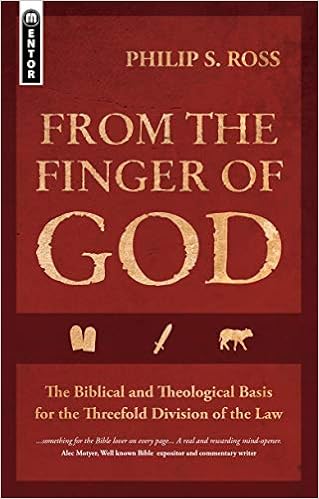
Monday, June 30, 2014

The Threefold Division of the Law: Part 7 - Sabbath Extracts


In part
six, we concluded the main argument that Ross makes in his lecture and his book for why the threefold division of the should be continue to be the church's ongoing testimony of understanding the law of God.

Ross ended that part by looking at Ephesians 6:1 - 3 in light of some commentators who try to argue that Paul is not issuing an immediate call for obedience to the fifth commandment, but issuing a call from some other source for children to obey their parents. Ross ended the lecture by reaffirming that the moral law shapes our understanding of Christ's penal substitution on the cross, and by exhorting his listeners and readers that we must hold on to this doctrine to understand the Gospel.

However, I left out Ross' main two defenses of understanding Sabbath as still being the moral law, and I want to now include those sections of Ross' argument separate from the other six posts for a few reasons. The main reason being that I view Ross' examples of Christians arguing for or against the abiding validity of the Sabbath as a demonstration of the confusion that exists within the Reformed churches and the broader Christian church about how to understand all the laws that God gave in light of Christ's finished work on the cross. For me, the biggest contribution of Ross' research is about explaining that the moral, ceremonial, and judicial laws are the only possible way to understand the whole of Scripture without having to sacrifice the parts of Scripture that don't fit. Therefore, defenses of any one particular commandment, while helpful, are in my opinion raising flags to get people to pay attention.

A number of Christians, however, today have trouble with how to understand the Sabbath, and furthermore, because of that problem will not consider Ross' book in the first place because of Ross' defense of the Sabbath throughout the book and in the lecture. Phil Johnson, who pastors with John MacArthur, while reviewing Ross' book cannot get past Ross' defense throughout his book of the Sabbath because of his dispensationalism and as a result the review becomes very difficult to follow and largely unhelpful. More generally, while Tom Shreiner believes that the threefold division is biblical, the presence of a commandment about the Sabbath raises questions in his mind about how to understand the division; Justin Taylor, while commending the threefold division, nevertheless does not think it "fully works" because of the commandment about the Sabbath. My point in separating the substance (problem) from the demonstration of the problem is that the argument for the division needs to be considered before some people will consider rather or not the Sabbath applies to belevers today or it does not.

There are other books which defend the Reformed position on the Sabbath, but none of them currently include much of a defense of the threefold division, but Ross' book does both because Ross believes, and I agree, that the rejection of the Sabbath and the threefold division are linked together. Just because, however, the link exists does not mean there is only one way to defend both truths. Ross chooses to lead out his defense of the threefold division by showing where the most heat against the doctrine is currently being generated. I, however, think it might be more helpful to lay out the doctrine then show how it practically affects other doctrines. I think it is more helpful because, as has been shown, the threefold division has had many different attacks from other angles in the past, that do not only originate with a rejection or acceptance of the Sabbath.

Despite whatever differences I might have with Ross about the structure of his presentation, I do agree with Ross about the abiding validity of the Sabbath for the Christian.
  1. Introduction
  2. Five Old Testament presuppositions that shape the New Testament's understanding of law
  3. Jesus and the Gospels
  4. The Apostolic Interpretation of the law in the Book of Acts
  5. The Epistles of the Apostles
  6. Conclusion
  7. Sabbath Extracts
I will break this up into two parts in my one post and note where in the lecture the two different sections the extracts are from in the lecture. The first part is from the Introduction in the lecture.

----------------

According to Tim Keller, nearly all presbyters in the PCA subscribe to the Westminster Confession of Faith (WCF) 'with only the most minor exceptions (the only common one being with regard to the Sabbath).' (pg. 5)

If, however, such an exception amounts to a wholesale rejection of the Confession's approach to the Sabbath, then Ross suspects the Westminster Divines might have thought that to call it minor was probably understatement. (pg. 5)

If the WCF were a garment, you would not want to pull this thread, unless you wanted to be altogether defrocked. (pg, 5)

Ross wonders if the reason why some people pull at this thread is because they regard the Confession as more of a straightjacket than a garment. (pg. 5)

Unbuckle the Sabbath, and as far as Reformed Theology is concerned you are well on the way to mastering theological escapology. (pg. 5)

If this sounds like overstatement to rival Keller's understatement, Ross wants to remind his listeners that biblical law, with its Sabbath, is not an easily dispensable part of our doctrinal infrastructure. (pgs. 5, 6)

You cannot perform a precision strike on the Sabbath without producing an embarrassing amount of collateral damage. (pg. 6)

You cannot strike out the Sabbath without shattering the entire category of moral law and all that depends on it. (pg. 6)

If the Shorter Catechism represents Westminster theology in its most practical form, it would seem that any expurgation of biblical law from the theological framework it expounds, should lead to its complete unraveling. (pg. 6)

----------------

The next part is from the section titled Jesus and the Gospels

----------------

One thing that does not appear in Matthew 5 is anything about Jesus' attitude to the Sabbath.

It's often assumed that Jesus disregarded the Sabbath and that the Gospel writers conveyed that.

But Ross thinks Géza Vermes is right, if the evangelists were seeking to do that 'they did a pitiful job'. (pg. 173)

Even the authors of From Sabbath to Lord's Day have to agree that Jesus did not brake the Sabbath. (pg. 167)

Ross think there is little point in going into detail with the book because of their conclusion in a summary written by Andrew Lincoln for the book (pgs. 171 - 172):
The veiled nature of Jesus' ministry accounts for the slight ambiguity in regard to His relation to the Sabbath and for the fact that for a time in the early church there were those who continued Sabbath observance while the full implications of the entry to the new age accomplished by Christ were being worked out.
Ross contends that Lincoln's conclusion makes little sense. In fact, it is inexplicable considering the dates for the Gospels range from A.D. 50 - 150. How much tome did they need to work things out? (pg. 172)

If Mark clearly understood that Jesus had declared all foods clean, why did He choose to leave his readers in the dark over so fundamental an issue as the Sabbath? (pg. 172)

Until someone does better than raise the anti-Sabbatarian case from the Gospels from the 'pitifil' to the ambiguous there is little to gain be engaging in this discussion.

The evangelists represent Jesus as a Sabbath-keeper, who does not undermine the ordnance by word, action, or yet-to-be-understood personal claims. (pg. 173)

----------------

While in this section Ross does not specifically deal with the Colossians 2:14 - 15 passage which both are the given reason for Taylor and Dr. Schreiner's caveat about the threefold division Ross did address the Colossian text in part five. Since I don't want to make in seem like I'm only picking on the Gospel Coalition or Baptists, I need to also include the Lutherans' Dr. John Theodore Mueller and Dr. Francis Pieper. Both men wrote very popular and still used works on Christian Dogmatics. Near the bottom of page 213, Dr. Mueller rests his entire case on the Ten Commandments not being identified with the moral law on the sole argument of the Sabbath commandment being the ceremonial feature of the Ten Commandments. Since Dr. Mueller's one-volume work is based on Dr. Pieper's four-volume work I assume that both men agree on this argument, but have not yet verified Dr. Pieper's position in print.

Now I'm really done with the whole lecture, but I do want to ofter a bit more coverage of Ross' book in relation to some other controversies in the Reformed world. One of, which, is about a claim made by a few Westminster California professors about the application of the first four commandments to the other nations than Israel in the time of the Old Testament.

Monday, May 19, 2014

The Threefold Division of the Law: Part 3 - Jesus and the Gospels

In part 2, we sketched out five presuppositions that run throughout the entire Old Testament (OT) that point the law given through Moses as not being an uniform united body of law. Ross concluded the second section by contending that if we don't see these distinctions that we will not, and cannot, make proper sense of the teachings of Christ in the four Gospels, in the Apostolic events in the Book of Acts and the Epistles written by the Apostles when they write about the law.

In this part we will focus on the words of Jesus as found in the four Gospel writings and try to understand how what Jesus says about the law and does during His first coming further develops the five observations made about the OT law.

These notes are based on an address that Phil Ross delivered to the Evangelical Presbyterian Church in England and Wales in March 2010.

Here's where we are in this series of posts relative to where we have been and where we are going:
  1. Introduction
  2. Five Old Testament presuppositions that shape the New Testament's understanding of law
  3. Jesus and the Gospels
  4. The Apostolic Interpretation of the law in the Book of Acts
  5. The Epistles of the Apostles
  6. Conclusion
  7. Sabbath Extracts
----------------

Ross wants to look at the teaching of Christ and the Apostles concerning the law in two parts divided chronologically by the veil of the temple that was torn in two (pg. 187):
  1. What may we conclude from the Gospels? - From the words and deeds of Jesus up to the point where the veil was torn.
  2. What, if anything, changes after the rending of the veil? - What do the Apostles and their Epistles have to say to all this?
We will in this post address the first question and then over the course of following two posts Ross will address his second question.

Jesus' subjecting himself to the law was basic to his humiliation.

One passage matters above all others when it comes to discussing Jesus' attitude to the law, namely Matthew 5.

Some say we should take the word commonly translated 'abolish' in a absolute sense. (pgs. 195 - 197)

Others use the word commonly translated 'fulfill' to determine that 'abolish' means anything but abolish. (pgs. 197 - 199)

When translators/interpreters focus on the lexical definition of 'fulfill' it generally leads them to seeing Jesus' fulfillment of the law and the prophets in the following three ways (pgs. 201 - 202):
  1. Eschatological - He fulfills the law by his teaching.
  2. Soteriological - He fulfills the law by bringing salvation.
  3. Moral - He fulfills the law by doing what the law commands.
Ross doesn't want to suggest totally disregarding the lexica, but contends that we will understand Jesus' words when we read them with the church, in the context of Matthew as a whole, and with the OT background in view. (pg. 199)

Pope Leo the Great and John Calvin may not have had much in common, but they both thought it was proper to connect the sermon on the mount with Jeremiah's new covenant prophecy. (pg. 199)

Their case is strengthened if we also accept that Jesus fulfilling the law and the prophets in Matthew 5:17 is a piece of his fulfillment of all righteousness in Matthew 3:50. (pgs. 199 - 200)

We might hear echos of this relationship when we line up the voice that says 'This is my beloved Son' with the same voice in Jeremiah 31:20 saying 'Ephraim my beloved Son'. May we not then see Jesus standing with his people, and in their place, 'here's the beloved Son that Israel failed to be. (pg. 200)

Read Matthew 5 in that context and we may then see Jesus' fulfillment of the law as eschatological, soteriological, and moral. (pg. 202)

To illustrate the relationship between the elements in Matthew 5 and Jeremiah 31, Ross wants to call attention to the following four components in Jeremiah's prophecy. (pg. 203)
  1. 'I will put my law within them' - According to Deuteronomy 6:4 - 9 the law was always meant to be internalized. Jesus promotes this intention as he calls for obedience to the great commandment, he promotes it in his exposition of the law throughout Matthew 5, and He fulfills it by exemplifying in his own life what it means to obey the law and be the obedient Son par excellence (meaning 'the best of its kind'). (pgs. 203 - 204)
  2. The promise, 'I will be their God, and they shall be my people.' That theme permeates Matthew from beginning to end. Matthew 1:23, '... God with us.' We know that the Shekinah who dwelt in the bush and in the tabernacle now dwells in the flesh and fleshy blood. Immanuel's closing promise is, 'I am with you always.' Christ's being with his people in fulfillment of the law and the prophets is the dominant idea, but moral fulfillment can't be excluded from that. His instruction, 'teach them all that I've commanded you' presupposes ongoing obedience as an indispensable concomitant to God with us. (pgs. 204 - 206)
  3. 'They shall all know me', is sometimes linked with Matthew 23:8 - 10 where Jesus says, 'You have one teacher'. We can hear in that passage a precise echo of the shama. Only one teacher fulfills Jeremiah's prophecy; he is the one who is one who will teach the New Covenant community. There is also a connection between Jeremiah 31:25 - 26 and Jesus' invitation to the laboring and heavy laden to come for rest (Matthew 11:28). He delivers the rest promised in the law and the prophets to those whom the Father reveals Jesus and to whom Jesus reveals the Father. (pgs. 206 - 211)
  4. 'For I will forgive their iniquity', is the absolutely indispensable (Ross uses the term, 'sine qua non') promise of the first few promises in Jeremiah 31. Note the preceding three. There's not much question that Matthew 26:27 - 28 recalls this. 'Drink of it, all of you.' The 'all' recalling the 'all' of Jeremiah 31:34 as Matthew once again draws several OT threads together to show that forgiveness of sin and God's presence are conjoined in Jesus. If Jeremiah is in the background, then sin is transgression of the Decalogue because that's generally how Jeremiah defines 'transgression'. (pgs. 211 - 214)
If the sermon on the mount introduced new law then spoke of forgiveness in relation to the old law, how could Matthew's notion of atonement be coherent? Sin would be a moving target. (pg. 215)

The point is to say that for Matthew, Jesus' fulfillment of the law and prophets is eschatological, soteriological, and moral. He is a mighty savior, whose assumptions about the law he shares with the prophets, whose full assumptions land on the Pentateuch. (pgs. 214 - 215)

So Jesus leaves untouched the embryonic framework that saw some laws as a 'pattern'; some to be obeyed 'in the land'; but the Decalogue as the controlling influence. (pg. 215)

When Jesus says, 'not a jot or a tittle shall pass away', his statement is in harmony with the framework because it only makes sense if we recognize that the law had built in limitations. (pgs. 215 - 220)

Even before the entry into Cana, they had the mana laws, which were of temporal jurisdiction/duration. Yet these laws remained but did not bind in the same way they abide as memorial and foretoken. (pgs. 218 - 219)

Everything that Jesus says about the law is in continuity with the intent of the law, and Ross rejects outright the universal description of what follows in Matthew 5:21 - 48 as the antithesis. (pgs. 220 - 236)

Despite all the arguments that Jesus is overturning the law in these verses, its demonstrable that everything Jesus says reflects a correct and proper understanding of the laws; his views of hatred, lust, divorce, oaths, the lex talionis - law of retaliation -, and love for enemies do not reflect abrogation of the law, but co-ordination with the law. (pgs. 236 - 237)

What was Jesus' attitude to things that were not of the weightier matters of the law? (pgs. 173 - 174)

One person wants to say that because Jesus touched a leper He made himself unclean and therefore held the purity laws in contempt, while another wants to defend him against accusations of uncleanness at all costs. (pgs. 174 - 177)

So was Jesus ever unclean? Well, of course he was. What Jew who ever sucked at his mother's breast was not unclean? But, so what? (pg. 178)

The law makes no straightforward equation between guilt and ceremonial uncleanness. (pg. 178)

So matters of:
  1. The woman bleeding who touched Jesus (Mark 5:27) is simply not a issue. (pgs. 174 - 177)
  2. Mark doesn't introduce us to an antinomian Jesus when he records Jesus' comments in Mark 7, 'nothing that goes into a man can defile a man'. Perhaps Jesus is reflecting creational norms: Nothing is intrinsically unclean. The Levitical law concurs - eating unclean foods could not itself defile. Jesus' statement is in continuity with the law. Looking back, Mark makes the kind of statement he should have made about the Sabbath if the anti-Sabbatarians are correct that the Sabbath ought to not be part of a Christian's life. (pgs. 179 - 187)
When we see Jesus at the end of his earthly life it's instructive to think about these events in the light of Leviticus 20:24 - 26. There the Lord separates Israel to himself, separates certain foods to uncleanness as a sign of Israel's separation to a God whose separation was marked by the temple veil. (pgs. 184 - 187)

Then when the veil is torn in two, it signifies not the departure of the Shekinah, as some argue. It signifies that the separation has ended. (pgs. 189 - 190)

Viewing this event through the lens of Isaiah 64, God has rent the heavens and come down, and the rent veil proclaims that from this point onwards no symbolic uncleanness can separate them from Emmanuel. (pg. 190)

In the Gospels we meet a Savior who lived in conformity with the law. He taught us to obey it in its own terms. Fulfilled its shadows. Evangelists confirm, rather than overturn, the presuppositions outlined from the Pentateuch. They do not abort the embryonic form of the threefold division that appears in the OT. (pgs. 190 - 191)

----------------

A lot more material this week than in the last post. Ross is summarizing chapters four and five in his book, which is 93 pages. In our next post in this series we will consider how the Apostles interpreted the law, as recorded in the book of Acts. We will start to develop a better idea about what actually changed in the church after the rending of the temple veil.