Showing posts with label Deuteronomy. Show all posts

Monday, June 16, 2014

The Threefold Division of the Law: Part 5 - The Epistles of the Apostles

In part four we began looking at what, if anything, changes after the rending of the veil once Jesus died on the cross with a focus on God's Law? We considered on that post the Book of Acts, paying attention to Luke's quoting of the Decalogue and the Apostolic decree of Acts 15. We found out that Luke's references to the Decalogue were in harmony with the Ten Commandments still being valid, and that the Apostolic decree does not give of new way of understanding the Decalogue but it does give us a example of Christian behavior.

The current post is about how the Apostles in their writings to various churches understood and applied God's Law to those particular saints. Of course, even though the Apostles were addressing particular concerns at a particular time we must remember that "[a]ll Scripture is breathed out by God and profitable for teaching, for reproof, for correction, and for training in righteousness, that that man of God my be competent, equipped for every good work" (II Timothy 3:16-17). In addition, we must remember that we are living in the same age as the saints who Paul, Peter, James, Jude, the author of Hebrews, and John were addressing. The issues are still relevant for today's church, because their writings were primarily addressing the spiritual issues of their day in light of Jesus' death, resurrection, and ascension. In this part of Ross' address we will see the threads of the previous four parts come together to clearly demonstrate that the Threefold Division is the Apostolic teaching of the entire Bible.

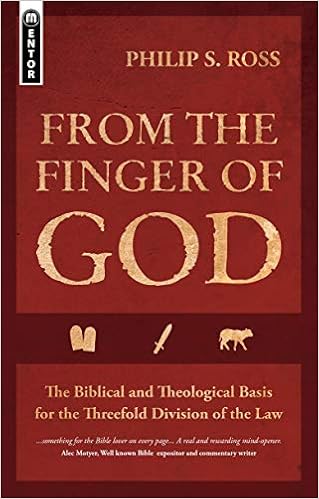
As a general reminder, these notes that I took are based on Philip S. Ross' March 2010 address to a Presbytery. Later on that same year, Christian Focus Publications published a book length treatment of Ross' research into the Threefold Division of the Law. This is part five of a seven part series.

Here's how I have broken down Ross' address into seven parts:
  1. Introduction
  2. Five Old Testament presuppositions that shape the New Testament's understanding of law
  3. Jesus and the Gospels
  4. The Apostolic Interpretation of the law in the Book of Acts
  5. The Epistles of the Apostles
  6. Conclusion
  7. Sabbath Extracts
----------------

Some passages that are relevant to the three categories of the threefold division. (pg. 266)

The study of Paul the law is an area of interminable debate, but much of those debates aren't directly relevant to this precise issue. (pg. 265)

The New Perspectives on Paul challenges the centrality of moral law in confessional soteriology more than it challenges the details of the threefold division. (pg. 266)

Beginning with ceremonial law, which the confession speaks of as 'typical ordinances' and 'moral duties', there are solid grounds to say that Hebrews 9 makes a purposeful and unavoidable demarcation of cultic laws. (pgs. 266 - 267)

This is not a demarcation, as certain scholars claim, that Hebrews imposes on the law but one that's derived from the law. (pgs. 266 - 267)

From the ceremonial law's first deliverance to Moses, they were intended to be shadows that proclaimed the existence of heavenly things and good things to come; the reality of Christ. (pgs. 267 - 275)

The same vocabulary emerges in Colossians 2:16 - 17, where Ross rejects the view arising from the hypothetical Colossian heresy that this passage refers to extra-Mosaic practices. The use of cult prostitutes, for example, can hardly be a shadow of things to come. (pgs. 273 - 275)

Rather the food and drink in view envisages all the dietary laws of the Old Testament (OT) and the OT usage itself suggests that 'Sabbaths' in that context serves as shorthand for the activities of those days and not the day itself. (pgs. 276 - 278)

The verses in Colossians 2:14 - 15 and Ephesians 2:14 - 18 speak of a wall of separation and of the breaking down of ordinances. (pgs. 279 - 280)

Commentators will argue that these two passages either refer to expansions of the law or to the law as a whole. (pgs. 280 - 284)

However, the law as a whole did not divide and why would God need to abolish man made laws at all?

Ephesians 2 and Colossians 2 may emphasize different things, but both deal with the laws of separation, which have gone with the rent veil. (pg. 284)

The veil was rent because of what Peter tells us about in 1 Peter 1:19 'the sacrifice of the lamb without blemish'. (pgs. 290 - 292)

Many theologians, following German theologians, dismiss the idea of vicarious suffering, rejecting any link between Peter and Leviticus, or arguing that in the Leviticus passage there is no idea of the transference of guilt to the goat. (pgs. 287 - 288)

Place taking is, however, central to Leviticus and to Isaiah 53, the lens through which Peter reads Leviticus, and if Jesus is a lamb without blemish his fulfillment of ceremonial law must depend on moral fulfillment. (pgs. 288 - 291)

For Peter, as for Matthew, Christ's fulfillment is moral, soteriological, and eschatological. (pg. 286)

As said earlier, the confessional approach to ceremonial law was not so crude that they failed to recognize that it also spoke of moral duties. (pg. 292)

These, 'moral duties', are the implied moral demands of ceremonial law that we see, for example, in 1 Corinthians 5 which calls on Christians to be what they are: the unleavened bread symbolizing discontinuity and a break with the past. (pgs. 292 - 293)

In such cases, Paul preserves inviolate the core significance of the ritual law while maintaining it is not binding. (pg. 295)

What the threefold division calls judicial, or civil, laws exist almost by default in the Epistles. (pg. 296)

But do they (the Epistles) support the idea that God always intended those laws (judicial) to have temporal standing? (pgs. 296 -298)

The mere fact that the Apostles called for Christians to submit themselves to secular authorities suggests as much, although that does not mean they (judicial laws) are irrelevant. (pgs. 298 - 299)

Hebrews shows us that although the penalties may have expired, they still speak. (pg. 299)

Paul's reference to oxen, 1 Corinthians 9:8 - 10, shows that the general equity of the law still applies. (pg. 300)

For God does not care about oxen, which is why Paul's point depends ultimately on the Decalogue substructure that undergirds the quotation Deuteronomy. (pgs. 304 - 306)

In that context, in Deuteronomy, the themes of integrity and contentment unite the ninth and the tenth commandments. (pg. 303) [As an aside from Ross, for a moment,  this would be numbered the eighth, ninth, and tenth commandments in both the Lutheran and Roman Catholic churches. Both Lutherans and Roman Catholics along with others Christians throughout the centuries have separated the tenth commandment into two commandments numbered nine and ten. The Reformed tradition along with other Christians throughout the centuries have maintained a slightly different numbering of the Ten Commandment which means that Ross is talking about the commandment to not lie and to not covet.]

We would also think of the two witness rule quoted in 2 Corinthians 13 and 1 Timothy 5. (pgs. 304 - 306)

It is a straightforward application of Mosaic equity, but it does not demand literal application of the law since it (the two witness rule) too depends on the substructure of Deuteronomy. (pgs. 305 - 306)

Deuteronomy at the point of being quoted is concerned with the preservation of life. (pg. 305)

Such examples indicate that the Westminster Confession's 35 words on judicial law do not comprise an imposition upon Scripture, but reflection of biblical teaching. (pg. 308)

For many Christians the threefold division's most controversial claim is that the moral law, the Decalogue, is an ever binding perfect rule of righteousness and an obligation, which for Christians, is strengthened by Christ in the Gospels. (pg. 308)

When you think of Epistolary passages that support this (the Decalogue as an ever binding rule of righteousness) you might mention 1 Timothy 1:8 - 11; Romans 13:8 - 10; or James 2:8 - 11, and you would be right to do so. (pg. 341)

Despite the reluctance of someone like Douglas Moo to see royal law as a specific reference to the Mosaic law. (pg. 336)

Perhaps all that such reluctance shows is that by the time we come to the Epistles, whatever our position, the interpretive frameworks that we have developed play a decisive part in our exegetical conclusions.

In the Apostolic illusions to the Shema in 1 Corinthians 8 or James 2:19; in the call to love our neighbor in Romans 13 or Galatians 5 we hear an echo of Christ's voice, we hear Apostolic agreement with the principal that the two greatest commandments are a précis (meaning: 'a type of summary of abridgment) of the Decalogue. (pgs. 334 - 341)

For some interpreters, any notion of Apostolic agreement with the law is unthinkable - Paul was schizophrenic at best, about as constant in his affections for Moses as was Saul for David. (pgs. 308 - 318)

According to Heikki Räisänen, Paul's view of the law is 'full of difficulties and inconsistencies'. (pg. 309)

Ironically, Räisänen is so convinced that the Mosaic law consists of different elements that he thinks the threefold division handles the material better than Paul (pgs. 309 - 310)

A Dutch Reformed minster, T.E. Van Spanje, has produced a lengthy answer to Räisänen's charge of theological schizophrenia, but we should not be afraid to see tension in Paul's attitude to the law. (pg. 310)

If his (Paul's) view of divine revelation is rooted in the Old Testament we should expect tension, but that's not the same as inconsistency.

The idea that divine revelation may bring blessing or curse, brokenness or hardness, life or death, weaves its way from the Pentateuch through the Psalms and Prophets into the Gospels where the same word that cuts off every dead branch and prunes every live branch and weaves its way into the Epistles. (pgs. 311 - 313)

In 2 Corinthians 3, the law brings a deadly holocaust to the Jewish people that cannot be ended unless the life giving Spirit intervenes (pg. 313)

It is no negative commentary on the law, but recognition of the law's impotence to bring life and lasting glory.

The tension continues in the new order, the law will still kill you if you read it with a veil and new covenant ministry that may be the fragrance of life to some is the odor of death to others - it produces its own holocaust. (pg. 314)

Paul is not the only one to be charged with hostility to the law. (pg. 314)

In the eyes of Michael Morrison, the author of Hebrews has no place for the law at all since law in Hebrews quotation of Jeremiah 31:33 found in Hebrews 8:10 and 10:16 should be understood in the widest possible sense as instruction. (pgs. 314 - 315)

Jeremiah, however, will not let Morrison off with the charge (of the law having no place in the book of Hebrews) so easily. (pg. 315)

When the prophet speaks of 'My law' the context is suggestive of Sinai and Jeremiah 31:33 is, Ross believes, addressing the same commandments as at Sinai. (pgs. 315 - 316)

These 'ten words' are the only laws that God inscribes. (pg. 316)

Hebrews is not talking about a redrafted morality. That is not what makes the New Covenant 'New'. (pg. 316)

It is not 'new' because the New Covenant believers' obedience is qualitatively superior to Abrams'; it is all about Jesus Christ. (pg. 317)

This covenant is better because it is enacted upon better promises, not necessarily those promises) contained within it (new covenant), but those promises made to Christ, 'You are a priest forever', God will not change His mind, Christ's priesthood will not fail. (pg. 317)

All the circumcised hearts in the cloud of witnesses, every law inscribed heart in which the Father makes His home is only so because of our Mediator. (pg. 318)

Far from rendering obsolete the laws inscribed in stone His all eclipsing priesthood makes them a lively script that will never pass away. (pg. 318)

Part of the argument in the WCF for ever-binding moral law is that this law is ineffably inscribed on human hearts. (pg. 318)

Romans 2:15, which speaks of Gentiles who have the work of the law written on their hearts, is a key passage. (pg. 318)

But what Gentile hearts?

'Not any Gentile hears,' says N.T. Wright, Jewett, and Gathercole, 'Paul is talking about Gentile Christians'. (pg. 318)

Gathercole's defense of this view is the most comprehensive, but Ross believes is seems inconceivable that there could have been Gentile Christians who were, as Gathercole says, 'actually not hearers of Torah at all'. (pgs. 319 - 320)

Just how did these Christians manage to avoid the Psalms, the Prophets, the Sermon on the Mount, and debates about the law? (pg. 320)

Why should the idea that all people, in some sense, do what the law requires have been foreign to Paul?

Surely, in view of the Pentateuch's assumptions about the law, that the laws of Sinai were self-understood from the beginning, it would have been natural for him (Paul) to think like that.

In fact, the suggestion from Akio Ito that Paul may have been alluding to Deuteronomy 30:14 may support that point, especially if Matthew Henry was right to see in the text of Deuteronomy a reference to 'the law of nature, which would have been found in every man's heart, and every man's mouth, if he would but have attended to it.' (pg. 322)

So Paul, then is reflecting Scripture-wide presuppositions about the Decalogue. (pg. 323)

Paul is, as John Murray says, answering 'the question arising from verse 12, namely: If the Gentiles are without the law, how can they be regarded as having sinned?' (pg. 323)

How else can we make sense of verses 15 - 16 of Romans 2? (pgs. 323 - 324)

It is not Gentile Christians who will be in turmoil on that day, but unbelievers, who having suppressed the truth find exposed upon their hearts an inscription of the law that reason could not erase and darkness could not hide. (pg. 324)

On this understanding of Romans, the opening section of chapter 19 of the WCF provides a coherent expression of Apostolic teaching. (pg. 324)

When that day comes when God judges the secrets of men's hearts by what standard will He judge? On what basis will men be convicted of their sin? What is sin?

Strangely enough, you might get a more conservative definition of 'sin' from a lexicographer than a theologian.

While the Oxford English Dictionary happily defines 'sin' as 'transgression of the divine law' some NT scholars prefer the generality of 'evil' or 'iniquity'. (pg. 325)

Even when the passage involved is 1 John 3:4. which defines 'sin' as transgression of the law, or lawlessness, Stephen Smalley wants to argue that the connection between sin and lawbreaking in the OT is not strong. (pgs. 325, 327)

None of the attempts to separate lawlessness from law are convincing. Especially when the alternative definition of sin that these writers generally propose, such as, 'opposing God' describe things that are transgressions of the law anyway. (pgs. 328 - 329)

Not only does John define sin as lawbreaking; James 2:8 - 12 indirectly defines sin as transgression of law from the Decalogue, or the summarizing great commandments. (pg. 329)

Sin is not a roughly defined problem.

Righteousness is not a fluctuating ideal.

The great Day of judgement will be according to the self-understood norms of the Decalogue, and that is an implicit assumption in Romans 2 and elsewhere.

When Romans 1 meets a litany of iniquities with unvarying response of judgement none of those death-deserving deeds go beyond established or plausible applications of the Decalogue. (pg. 332)

The only lawgiver and judge employs no double standard.

----------------

So, there you have it. The threefold division is biblical and comes to full expression in the Epistles. However, it is important to note all the threads that begun in Genesis up through Acts in the previous four parts that lead to the full revelation of how we need to understand God's law. The next post, on this topic, will be a much shorter conclusion of the entire address. This part covered chapter seven in Ross' book, which is 85 pages.

Sunday, May 25, 2014

The Threefold Division of the Law: Part 4 - The Apostolic Interpretation of the law in the Book of Acts

In part 3, we Ross introduced the majority of the remaining time of his lecture by framing his discussion around the following two questions:

1. What may we conclude from the Gospels? - From the words and deeds of  Jesus up to the point where the veil was torn.

2.What, if anything, changes after the rending of the veil? - What do the Apostles and their Epistles have to say to all this?

We dealt with the first question in its entirety in the last post. This post is the first half of Ross' answer to the second question dealing with the events in the Book of Acts focusing on how the church viewed God's Law in light of Jesus' mission being accomplished. The last post was about how Jesus talked about the law in his Sermon on the Mount and how Jesus demonstrated in his actions that the purpose of the purity laws were to show Israel's separation from the other nations which was coming to an end with the temple veil being torn in two when Christ died.

Jesus' entire earthy ministry was a life in conformity with the law. His teachings highlighted that obedience to the law was not conformable to the terms that the receivers understood, but that God's laws came with their own terms of obedience which were not being followed in Jesus' day. Ross, finally, pointed out that the embryonic form of the threefold division appearing in the Old Testament (OT) was not overturned by Jesus' life or teaching.

Now, Ross will be contending that the Evangelists will be confirming those same presuppositions through the book of Acts and their Epistles throughout the rest of the New Testament (NT).

As with the previous three posts and next three in this series, here's the big picture of where this current post fits:
  1. Introduction
  2. Five Old Testament presuppositions that shape the New Testament's understanding of law
  3. Jesus and the Gospels
  4. The Apostolic Interpretation of the law in the Book of Acts
  5. The Epistles of the Apostles
  6. Conclusion
  7. Sabbath Extracts
----------------

The book of Acts provides indications of the Apostles' approach to the law and gives us some narrative background to the Epistles. (pgs. 239 - 240)

Some say Luke was zealous for the law, while Evangelicals, such as Craig Blomberg, are happy to think Luke saw the law as nothing more than 'a cultural phenomenon'. Neither approach is satisfactory. (pgs. 241 - 242)

Throughout the book of Acts we encounter Christian thinking that presupposes the validity of the Decalogue. (pgs. 243 - 244)

For Luke, the Jews were the real transgressors of the Decalogue's precepts. (pgs. 242 - 243)

Luke quotes several laws outside of the Decalogue, but Ross only has time to address one instance in Acts. (pgs. 247 - 254)

Peter's reference to Deuteronomy 10:17 in Acts 10:34. (pgs. 248 - 250)

Peter's use of Deuteronomy shows how he took that one law in its context and began to see that not only are all animals fundamentally clean, but that all people are equal. Peter understands that the abolition of food distinctions means that national Israel is no longer the exclusive theater of Divine love. (pg. 249)

From where Peter now stands Deuteronomy's declaration of God's love for the sojourner may always have been indicative of the temporality of the separation laws. (pgs. 249 - 250)

The most complex legal issue in Acts seems to be the Apostolic decree of Acts 15. Partly because of differences in biblical manuscripts that the church has used throughout history. (pgs. 254 - 257)

Richard Bauckham gives exhaustive arguments for the decree being based on Leviticus 17 - 18, but Ross thinks his arguments are unconvincing. (pgs. 257 - 261)

The decree is only really complex when people are determined to interpret it either as liberation from the law, or imposition of the law. (pg. 261)

In the end, the basis for the decision was that it seemed good to us. It was no more a legal decision than the council's decision to send out Paul and Barnabas, or Luke's decision to write his gospel. It seemed good. The rationale was unity. Church unity was more important than absolute liberty. (pgs. 261 - 263)

The decree does not give us a hermeneutic of biblical law but a example of Christian behavior. (pg. 262)

In the end, all we can say about Acts is that it assumes the principles of the Decalogue. It gives good reason, at points, to support the confessional statement of cultic and judicial law, but the decree and the accounts of cultic obedience are legally neutral. (pgs. 263 - 264)

----------------

The notes above are a summary of chapter 6 in Ross' book which is 25 pages long. The next post in this topic will continue to address the changes in the law after Jesus' death as found in the Epistles of the Apostles.

Monday, May 19, 2014

The Threefold Division of the Law: Part 3 - Jesus and the Gospels

In part 2, we sketched out five presuppositions that run throughout the entire Old Testament (OT) that point the law given through Moses as not being an uniform united body of law. Ross concluded the second section by contending that if we don't see these distinctions that we will not, and cannot, make proper sense of the teachings of Christ in the four Gospels, in the Apostolic events in the Book of Acts and the Epistles written by the Apostles when they write about the law.

In this part we will focus on the words of Jesus as found in the four Gospel writings and try to understand how what Jesus says about the law and does during His first coming further develops the five observations made about the OT law.

These notes are based on an address that Phil Ross delivered to the Evangelical Presbyterian Church in England and Wales in March 2010.

Here's where we are in this series of posts relative to where we have been and where we are going:
  1. Introduction
  2. Five Old Testament presuppositions that shape the New Testament's understanding of law
  3. Jesus and the Gospels
  4. The Apostolic Interpretation of the law in the Book of Acts
  5. The Epistles of the Apostles
  6. Conclusion
  7. Sabbath Extracts
----------------

Ross wants to look at the teaching of Christ and the Apostles concerning the law in two parts divided chronologically by the veil of the temple that was torn in two (pg. 187):
  1. What may we conclude from the Gospels? - From the words and deeds of Jesus up to the point where the veil was torn.
  2. What, if anything, changes after the rending of the veil? - What do the Apostles and their Epistles have to say to all this?
We will in this post address the first question and then over the course of following two posts Ross will address his second question.

Jesus' subjecting himself to the law was basic to his humiliation.

One passage matters above all others when it comes to discussing Jesus' attitude to the law, namely Matthew 5.

Some say we should take the word commonly translated 'abolish' in a absolute sense. (pgs. 195 - 197)

Others use the word commonly translated 'fulfill' to determine that 'abolish' means anything but abolish. (pgs. 197 - 199)

When translators/interpreters focus on the lexical definition of 'fulfill' it generally leads them to seeing Jesus' fulfillment of the law and the prophets in the following three ways (pgs. 201 - 202):
  1. Eschatological - He fulfills the law by his teaching.
  2. Soteriological - He fulfills the law by bringing salvation.
  3. Moral - He fulfills the law by doing what the law commands.
Ross doesn't want to suggest totally disregarding the lexica, but contends that we will understand Jesus' words when we read them with the church, in the context of Matthew as a whole, and with the OT background in view. (pg. 199)

Pope Leo the Great and John Calvin may not have had much in common, but they both thought it was proper to connect the sermon on the mount with Jeremiah's new covenant prophecy. (pg. 199)

Their case is strengthened if we also accept that Jesus fulfilling the law and the prophets in Matthew 5:17 is a piece of his fulfillment of all righteousness in Matthew 3:50. (pgs. 199 - 200)

We might hear echos of this relationship when we line up the voice that says 'This is my beloved Son' with the same voice in Jeremiah 31:20 saying 'Ephraim my beloved Son'. May we not then see Jesus standing with his people, and in their place, 'here's the beloved Son that Israel failed to be. (pg. 200)

Read Matthew 5 in that context and we may then see Jesus' fulfillment of the law as eschatological, soteriological, and moral. (pg. 202)

To illustrate the relationship between the elements in Matthew 5 and Jeremiah 31, Ross wants to call attention to the following four components in Jeremiah's prophecy. (pg. 203)
  1. 'I will put my law within them' - According to Deuteronomy 6:4 - 9 the law was always meant to be internalized. Jesus promotes this intention as he calls for obedience to the great commandment, he promotes it in his exposition of the law throughout Matthew 5, and He fulfills it by exemplifying in his own life what it means to obey the law and be the obedient Son par excellence (meaning 'the best of its kind'). (pgs. 203 - 204)
  2. The promise, 'I will be their God, and they shall be my people.' That theme permeates Matthew from beginning to end. Matthew 1:23, '... God with us.' We know that the Shekinah who dwelt in the bush and in the tabernacle now dwells in the flesh and fleshy blood. Immanuel's closing promise is, 'I am with you always.' Christ's being with his people in fulfillment of the law and the prophets is the dominant idea, but moral fulfillment can't be excluded from that. His instruction, 'teach them all that I've commanded you' presupposes ongoing obedience as an indispensable concomitant to God with us. (pgs. 204 - 206)
  3. 'They shall all know me', is sometimes linked with Matthew 23:8 - 10 where Jesus says, 'You have one teacher'. We can hear in that passage a precise echo of the shama. Only one teacher fulfills Jeremiah's prophecy; he is the one who is one who will teach the New Covenant community. There is also a connection between Jeremiah 31:25 - 26 and Jesus' invitation to the laboring and heavy laden to come for rest (Matthew 11:28). He delivers the rest promised in the law and the prophets to those whom the Father reveals Jesus and to whom Jesus reveals the Father. (pgs. 206 - 211)
  4. 'For I will forgive their iniquity', is the absolutely indispensable (Ross uses the term, 'sine qua non') promise of the first few promises in Jeremiah 31. Note the preceding three. There's not much question that Matthew 26:27 - 28 recalls this. 'Drink of it, all of you.' The 'all' recalling the 'all' of Jeremiah 31:34 as Matthew once again draws several OT threads together to show that forgiveness of sin and God's presence are conjoined in Jesus. If Jeremiah is in the background, then sin is transgression of the Decalogue because that's generally how Jeremiah defines 'transgression'. (pgs. 211 - 214)
If the sermon on the mount introduced new law then spoke of forgiveness in relation to the old law, how could Matthew's notion of atonement be coherent? Sin would be a moving target. (pg. 215)

The point is to say that for Matthew, Jesus' fulfillment of the law and prophets is eschatological, soteriological, and moral. He is a mighty savior, whose assumptions about the law he shares with the prophets, whose full assumptions land on the Pentateuch. (pgs. 214 - 215)

So Jesus leaves untouched the embryonic framework that saw some laws as a 'pattern'; some to be obeyed 'in the land'; but the Decalogue as the controlling influence. (pg. 215)

When Jesus says, 'not a jot or a tittle shall pass away', his statement is in harmony with the framework because it only makes sense if we recognize that the law had built in limitations. (pgs. 215 - 220)

Even before the entry into Cana, they had the mana laws, which were of temporal jurisdiction/duration. Yet these laws remained but did not bind in the same way they abide as memorial and foretoken. (pgs. 218 - 219)

Everything that Jesus says about the law is in continuity with the intent of the law, and Ross rejects outright the universal description of what follows in Matthew 5:21 - 48 as the antithesis. (pgs. 220 - 236)

Despite all the arguments that Jesus is overturning the law in these verses, its demonstrable that everything Jesus says reflects a correct and proper understanding of the laws; his views of hatred, lust, divorce, oaths, the lex talionis - law of retaliation -, and love for enemies do not reflect abrogation of the law, but co-ordination with the law. (pgs. 236 - 237)

What was Jesus' attitude to things that were not of the weightier matters of the law? (pgs. 173 - 174)

One person wants to say that because Jesus touched a leper He made himself unclean and therefore held the purity laws in contempt, while another wants to defend him against accusations of uncleanness at all costs. (pgs. 174 - 177)

So was Jesus ever unclean? Well, of course he was. What Jew who ever sucked at his mother's breast was not unclean? But, so what? (pg. 178)

The law makes no straightforward equation between guilt and ceremonial uncleanness. (pg. 178)

So matters of:
  1. The woman bleeding who touched Jesus (Mark 5:27) is simply not a issue. (pgs. 174 - 177)
  2. Mark doesn't introduce us to an antinomian Jesus when he records Jesus' comments in Mark 7, 'nothing that goes into a man can defile a man'. Perhaps Jesus is reflecting creational norms: Nothing is intrinsically unclean. The Levitical law concurs - eating unclean foods could not itself defile. Jesus' statement is in continuity with the law. Looking back, Mark makes the kind of statement he should have made about the Sabbath if the anti-Sabbatarians are correct that the Sabbath ought to not be part of a Christian's life. (pgs. 179 - 187)
When we see Jesus at the end of his earthly life it's instructive to think about these events in the light of Leviticus 20:24 - 26. There the Lord separates Israel to himself, separates certain foods to uncleanness as a sign of Israel's separation to a God whose separation was marked by the temple veil. (pgs. 184 - 187)

Then when the veil is torn in two, it signifies not the departure of the Shekinah, as some argue. It signifies that the separation has ended. (pgs. 189 - 190)

Viewing this event through the lens of Isaiah 64, God has rent the heavens and come down, and the rent veil proclaims that from this point onwards no symbolic uncleanness can separate them from Emmanuel. (pg. 190)

In the Gospels we meet a Savior who lived in conformity with the law. He taught us to obey it in its own terms. Fulfilled its shadows. Evangelists confirm, rather than overturn, the presuppositions outlined from the Pentateuch. They do not abort the embryonic form of the threefold division that appears in the OT. (pgs. 190 - 191)

----------------

A lot more material this week than in the last post. Ross is summarizing chapters four and five in his book, which is 93 pages. In our next post in this series we will consider how the Apostles interpreted the law, as recorded in the book of Acts. We will start to develop a better idea about what actually changed in the church after the rending of the temple veil.