Showing posts with label moral law. Show all posts

Sunday, June 21, 2015

Issues to Consider about the Second/Third Commandment

One hard text to understand is the following part of the Second/Third Commandment in Exodus 20:5-6:
You shall not bow down to them or serve them, for I the Lord your God am a jealous God, visiting the iniquity of the fathers on the children to the third and the fourth generation of those who hate me, but showing steadfast love to thousands of those who love me and keep my commandments.

Roderick Lawson of Maybole (1863-1897) reprinted the Westminster Shorter Catechism along with his own explanatory notes and review questions for each Shorter Catechism question. Lawson's comment on question and answer 56 is very helpful:
Comment: The special warning here held out to us is, that although men may permit us to break this commandment with impunity, yet God will assuredly not do so. He will not fail to judge us.
Lawson makes this commandment very personal. Both the Larger and Shorter Catechism do not deal directly with verses 5-6.

In Martin Luther's Large Catechism he explained the words of the third Commandment in his concluding section about the Ten Commandments. Luther numbered the third commandment the second commandment. The following quote are marked as paragraphs 319-326:
In conclusion, however, we must repeat the text which belongs here, of which we have treated already in the First Commandment, in order that we may learn what pains God requires to the end we may learn to inculcate and practise the Ten Commandments: For I the Lord, thy God, am a jealous God, visiting the iniquity of the fathers upon the children unto the third and fourth generation of them that hate Me, and showing mercy unto thousands of them that love Me and keep My commandments. Although (as we have heard above) this appendix was primarily attached to the First Commandment, it was nevertheless [we cannot deny that it was] laid down for the sake of all the commandments, as all of them are to be referred and directed to it. Therefore I have said that this, too, should be presented to and inculcated upon the young, that they may learn and remember it, in order to see what is to urge and compel us to keep these Ten Commandments. And it is to be regarded as though this part were specially added to each, so that it inheres in, and pervades, them all. Now, there is comprehended in these words (as said before) both an angry word of threatening and a friendly promise to terrify and warn us, and, moreover, to induce and encourage us to receive and highly esteem His Word as a matter of divine earnestness, because He Himself declares how much He is concerned about it, and how rigidly He will enforce it, namely, that He will horribly and terribly punish all who despise and transgress His commandments; and again, how richly He will reward, bless, and do all good to those who hold them in high esteem, and gladly do and live according to them. Thus He demands that all our works proceed from a heart which fears and regards God alone, and from such fear avoids everything that is contrary to His will, lest it should move Him to wrath; and, on the other hand, also trusts in Him alone and from love to Him does all He wishes, because he speaks to us as friendly as a father, and offers us all grace and every good. Just this is also the meaning and true interpretation of the first and chief commandment, from which all the others must flow and proceed, so that this word: Thou shalt have no other gods before Me, in its simplest meaning states nothing else than this demand: Thou shalt fear, love, and trust in Me as thine only true God. For where there is a heart thus disposed towards God, the same has fulfilled this and all the other commandments. On the other hand, whoever fears and loves anything else in heaven and upon earth will keep neither this nor any. 325] Thus the entire Scriptures have everywhere preached and inculcated this commandment, aiming always at these two things: fear of God and trust in Him. And especially the prophet David throughout the Psalms, as when he says [Ps. 147:11]: The Lord taketh pleasure in them that fear Him, in those that hope in His mercy. As if the entire commandment were explained by one verse, as much as to say: The Lord taketh pleasure in those who have no other gods. Thus the First Commandment is to shine and impart its splendor to all the others. Therefore you must let this declaration run through all the commandments, like a hoop in a wreath, joining the end to the beginning and holding them all together, that it be continually repeated and not forgotten; as, namely, in the Second Commandment, that we fear God and do not take His name in vain for cursing, lying, deceiving, and other modes of leading men astray, or rascality, but make proper and good use of it by calling upon Him in prayer, praise, and thanksgiving, derived from love and trust according to the First Commandment. In like manner such fear, love, and trust is to urge and force us not to despise His Word, but gladly to learn, hear, and esteem it holy, and honor it.
Since we are talking about trying to understand a particular command of the moral law another good resource to look at is the Prophetic books of the Old Testament. The Prophets gave the word of the Lord to the nation of Israel during a long time of disobedience towards God, and so much of their prophesies are targeted towards how the covenant nation of Judah and the uncovenanted nation of Samaria (Willson, 64-67) were in an active state of breaking and twisting God's moral law. The tasks of the Prophets were to correctly interpret God's ten words given on Sinai so that the people's comfortable lifestyles were correctly understood as actually being uncomfortable to God. Their lives were a mess, because they have lowered God's standard so that "It's not their fault."

Three specific passages can help us understand Luther's appendix to every commandment. Jeremiah 16:10-13, Ezekiel 18, and 33:7-20. The most helpful passage is spoken through Jeremiah and says:
And when you tell this people all these words, and they say to you, "Why has the Lord pronounced all this great evil against us? What is our iniquity? What is the sin that we have committed against the Lord our God?" then you shall say to them: "Because your fathers have forsaken me, declares the Lord, and have gone after other gods and have served and worshiped them, and have forsaken me and have not kept my law, and because you have done worse than your fathers, for behold, every one of you follows his stubborn, evil will, refusing to listen to me. Therefore I will hurl you out of this land into a land that neither you nor your fathers have known, and there you shall serve other gods day and night, for I will show you no favor."
According to Jeremiah the people were correct to say that God was not judging them based on the actions of their fathers, but Jeremiah's message went further to say that the present generation of the nation of Israel had exceeded their fathers in their sinful acts.

My pastor, Dave Long, helpfully pointed out the Jeremiah passage many years ago while preaching on the Westminster Larger Catechism.

Monday, March 23, 2015

A Few Additional Thoughts About the Threefold Division of the Law

Dr. C.J. Williams, Old Testament Professor at RPTS, demonstrates the Threefold Division of the Law in the Old Testament by pointing to Leviticus 19. For example, let's look at verses 4-10:
4 Do not turn to idols or make for yourselves any gods of cast metal: I am the Lord your God. 5 “When you offer a sacrifice of peace offerings to the Lord, you shall offer it so that you may be accepted. 6 It shall be eaten the same day you offer it or on the day after, and anything left over until the third day shall be burned up with fire. 7 If it is eaten at all on the third day, it is tainted; it will not be accepted, 8 and everyone who eats it shall bear his iniquity, because he has profaned what is holy to the Lord, and that person shall be cut off from his people. 9 “When you reap the harvest of your land, you shall not reap your field right up to its edge, neither shall you gather the gleanings after your harvest. 10 And you shall not strip your vineyard bare, neither shall you gather the fallen grapes of your vineyard. You shall leave them for the poor and for the sojourner: I am the Lord your God."
In verse 4, we have a restatement of the second commandment of the moral law. In verses 5-10, we then see the commandment applied to the state of Israel in two slightly different ways. Verses 5-8, instruct the people how to apply the second commandment through the ceremonial system that God gave His people to show them Christ. Verses 9-10, then, show how the second commandment applies to the civil society of Israel before Christ's coming (Genesis 49:10).

----------------

 Here's a brief original restatement of the three categories of law that makeup the Threefold Division:
Moral—God's standard for all the people of the world at all times which is written on every person's heart as a part of the image of God (Genesis 1:26; 9:6; Romans 2:15-16).
Ceremonial—God's requirement for sin to be dealt with that pictures Christ's satisfaction for our sins before Christ came, died, and rose again.
Civil—God's application of the moral law to a special people before Christ's first coming.
I think this is a helpful short summary for the following three reasons:
  1. Both the ceremonial and civil laws had different purposes in God's redemptive history when they were revealed
  2. They were both instituted at different times: the ceremonial law was given to Adam and Eve in the Garden after they sinned to prefigure Christ; the civil laws were given to Israel through Moses after the Ten Commandments were republished to the entire nation of Israel in Exodus 21:1-22:29
  3. Different events in redemptive history marked the end of these two different laws: the ceremonial law was abrogated upon Christ's death as demonstrated by the temple veil being torn in two (Matthew 27:51); the civil law ended when Christ came (Genesis 49:10). Jesus is the Shiloh that Jacob was prophesying to Judah about. Christ took the scepter from Judah and now has it with Him in heaven
----------------

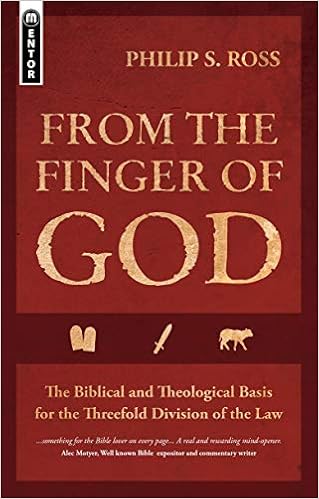
For more information about the Threefold Division start with part one of Phillip Ross' lecture about the Division.

Monday, June 30, 2014

The Threefold Division of the Law: Part 7 - Sabbath Extracts


In part
six, we concluded the main argument that Ross makes in his lecture and his book for why the threefold division of the should be continue to be the church's ongoing testimony of understanding the law of God.

Ross ended that part by looking at Ephesians 6:1 - 3 in light of some commentators who try to argue that Paul is not issuing an immediate call for obedience to the fifth commandment, but issuing a call from some other source for children to obey their parents. Ross ended the lecture by reaffirming that the moral law shapes our understanding of Christ's penal substitution on the cross, and by exhorting his listeners and readers that we must hold on to this doctrine to understand the Gospel.

However, I left out Ross' main two defenses of understanding Sabbath as still being the moral law, and I want to now include those sections of Ross' argument separate from the other six posts for a few reasons. The main reason being that I view Ross' examples of Christians arguing for or against the abiding validity of the Sabbath as a demonstration of the confusion that exists within the Reformed churches and the broader Christian church about how to understand all the laws that God gave in light of Christ's finished work on the cross. For me, the biggest contribution of Ross' research is about explaining that the moral, ceremonial, and judicial laws are the only possible way to understand the whole of Scripture without having to sacrifice the parts of Scripture that don't fit. Therefore, defenses of any one particular commandment, while helpful, are in my opinion raising flags to get people to pay attention.

A number of Christians, however, today have trouble with how to understand the Sabbath, and furthermore, because of that problem will not consider Ross' book in the first place because of Ross' defense of the Sabbath throughout the book and in the lecture. Phil Johnson, who pastors with John MacArthur, while reviewing Ross' book cannot get past Ross' defense throughout his book of the Sabbath because of his dispensationalism and as a result the review becomes very difficult to follow and largely unhelpful. More generally, while Tom Shreiner believes that the threefold division is biblical, the presence of a commandment about the Sabbath raises questions in his mind about how to understand the division; Justin Taylor, while commending the threefold division, nevertheless does not think it "fully works" because of the commandment about the Sabbath. My point in separating the substance (problem) from the demonstration of the problem is that the argument for the division needs to be considered before some people will consider rather or not the Sabbath applies to belevers today or it does not.

There are other books which defend the Reformed position on the Sabbath, but none of them currently include much of a defense of the threefold division, but Ross' book does both because Ross believes, and I agree, that the rejection of the Sabbath and the threefold division are linked together. Just because, however, the link exists does not mean there is only one way to defend both truths. Ross chooses to lead out his defense of the threefold division by showing where the most heat against the doctrine is currently being generated. I, however, think it might be more helpful to lay out the doctrine then show how it practically affects other doctrines. I think it is more helpful because, as has been shown, the threefold division has had many different attacks from other angles in the past, that do not only originate with a rejection or acceptance of the Sabbath.

Despite whatever differences I might have with Ross about the structure of his presentation, I do agree with Ross about the abiding validity of the Sabbath for the Christian.
  1. Introduction
  2. Five Old Testament presuppositions that shape the New Testament's understanding of law
  3. Jesus and the Gospels
  4. The Apostolic Interpretation of the law in the Book of Acts
  5. The Epistles of the Apostles
  6. Conclusion
  7. Sabbath Extracts
I will break this up into two parts in my one post and note where in the lecture the two different sections the extracts are from in the lecture. The first part is from the Introduction in the lecture.

----------------

According to Tim Keller, nearly all presbyters in the PCA subscribe to the Westminster Confession of Faith (WCF) 'with only the most minor exceptions (the only common one being with regard to the Sabbath).' (pg. 5)

If, however, such an exception amounts to a wholesale rejection of the Confession's approach to the Sabbath, then Ross suspects the Westminster Divines might have thought that to call it minor was probably understatement. (pg. 5)

If the WCF were a garment, you would not want to pull this thread, unless you wanted to be altogether defrocked. (pg, 5)

Ross wonders if the reason why some people pull at this thread is because they regard the Confession as more of a straightjacket than a garment. (pg. 5)

Unbuckle the Sabbath, and as far as Reformed Theology is concerned you are well on the way to mastering theological escapology. (pg. 5)

If this sounds like overstatement to rival Keller's understatement, Ross wants to remind his listeners that biblical law, with its Sabbath, is not an easily dispensable part of our doctrinal infrastructure. (pgs. 5, 6)

You cannot perform a precision strike on the Sabbath without producing an embarrassing amount of collateral damage. (pg. 6)

You cannot strike out the Sabbath without shattering the entire category of moral law and all that depends on it. (pg. 6)

If the Shorter Catechism represents Westminster theology in its most practical form, it would seem that any expurgation of biblical law from the theological framework it expounds, should lead to its complete unraveling. (pg. 6)

----------------

The next part is from the section titled Jesus and the Gospels

----------------

One thing that does not appear in Matthew 5 is anything about Jesus' attitude to the Sabbath.

It's often assumed that Jesus disregarded the Sabbath and that the Gospel writers conveyed that.

But Ross thinks Géza Vermes is right, if the evangelists were seeking to do that 'they did a pitiful job'. (pg. 173)

Even the authors of From Sabbath to Lord's Day have to agree that Jesus did not brake the Sabbath. (pg. 167)

Ross think there is little point in going into detail with the book because of their conclusion in a summary written by Andrew Lincoln for the book (pgs. 171 - 172):
The veiled nature of Jesus' ministry accounts for the slight ambiguity in regard to His relation to the Sabbath and for the fact that for a time in the early church there were those who continued Sabbath observance while the full implications of the entry to the new age accomplished by Christ were being worked out.
Ross contends that Lincoln's conclusion makes little sense. In fact, it is inexplicable considering the dates for the Gospels range from A.D. 50 - 150. How much tome did they need to work things out? (pg. 172)

If Mark clearly understood that Jesus had declared all foods clean, why did He choose to leave his readers in the dark over so fundamental an issue as the Sabbath? (pg. 172)

Until someone does better than raise the anti-Sabbatarian case from the Gospels from the 'pitifil' to the ambiguous there is little to gain be engaging in this discussion.

The evangelists represent Jesus as a Sabbath-keeper, who does not undermine the ordnance by word, action, or yet-to-be-understood personal claims. (pg. 173)

----------------

While in this section Ross does not specifically deal with the Colossians 2:14 - 15 passage which both are the given reason for Taylor and Dr. Schreiner's caveat about the threefold division Ross did address the Colossian text in part five. Since I don't want to make in seem like I'm only picking on the Gospel Coalition or Baptists, I need to also include the Lutherans' Dr. John Theodore Mueller and Dr. Francis Pieper. Both men wrote very popular and still used works on Christian Dogmatics. Near the bottom of page 213, Dr. Mueller rests his entire case on the Ten Commandments not being identified with the moral law on the sole argument of the Sabbath commandment being the ceremonial feature of the Ten Commandments. Since Dr. Mueller's one-volume work is based on Dr. Pieper's four-volume work I assume that both men agree on this argument, but have not yet verified Dr. Pieper's position in print.

Now I'm really done with the whole lecture, but I do want to ofter a bit more coverage of Ross' book in relation to some other controversies in the Reformed world. One of, which, is about a claim made by a few Westminster California professors about the application of the first four commandments to the other nations than Israel in the time of the Old Testament.

Monday, June 23, 2014

The Threefold Division of the Law: Part 6 - Conclusion


In part
five, we finished looking at the changes that took place to the law after the temple veil was torn in two pieces when Jesus died by surveying the letters that the Apostles wrote to the churches about how to understand and apply the Old Testament (OT) writings to their new situation of living in between the first coming of Christ and the second coming of Christ.

We saw, where in the New Testament (NT) the category of ceremonial law is demonstrated, and we saw why the Westminster Divines conclude that this part of God's law is abrogated. Furthermore, we saw that the civil laws entail the laws that God gave are neither ceremonial or moral; these laws had a temporal standing for the Jewish nation that still speak even though they and their penalties have expired with the nation of Israel being the exclusive theater of God's redemptive work. Lastly, we saw, that in spite of some older and more recent attempts to explain the Ten Commandments as not being an ever binding rule in this present age that the moral law is ineffably inscribed on human hearts and binding on all people everywhere regardless of time or place.

The following notes are from a March 2010 address delivered by Philip S. Ross. He also published a book on the same topic.

As with my other posts, here's the bird's eye view on all the posts in this series:
  1. Introduction
  2. Five Old Testament presuppositions that shape the New Testament's understanding of law
  3. Jesus and the Gospels
  4. The Apostolic Interpretation of the law in the Book of Acts
  5. The Epistles of the Apostles
  6. Conclusion
  7. Sabbath Extracts
----------------

Ross wants to conclude by considering the most prominent example of a single commandment cited in the context of a ethical exhortation: Ephesians 6:1 - 3. (pg. 341)

Ephesians 6:1 - 3, in Ross' opinion which he seeks to prove, is difficult to interpret in any other way than as an immediate call for obedience to the fifth commandment. (pg, 341)

It is interesting to how two contributors to From Sabbath to Lord's Day deal with Ephesians 6:1 - 3 because From Sabbath to Lord's Day is an anti-Sabbatarian manifesto. (pg, 341)

De Lacey, for example, is at pains to distance the call for children to obey their parents as coming from the Decalogue. (pg. 341)

His fellow contributor, Andrew Lincoln, is equally keen to disentangle Paul from the ten words claiming that the Apostles appeal is to a 'general sense of what was fitting and right.' (pg. 341)

When it comes to the promise in the commandment 'it is more likely to have been penned by a Jewish Christian follower.' (pg.342)

What choice does he (Lincoln) have? If the Sabbath is dismissed on the basis that Christ has fulfilled the concept of rites tied up with the Sabbath, if the Sabbath is more already than not yet then the promise in Ephesians 6 should not by there. (pg.344)

Even assuming a high degree of typology in the fourth commandment it is the same basic theme that is explicit in the fifth [commandment]. (pg. 344)

This promise (of the fifth commandment) is there (in Ephesians), because Paul sees its fulfillment as sufficiently not yet. That the promise and the moral law that accompanies it is still binding. (pg. 345)

In an article on penal substitution, Don Carson says that recent works on the subject have shown 'that historic Christian confessionalism will not roll over and play dead.' [Apparently, the Gospel Coalition's web site no longer hosts Carson's original post; however, there are number of blogs that do, so I have chosen to link to one of those blogs] (pg. 353)

If Hugh Martin's link between a person's view of the distinctiveness of the moral law and the view of how to understand the Atonement is correct then the threefold division of the law does not, and should not, roll over and die either if the source of Christian confessionalism is Scripture. (pgs. 352 - 353)

----------------

That's it, the end of Ross' case for the Biblical and Theological Basis for the Threefold Division of the Law. Many members of the Westminster Assembly around the 1630s and 40s made similar defenses of the Threefold Division in there day, here's a list of some of the ones that I thought were the most helpful in understanding the proof texts and the wording of the Confession of Faith. However, I am not entirely done with Ross' book, or the lecture. I have purposefully left out Ross' two specific defenses in his speech about the the doctrine of the Sabbath and chosen to put those in the next post in this series. I'll explain my reasoning in that post. Ross also has a few comments in his book that are very interesting in light of the controversy around the doctrine of the Two Kingdom's that I want to share and comment upon.

Monday, June 16, 2014

The Threefold Division of the Law: Part 5 - The Epistles of the Apostles

In part four we began looking at what, if anything, changes after the rending of the veil once Jesus died on the cross with a focus on God's Law? We considered on that post the Book of Acts, paying attention to Luke's quoting of the Decalogue and the Apostolic decree of Acts 15. We found out that Luke's references to the Decalogue were in harmony with the Ten Commandments still being valid, and that the Apostolic decree does not give of new way of understanding the Decalogue but it does give us a example of Christian behavior.

The current post is about how the Apostles in their writings to various churches understood and applied God's Law to those particular saints. Of course, even though the Apostles were addressing particular concerns at a particular time we must remember that "[a]ll Scripture is breathed out by God and profitable for teaching, for reproof, for correction, and for training in righteousness, that that man of God my be competent, equipped for every good work" (II Timothy 3:16-17). In addition, we must remember that we are living in the same age as the saints who Paul, Peter, James, Jude, the author of Hebrews, and John were addressing. The issues are still relevant for today's church, because their writings were primarily addressing the spiritual issues of their day in light of Jesus' death, resurrection, and ascension. In this part of Ross' address we will see the threads of the previous four parts come together to clearly demonstrate that the Threefold Division is the Apostolic teaching of the entire Bible.

As a general reminder, these notes that I took are based on Philip S. Ross' March 2010 address to a Presbytery. Later on that same year, Christian Focus Publications published a book length treatment of Ross' research into the Threefold Division of the Law. This is part five of a seven part series.

Here's how I have broken down Ross' address into seven parts:
  1. Introduction
  2. Five Old Testament presuppositions that shape the New Testament's understanding of law
  3. Jesus and the Gospels
  4. The Apostolic Interpretation of the law in the Book of Acts
  5. The Epistles of the Apostles
  6. Conclusion
  7. Sabbath Extracts
----------------

Some passages that are relevant to the three categories of the threefold division. (pg. 266)

The study of Paul the law is an area of interminable debate, but much of those debates aren't directly relevant to this precise issue. (pg. 265)

The New Perspectives on Paul challenges the centrality of moral law in confessional soteriology more than it challenges the details of the threefold division. (pg. 266)

Beginning with ceremonial law, which the confession speaks of as 'typical ordinances' and 'moral duties', there are solid grounds to say that Hebrews 9 makes a purposeful and unavoidable demarcation of cultic laws. (pgs. 266 - 267)

This is not a demarcation, as certain scholars claim, that Hebrews imposes on the law but one that's derived from the law. (pgs. 266 - 267)

From the ceremonial law's first deliverance to Moses, they were intended to be shadows that proclaimed the existence of heavenly things and good things to come; the reality of Christ. (pgs. 267 - 275)

The same vocabulary emerges in Colossians 2:16 - 17, where Ross rejects the view arising from the hypothetical Colossian heresy that this passage refers to extra-Mosaic practices. The use of cult prostitutes, for example, can hardly be a shadow of things to come. (pgs. 273 - 275)

Rather the food and drink in view envisages all the dietary laws of the Old Testament (OT) and the OT usage itself suggests that 'Sabbaths' in that context serves as shorthand for the activities of those days and not the day itself. (pgs. 276 - 278)

The verses in Colossians 2:14 - 15 and Ephesians 2:14 - 18 speak of a wall of separation and of the breaking down of ordinances. (pgs. 279 - 280)

Commentators will argue that these two passages either refer to expansions of the law or to the law as a whole. (pgs. 280 - 284)

However, the law as a whole did not divide and why would God need to abolish man made laws at all?

Ephesians 2 and Colossians 2 may emphasize different things, but both deal with the laws of separation, which have gone with the rent veil. (pg. 284)

The veil was rent because of what Peter tells us about in 1 Peter 1:19 'the sacrifice of the lamb without blemish'. (pgs. 290 - 292)

Many theologians, following German theologians, dismiss the idea of vicarious suffering, rejecting any link between Peter and Leviticus, or arguing that in the Leviticus passage there is no idea of the transference of guilt to the goat. (pgs. 287 - 288)

Place taking is, however, central to Leviticus and to Isaiah 53, the lens through which Peter reads Leviticus, and if Jesus is a lamb without blemish his fulfillment of ceremonial law must depend on moral fulfillment. (pgs. 288 - 291)

For Peter, as for Matthew, Christ's fulfillment is moral, soteriological, and eschatological. (pg. 286)

As said earlier, the confessional approach to ceremonial law was not so crude that they failed to recognize that it also spoke of moral duties. (pg. 292)

These, 'moral duties', are the implied moral demands of ceremonial law that we see, for example, in 1 Corinthians 5 which calls on Christians to be what they are: the unleavened bread symbolizing discontinuity and a break with the past. (pgs. 292 - 293)

In such cases, Paul preserves inviolate the core significance of the ritual law while maintaining it is not binding. (pg. 295)

What the threefold division calls judicial, or civil, laws exist almost by default in the Epistles. (pg. 296)

But do they (the Epistles) support the idea that God always intended those laws (judicial) to have temporal standing? (pgs. 296 -298)

The mere fact that the Apostles called for Christians to submit themselves to secular authorities suggests as much, although that does not mean they (judicial laws) are irrelevant. (pgs. 298 - 299)

Hebrews shows us that although the penalties may have expired, they still speak. (pg. 299)

Paul's reference to oxen, 1 Corinthians 9:8 - 10, shows that the general equity of the law still applies. (pg. 300)

For God does not care about oxen, which is why Paul's point depends ultimately on the Decalogue substructure that undergirds the quotation Deuteronomy. (pgs. 304 - 306)

In that context, in Deuteronomy, the themes of integrity and contentment unite the ninth and the tenth commandments. (pg. 303) [As an aside from Ross, for a moment,  this would be numbered the eighth, ninth, and tenth commandments in both the Lutheran and Roman Catholic churches. Both Lutherans and Roman Catholics along with others Christians throughout the centuries have separated the tenth commandment into two commandments numbered nine and ten. The Reformed tradition along with other Christians throughout the centuries have maintained a slightly different numbering of the Ten Commandment which means that Ross is talking about the commandment to not lie and to not covet.]

We would also think of the two witness rule quoted in 2 Corinthians 13 and 1 Timothy 5. (pgs. 304 - 306)

It is a straightforward application of Mosaic equity, but it does not demand literal application of the law since it (the two witness rule) too depends on the substructure of Deuteronomy. (pgs. 305 - 306)

Deuteronomy at the point of being quoted is concerned with the preservation of life. (pg. 305)

Such examples indicate that the Westminster Confession's 35 words on judicial law do not comprise an imposition upon Scripture, but reflection of biblical teaching. (pg. 308)

For many Christians the threefold division's most controversial claim is that the moral law, the Decalogue, is an ever binding perfect rule of righteousness and an obligation, which for Christians, is strengthened by Christ in the Gospels. (pg. 308)

When you think of Epistolary passages that support this (the Decalogue as an ever binding rule of righteousness) you might mention 1 Timothy 1:8 - 11; Romans 13:8 - 10; or James 2:8 - 11, and you would be right to do so. (pg. 341)

Despite the reluctance of someone like Douglas Moo to see royal law as a specific reference to the Mosaic law. (pg. 336)

Perhaps all that such reluctance shows is that by the time we come to the Epistles, whatever our position, the interpretive frameworks that we have developed play a decisive part in our exegetical conclusions.

In the Apostolic illusions to the Shema in 1 Corinthians 8 or James 2:19; in the call to love our neighbor in Romans 13 or Galatians 5 we hear an echo of Christ's voice, we hear Apostolic agreement with the principal that the two greatest commandments are a précis (meaning: 'a type of summary of abridgment) of the Decalogue. (pgs. 334 - 341)

For some interpreters, any notion of Apostolic agreement with the law is unthinkable - Paul was schizophrenic at best, about as constant in his affections for Moses as was Saul for David. (pgs. 308 - 318)

According to Heikki Räisänen, Paul's view of the law is 'full of difficulties and inconsistencies'. (pg. 309)

Ironically, Räisänen is so convinced that the Mosaic law consists of different elements that he thinks the threefold division handles the material better than Paul (pgs. 309 - 310)

A Dutch Reformed minster, T.E. Van Spanje, has produced a lengthy answer to Räisänen's charge of theological schizophrenia, but we should not be afraid to see tension in Paul's attitude to the law. (pg. 310)

If his (Paul's) view of divine revelation is rooted in the Old Testament we should expect tension, but that's not the same as inconsistency.

The idea that divine revelation may bring blessing or curse, brokenness or hardness, life or death, weaves its way from the Pentateuch through the Psalms and Prophets into the Gospels where the same word that cuts off every dead branch and prunes every live branch and weaves its way into the Epistles. (pgs. 311 - 313)

In 2 Corinthians 3, the law brings a deadly holocaust to the Jewish people that cannot be ended unless the life giving Spirit intervenes (pg. 313)

It is no negative commentary on the law, but recognition of the law's impotence to bring life and lasting glory.

The tension continues in the new order, the law will still kill you if you read it with a veil and new covenant ministry that may be the fragrance of life to some is the odor of death to others - it produces its own holocaust. (pg. 314)

Paul is not the only one to be charged with hostility to the law. (pg. 314)

In the eyes of Michael Morrison, the author of Hebrews has no place for the law at all since law in Hebrews quotation of Jeremiah 31:33 found in Hebrews 8:10 and 10:16 should be understood in the widest possible sense as instruction. (pgs. 314 - 315)

Jeremiah, however, will not let Morrison off with the charge (of the law having no place in the book of Hebrews) so easily. (pg. 315)

When the prophet speaks of 'My law' the context is suggestive of Sinai and Jeremiah 31:33 is, Ross believes, addressing the same commandments as at Sinai. (pgs. 315 - 316)

These 'ten words' are the only laws that God inscribes. (pg. 316)

Hebrews is not talking about a redrafted morality. That is not what makes the New Covenant 'New'. (pg. 316)

It is not 'new' because the New Covenant believers' obedience is qualitatively superior to Abrams'; it is all about Jesus Christ. (pg. 317)

This covenant is better because it is enacted upon better promises, not necessarily those promises) contained within it (new covenant), but those promises made to Christ, 'You are a priest forever', God will not change His mind, Christ's priesthood will not fail. (pg. 317)

All the circumcised hearts in the cloud of witnesses, every law inscribed heart in which the Father makes His home is only so because of our Mediator. (pg. 318)

Far from rendering obsolete the laws inscribed in stone His all eclipsing priesthood makes them a lively script that will never pass away. (pg. 318)

Part of the argument in the WCF for ever-binding moral law is that this law is ineffably inscribed on human hearts. (pg. 318)

Romans 2:15, which speaks of Gentiles who have the work of the law written on their hearts, is a key passage. (pg. 318)

But what Gentile hearts?

'Not any Gentile hears,' says N.T. Wright, Jewett, and Gathercole, 'Paul is talking about Gentile Christians'. (pg. 318)

Gathercole's defense of this view is the most comprehensive, but Ross believes is seems inconceivable that there could have been Gentile Christians who were, as Gathercole says, 'actually not hearers of Torah at all'. (pgs. 319 - 320)

Just how did these Christians manage to avoid the Psalms, the Prophets, the Sermon on the Mount, and debates about the law? (pg. 320)

Why should the idea that all people, in some sense, do what the law requires have been foreign to Paul?

Surely, in view of the Pentateuch's assumptions about the law, that the laws of Sinai were self-understood from the beginning, it would have been natural for him (Paul) to think like that.

In fact, the suggestion from Akio Ito that Paul may have been alluding to Deuteronomy 30:14 may support that point, especially if Matthew Henry was right to see in the text of Deuteronomy a reference to 'the law of nature, which would have been found in every man's heart, and every man's mouth, if he would but have attended to it.' (pg. 322)

So Paul, then is reflecting Scripture-wide presuppositions about the Decalogue. (pg. 323)

Paul is, as John Murray says, answering 'the question arising from verse 12, namely: If the Gentiles are without the law, how can they be regarded as having sinned?' (pg. 323)

How else can we make sense of verses 15 - 16 of Romans 2? (pgs. 323 - 324)

It is not Gentile Christians who will be in turmoil on that day, but unbelievers, who having suppressed the truth find exposed upon their hearts an inscription of the law that reason could not erase and darkness could not hide. (pg. 324)

On this understanding of Romans, the opening section of chapter 19 of the WCF provides a coherent expression of Apostolic teaching. (pg. 324)

When that day comes when God judges the secrets of men's hearts by what standard will He judge? On what basis will men be convicted of their sin? What is sin?

Strangely enough, you might get a more conservative definition of 'sin' from a lexicographer than a theologian.

While the Oxford English Dictionary happily defines 'sin' as 'transgression of the divine law' some NT scholars prefer the generality of 'evil' or 'iniquity'. (pg. 325)

Even when the passage involved is 1 John 3:4. which defines 'sin' as transgression of the law, or lawlessness, Stephen Smalley wants to argue that the connection between sin and lawbreaking in the OT is not strong. (pgs. 325, 327)

None of the attempts to separate lawlessness from law are convincing. Especially when the alternative definition of sin that these writers generally propose, such as, 'opposing God' describe things that are transgressions of the law anyway. (pgs. 328 - 329)

Not only does John define sin as lawbreaking; James 2:8 - 12 indirectly defines sin as transgression of law from the Decalogue, or the summarizing great commandments. (pg. 329)

Sin is not a roughly defined problem.

Righteousness is not a fluctuating ideal.

The great Day of judgement will be according to the self-understood norms of the Decalogue, and that is an implicit assumption in Romans 2 and elsewhere.

When Romans 1 meets a litany of iniquities with unvarying response of judgement none of those death-deserving deeds go beyond established or plausible applications of the Decalogue. (pg. 332)

The only lawgiver and judge employs no double standard.

----------------

So, there you have it. The threefold division is biblical and comes to full expression in the Epistles. However, it is important to note all the threads that begun in Genesis up through Acts in the previous four parts that lead to the full revelation of how we need to understand God's law. The next post, on this topic, will be a much shorter conclusion of the entire address. This part covered chapter seven in Ross' book, which is 85 pages.

Sunday, May 25, 2014

The Threefold Division of the Law: Part 4 - The Apostolic Interpretation of the law in the Book of Acts

In part 3, we Ross introduced the majority of the remaining time of his lecture by framing his discussion around the following two questions:

1. What may we conclude from the Gospels? - From the words and deeds of  Jesus up to the point where the veil was torn.

2.What, if anything, changes after the rending of the veil? - What do the Apostles and their Epistles have to say to all this?

We dealt with the first question in its entirety in the last post. This post is the first half of Ross' answer to the second question dealing with the events in the Book of Acts focusing on how the church viewed God's Law in light of Jesus' mission being accomplished. The last post was about how Jesus talked about the law in his Sermon on the Mount and how Jesus demonstrated in his actions that the purpose of the purity laws were to show Israel's separation from the other nations which was coming to an end with the temple veil being torn in two when Christ died.

Jesus' entire earthy ministry was a life in conformity with the law. His teachings highlighted that obedience to the law was not conformable to the terms that the receivers understood, but that God's laws came with their own terms of obedience which were not being followed in Jesus' day. Ross, finally, pointed out that the embryonic form of the threefold division appearing in the Old Testament (OT) was not overturned by Jesus' life or teaching.

Now, Ross will be contending that the Evangelists will be confirming those same presuppositions through the book of Acts and their Epistles throughout the rest of the New Testament (NT).

As with the previous three posts and next three in this series, here's the big picture of where this current post fits:
  1. Introduction
  2. Five Old Testament presuppositions that shape the New Testament's understanding of law
  3. Jesus and the Gospels
  4. The Apostolic Interpretation of the law in the Book of Acts
  5. The Epistles of the Apostles
  6. Conclusion
  7. Sabbath Extracts
----------------

The book of Acts provides indications of the Apostles' approach to the law and gives us some narrative background to the Epistles. (pgs. 239 - 240)

Some say Luke was zealous for the law, while Evangelicals, such as Craig Blomberg, are happy to think Luke saw the law as nothing more than 'a cultural phenomenon'. Neither approach is satisfactory. (pgs. 241 - 242)

Throughout the book of Acts we encounter Christian thinking that presupposes the validity of the Decalogue. (pgs. 243 - 244)

For Luke, the Jews were the real transgressors of the Decalogue's precepts. (pgs. 242 - 243)

Luke quotes several laws outside of the Decalogue, but Ross only has time to address one instance in Acts. (pgs. 247 - 254)

Peter's reference to Deuteronomy 10:17 in Acts 10:34. (pgs. 248 - 250)

Peter's use of Deuteronomy shows how he took that one law in its context and began to see that not only are all animals fundamentally clean, but that all people are equal. Peter understands that the abolition of food distinctions means that national Israel is no longer the exclusive theater of Divine love. (pg. 249)

From where Peter now stands Deuteronomy's declaration of God's love for the sojourner may always have been indicative of the temporality of the separation laws. (pgs. 249 - 250)

The most complex legal issue in Acts seems to be the Apostolic decree of Acts 15. Partly because of differences in biblical manuscripts that the church has used throughout history. (pgs. 254 - 257)

Richard Bauckham gives exhaustive arguments for the decree being based on Leviticus 17 - 18, but Ross thinks his arguments are unconvincing. (pgs. 257 - 261)

The decree is only really complex when people are determined to interpret it either as liberation from the law, or imposition of the law. (pg. 261)

In the end, the basis for the decision was that it seemed good to us. It was no more a legal decision than the council's decision to send out Paul and Barnabas, or Luke's decision to write his gospel. It seemed good. The rationale was unity. Church unity was more important than absolute liberty. (pgs. 261 - 263)

The decree does not give us a hermeneutic of biblical law but a example of Christian behavior. (pg. 262)

In the end, all we can say about Acts is that it assumes the principles of the Decalogue. It gives good reason, at points, to support the confessional statement of cultic and judicial law, but the decree and the accounts of cultic obedience are legally neutral. (pgs. 263 - 264)

----------------

The notes above are a summary of chapter 6 in Ross' book which is 25 pages long. The next post in this topic will continue to address the changes in the law after Jesus' death as found in the Epistles of the Apostles.

Sunday, March 23, 2014

The Marrow, Romans 3, and multiple Laws?

On the night of March the 5th, the Wednesday night bible study that I am a part of took up Romans chapter 3. Quite separately also I have been rereading The Marrow of Modern Divinity by Edward Fisher first written in 1645 then updated in 1648 with a second part and finally in 1726 Thomas Boston added extensive explanatory notes to the volume to increase its helpfulness to the church of Scotland in his day, and as I hope to demonstrate in this post Boston's notes can also help the church today. The text has been helpfully reformatted by Christian Focus Publications in 2009, or can be read and downloaded through the Chapel Library for free. The note I am summering is found on pages 48 - 50 of the Christian Focus Publications edition.

What follows are my notes so that I could helpfully bring some issues that Paul deals with in Romans 3 to my bible study group.

Notes on Thomas Boston's Note about "the Law of Works", "the Law of Faith", and "the Law of Christ".

Relevant texts: Romans 3:27 ("law of works", "law of faith"); 1 Corinthians 9:21, Galatians 6:2 ("law of Christ").

Meaning of the terms under consideration: Boston gives the following definitions for the three phrase under consideration according to their biblical and systematic usage throughout the Bible:
  • Law of Works - The law of the Ten Commandments, as the Covenant of Works.
  • Law of Faith - The gospel, or the covenant of grace.
  • Law of Christ - The same law of the Ten Commandments, but as a rule of life.
Now that we have our terms down, all from the two biblical texts by the way, and that we have some definitions of these three terms we should ask how they relate to each other and how do they differ from each other. This is one way that Boston, and Fisher, really help.

The use of the term "law".

The term "law" is not used by Paul in these two passages in the same sense in all three instance where the term "law" is used. The "law of faith" is not used in the sense of a law to be obeyed. The "law of faith" is not a properly a preceptive - meaning "instructive" - law. Boston argues the Paul uses the phrase only in imitation of the Jews manner of speaking, who had the law continually in their mouths.

The term "law" as used in the phrases "law of works" and "law of Christ" is used in both phrases to mean preceptive law, but their is a difference, but the terms "law" is used in the same sense with both of these laws.

"The law of Works" vs. "the Law of Faith".

Paul says in Romans 3:27:
Then what becomes of our boasting? It is excluded. By what kind of law? By a law of works? No, but by the law of faith.
From this statement by Paul, Boston concludes that in the case of Romans 3 where Paul is speaking of his hearers justification before God, Paul states these two laws in opposition to each other.

Boston's Proof: Paul says that the "law of works" says that anyone who keeps it can boast of their ability to keep it; but, the "law of grace" does not allow for any boasting, because by the "law of grace" the sinner is justified before God.

The "law of works" is the law to be done, that one might be saved if they follow it; whereas, the "law of faith" is the law to be believed, that one may be saved.

Similarity between "the law of Works" and "the law of Faith".

Boston really doesn't address any similarities between "the law of Works" and "the law of Faith" in his note, but I can think of one: they both come from God.

"The law of Works" and "the law of Christ".

"The law of works" and "the law of Christ" are in substance one law. That shared substance is called "the moral law". The phrase "moral law" is defined in  all three documents that make up the Westminster Standards in the following places: the Westminster Confession 19.3; the Westminster Shorter Catechism questions 40 - 41; and in the Westminster Larger Catechism questions 92 - 98. For the purposes of this post, I will only quote the question and answer for question 93 of the Larger Catechism, which says,
Q. 93. What is the moral law?
A. The moral law is the declaration of the will of God to mankind, directing and binding every one to personal, perfect, and perpetual conformity and obedience thereunto, in the frame and disposition of the whole man, soul and body, and in performance of all those duties of holiness and righteousness which he oweth to God and man: promising life upon the fulfilling, and threatening death upon the breach of it.
According to Boston, "the law of Christ" is not a new, proper, preceptive law, but the old (a.k.a. moral), proper preceptive law, which was from the beginning, under a new accidental form. The word "accidental" is being used by Boston in a philosophical Aristotelian sense and means that the form of 'the law of Christ' is not the same as the nature of the law.

Therefore, Boston is teaching that the moral law is the nature of the one law that God has given to his creatures. However, from this one law (or property) there are two accidental forms. One form is known in Scripture as "the law of works". The other accidental form is known as "the law of Christ". These two forms point back to the moral law, which is the same property.

Regardless of the form that moral law takes the following points are in common:
  • The law is perfect.
  • Sin is any want of conformity unto, or transgression of the moral law.
  • All commands of God are comprehended under the one moral law, particularly:
    • The command to repent is common to all including pagans to turn from sin to God.
    • The command to believe in Christ.
The obligation of the law of the Ten Commandments is not weakened by the believer's taking the moral law as "the law of Christ", and not as "the law of works". The sovereign authority of God the Creator in whatever means He uses to give the moral law unto humanity is not weakened by the difference in the forms.
This understanding is in direct conflict with the movement known as the New Covenant Theology movement, which teach that "the law of works" and "the law of Christ" are not only different in their forms, but also different in their substance. In this regard, Boston and Fisher are also very important to 21st-century Covenant Theology.

"The law of Works" vs. "the law of Christ".

"The law of Works" is a covenant of works. Whereas, "the law of Christ" is a rule of life to believers. The law stands under different forms to those who are in a state of union with Christ by faith, and those who are not united with Christ by faith who are still under the covenant of works.

As a result, the following points can be said of those are believers by their union with Christ, which cannot be said of those under the covenant of works by not being united with Christ:
  1. Believers are dead to the law of works.
  2. "The law of Christ" is an "easy yoke", and a "light burden".
Boston says that the distinction, relating to the moral law (or Ten Commandments), is that as "the law of works" the Ten Commandments came from an absolute God out of Christ unto sinners. Whereas, "the law of Christ" is the Ten Commandments coming from an absolute God in Christ unto sinners.

"The law of Christ" vs. "the law of Faith".

The distinction between "the law of Faith" and "the law of Christ" is that "the law of Christ" severs "the law of Faith".

Relating these three "laws" to each other

In conclusion, "the law of Works" is the law to be done, that one might be saved if they follow it; "the law of Faith" is the law to be believed, that one may be saved; "the law of Christ" is the law of the Savior, binding His saved people to acts of obedience (Gal. 3:12; Acts 16:31).

Every person is under "the law of works" by nature; but by taking the benefit of "the law of faith", by believing in the Lord Jesus Christ, they are set free from "the law of works", and brought under "the law of Christ" (Matt. 11:28-29).

Monday, March 10, 2014

The G3N3S1S Debate: A Minor Point Which Was A Missed Opportunity

I finished reading The Genesis Debate edited by David G. Hagopian and published in 2001 by Crux Press. I actually bought this book probably almost ten years ago, but didn't read it until now because I didn't necessarily like the context under which I bought it. However, a few years ago, when I started working for Wal-Mart I decided that one good use of my hour long lunch break would be to read the books I have purchased before buying new ones. It has resulted into a pretty good use of my time. Furthermore, at some point I decided that some of my books fall into similar topical categories, so I decided that would make more sense than just randomly picking a book the night that I need to have a new book. My current category is books that are edited by a general editor. I have worked through books that are collection of essays written "In honor of ..." usually a retired theologian or some other reason. The essays typically on very different topics that may be related to the person's professional career, or something else. The best collected writings volume, from an editing standpoint, that I've read so far has been Always Reformed: Essays in Honor of W. Robert Godfrey. The reason why I enjoyed in was because each author told the reader why he wrote the essay in relation to Dr. Godfrey. I did, however, also enjoy The Faith Once Delivered: Essays in Honor of Wayne R. Spear because of particularly the RP contributions to the volume.

Back to the book pictured. It was on my "books with an editor" list and once I noticed that it was on Westminster Philadelphia's reading list, I decided I should get to my debate books. I wouldn't call what follows a review as much as one or two observations. I may write more about the book later, but I wanted to put the idea's that follow out there and then add if I feel like adding.

The first point is, how do you read a debate book? In the case of this book it has the following structure:
  • Forward
  • Introduction
  • Position 1
    • Position 1's main paper
    • Position 2's response
    • Position 3's response
    • Position 1's reply
  • Position 2
    • Position 2's main paper
    • Position 1's response
    • Position 3's response
    • Position 2's reply
  • Position 3
    • Position 3's main paper
    • Position 1's response
    • Position 2's response
    • Position 3's reply
  • Conclusion
  • Index
How do you go about reading it? Do you just plow through one view's entire section and then do it again for two more times; or, do you try to read the main papers of the three views then all the responses then all the replies?

The later approach is what I largely tried to do, because the main papers are ideally written at the same time by the different groups without any kind of input from the other groups about what they are actually writing for this particular volume. I figured it would be safe to read the response papers along with the replies, but I found out after reading Position 1's reply that the reply papers actually are each group's final word after all the responses have been shared.

The second point is actually where the title came from of this post. The Lee Irons with Meredith G. Kline team represent The Framework View and are Reformed theologians. In addition, the J. Ligon Duncan III and David W. Hall team represent the 24-Hour View and are also Reformed theologians. Dr. Kline is now dead, but when he was alive he was very groundbreaking, to say the least, in some of his writings about Covenant Theology in addition to introducing the English speaking world to the Framework View. What was interesting, for me, was how the Framework team explained their view of Genesis 1 in opposition to both the 24-Hour View and the Day-Age View. On page 218, the team says,
Consequently, adherents of those views lose sight of the covenantal and theological burden of the [Creation] narrative.
What's so interesting about this quote is the idea of a covenantal narrative to Genesis 1. Then, on pages 181 and 182 the Framework View in responding to the Day-Age View and their Science-Driven Approach to the Text says the following on page 181:
The Bible was given, rather, as the covenant revelation of God to His people that they might be made wise unto salvation through faith in Christ Jesus (2 Tim. 3:15). The creation account functions as a prologue to the book of Genesis, indeed to all the canonical Scriptures, laying the presuppositional foundations concerning the doctrine of creation and God's eschtological purpose for the cosmos with man as central to that purpose.
They go on page 182 to say,
Unbridled concordism, on the other hand, errs by obscuring the covenantal and eschatological thrust of the text in the process of treating it as a series of anticipations of future scientific discoveries.
Finally on page 117, in a footnote the 24-Hour View team in their reply says the following,
We reiterate, however, our disagreement with framework interpreters who view Genesis as primarily eschatological and covenantal. Genesis has long been correctly understood as protological and covenantal. To illustrate the point, consider Revelation. Merely asserting or citing a few journal articles claiming that Revelation is protological instead of eschatological (as the Church has read for years) does not make it so.
This point of covenantal aspects to creation, protological and eschatological discussions are a big deal to people who agree with the Framework View. Therefore, I would have like to have seen more dialog on this issue between the various views besides a few scattered references that only vaguely address the issues of covenant and creation; protology and creation; and eschatology and creation.

It's not just the second noun in either phrase that interests me - either "protological", or "eschatological". It's the idea of "covenantal". What do the Irons with Kline team mean by "covenantal"? What bearing might that have on the WCF 7.1 in relation to 7.2? What does the Duncan and Hall team mean by "covenantal"? Do they mean the same thing or something different?

Here's my point, within the Reformed world we are currently having a debate about a doctrine called Republication. An aspect of this debate seems to center around if  WCF 7.1 and 7.2 must mean that God only speaks to His creatures through a covenant; or, if covenant is the primary way, but not the exclusive way God communicates with His creature. The text of WCF 7.1 and 7.2 is,
The distance between God and the creature is so great, that although reasonable creatures do owe obedience unto Him as their Creator, yet they could never have any fruition of Him as their blessedness and reward, but by some voluntary condescension on God's part, which He has been pleased to express by way of covenant.
The first covenant made with man was a covenant of works, wherein life was promised to Adam; and in him to his posterity, upon condition of perfect and personal obedience.
The question is, what is the relationship between the "voluntary condescension" of 7.1 with "The first covenant made with man was a covenant of works"? It seems that one side of the debate is arguing that the "voluntary condescension" has to be exclusively the covenant of works. Whereas, on the other side, they are saying that God's "voluntary condescension" includes the moral law which was communicated to humanity before he was given the first covenant which was the covenant of works. The covenant of works was the "Besides this law written in their hearts, they received a command, not to eat of the tree of the knowledge of good and evil; ..." of WCF 4.2.

The wrong question in this debate is "Was anything republished on Sinai?" The correct question is, "What was republished on Sinai?" Was "it", the Covenant of Works (CoW) "in some sense", which is what one side wants to contend. Or, was "it", the moral law, which was written in their hearts before the CoW?

Another place in the WCF that we need to consider is chapter 19 section 1 - 3, which says,
God gave to Adam a law, as a covenant of works, by which He bound him and all his posterity, to personal, entire, exact, and perpetual obedience, promised life upon the fulfilling, and threatened death upon the breach of it, and endued him with power and ability to keep it. This law, after his fall, continued to be a perfect rule of righteousness; and, as such, was delivered by God upon Mount Sinai, in ten commandments, and written in two tables: the first four commandments containing our duty towards God; and the other six, our duty to man. Besides this law, commonly called moral, God was pleased to give to the people of Israel, as a church under age, ceremonial laws, containing several typical ordinances, partly of worship, prefiguring Christ, His graces, actions, sufferings, and benefits; and partly, holding forth divers instructions of moral duties. All which ceremonial laws are now abrogated, under the New Testament.
The side that contends that the CoW was republished in some sense, makes the argument that the law given to Adam was the CoW, and since according to 7.2 the first covenant made with man was the CoW it must therefore, be the case that the CoW was republished on Mt. Sinai in some sense. This carries the meaning of saying, first covenant is identical to the law given by God that is written about in 19.1.

However, the side that says it was the pre-CoW moral law points to the fact that 19.1 says "God gave to Adam a law, as a covenant of works, ..." and then the rest of section 1 describes the law - which hasn't been named yet - as a CoW. The beginning section II resumes describing how "this [still unnamed] law" functions after the fall and talks about how it "was delivered by God upon Mount Sinai, in ten commandments, ...". At the beginning of section 3 the unnamed law finally receives a name which is " ... commonly called moral ...." The moral law was also referred to in 4.2 as the "... law written in their hearts ...." So, the Confession is teaching, under this interpretation, that the law given to man by God is similar but not identical with CoW and it is named the moral law.

Now you maybe wondering what is has to do with the book and the four quotes from the book under consideration. I'm going to speculate that the Irons with Kline team are arguing in the Genesis debate book for the same particular understanding of WCF 7.1 - 7.2 and 19.1 - 19.2 that the Republication of the CoW people are arguing for in today's Republication debate.

I'm still gathering information. Oh well, another topic for another day.

On a related note, it seems Dr. J.V. Fesko's Last Things First book gets into this Eschatology and the book of Genesis relationship from a Framework perspective. However, the book is not a debate book so the dialogue still goes without comment.

Now, on to Three Views on the Millennium and Beyond!

Sunday, March 2, 2014

Theonomy vs. the Westminster Confession of Faith

For the past seven weeks I have been reading David McKay's book The Bond of Love, which I would recommend for anybody who's thinking of going to seminary or just wants to know how the Bible fits together. Today I reached Chapter 8 which is about The Way of Holiness. The last section pages 190 - 193 is about the law and society and talks about Theonomy and questions if its teachings are scriptural and confessional.

Professor McKay says "No!" to Theonomy and helpfully shows how a Theonomic interpretation of the Westminster Confession of Faith 19.4 makes that section have no actual meaning in a chapter end note numbered 60 on page 196. Professor McKay writes,
Theonomists who appeal to the Confession tend to interpret 'general equity' in such a way (i.e. embracing the detail of the laws) that they in effect reverse the Confession's statements about the laws having 'expired' and their 'not obligating any'.
The Confession says at 19.4,
To them also, as a body politic, He gave sundry judicial laws, which expired together with the State of that people; not obliging any other now, further than the general equity thereof may require.
So what is Professor McKay actually suggesting in his end note? Well here's how we should read the section if Theonomists had their way (according to McKay):
To them also, as a body politic, He gave sundry judicial laws, which though they expired together with the State of that people; the general equity thereof requires obligation of all.
The changed words are in italics, and the meaning of this altered WCF is clearly different than what the Confession actually says. Though what's not so clear is why section four would have existed if the writers were Theonomic? I'll get into the question of if Theonomy is biblical in a later series of posts, but my point for this post is to ask if it's what the RPCNA, or any other church confessing the Westminster Standards actually clearly teaches or can allow? My argument, and the argument of Professor McKay, is an emphatic, "NO!"

Furthermore, over at The Confessional Outhouse, they have a helpful post (Doing Justice to Equity), which suggests the following change to WCF 19.4 as faithful to the original intent of the Standards,
To them also, as a body politic, He gave sundry judicial laws, which expired together with the State of that people; not obliging any other now, further than the Natural Law thereof may require.
Now I realize the phrase "Natural Law" is can be a bit tricky to figure out. I also don't want to leave the impression that I agree with everything that's promoted at The Confessional Outhouse, but if we could agree that by the phrase "natural law" we mean only the Ten Commandments, also called the moral law (WCF 19.3, WLC Q. 93), and don't confuse the Ten Commandments with the Covenant of Works either, which was added to the moral law (WCF 4.2), we have pretty clear modern statement.

Sinclair Ferguson in his chapter, "An Assembly of Theonomists? The Teaching of the Westminster Divines on the Law of God" published in Theonomy: A Reformed Critique, on page 330 offers a slightly different rewording of 19.4 than McKay which is also helpful:
The Mosaic law has actually expired minimally: it remains obligatory and must be applied maximally.

I'm looking forward to having a book review series on Theonomy: A Reformed Critique soon, but it is interesting to note the publication date is 1990. Therefore, for at least over 20 years Ferguson has argued that it would be more honest to modify the Confession and hold to Theonomy than to have a secret meaning to 19.4 and then have to explain what the Confession "actually" must mean.
 
I am suggesting is that the term "general equity" had a long social context which, at least in America, is not easily understood currently. I actually plan to address the term "general equity" in a later post, but for now my best suggestion on understanding section four is,
To them also, as a body politic, He gave sundry judicial laws, which expired together with the State of that people; not obliging any other now, further than the moral law thereof may require.
This suggestion actually keeps all the terms within the confession because section three defines the moral law. Thanks must go to my dad, Chris Stockwell, for reminding me about how Professor McKay's chapter end note exactly changes the wording of WCF 19.4.

Friday, February 28, 2014

Katy Perry vs. Muslims and The "Son of God" movie vs. The Reformed Confession

According to the BBC, Pop-singer one of Katy Perry new videos recently was edited in response to a petition claiming that a scene was blasphemous because a pendent with the Arabic word for God was reduced to sand in the video. The petition instigator is apparently very pleased and feels like his petition showed the justness of his cause based on the number of signers and the result. One could only assume from his concern that he can now watch the video and listen to Perry's music with a certain piece of mind that before the video allowed his to tolerate some Perry's other questionable tastes of clothing and behavior in her other videos. However, does this really change any hearts and minds? No, it just shows that people can get a studio to change a music video if it offends Muslims.

Don't misunderstand me, the third commandment - "You shall not take the name of the Lord your God in vain, for the Lord will not hold him guiltless who takes his name in vain" - is important and the application of WLC 113 list of sins forbidden in third commandment might mean that Perry's unedited video actually breaks the third commandment. So it commendable that the video was changed.

Oddly enough, though, there is a new Jesus movie coming out titled Son of God today. As a Reformed Christian who confesses that Jesus is one person with both a human and divine nature (WCF 8.2, 3) and as a result, in the language of WLC 109 about sins forbidden in the second - or first, if your Lutheran - commandment the movie coming out today is also blasphemous.  WLC 109 says,
... the making any representation of God, of all or of any of the three persons, either inwardly in our mind, or outwardly in any kind of image or likeness of any creature whatsoever; ... oppos[es] the worship and ordinances which God hath appointed.
Since Jesus' person was both fully man and God the latest movie about Jesus is blasphemous. The question and answer in the Heidelberg Catechism (questions 96, 97, and 98) is also helpful here:
Question 96. What does God require in the second commandment?
Answer: That we in no wise represent God by images, nor worship him in any other way than he has commanded in his word.

Question 97. Are images then not at all to be made?
Answer: God neither can, nor may be represented by any means: but as to creatures; though they may be represented, yet God forbids to make, or have any resemblance of them, either in order to worship them or to serve God by them.
Question 98. But may not images be tolerated in the churches, as books to the laity?
Answer: No: for we must not pretend to be wiser than God, who will have his people taught, not by dumb images, (a) but by the lively preaching of his word.
Therefore, what are we to make of this latest movie about Jesus? Are we to petition the studios and movie theaters showing the movie? Am I supposed to close my eyes while I'm at work when the trailer is playing while I am going into the backroom of Wal-Mart? Or, even tell my employer that I quit because they're advertising a blasphemous film? No. That person up on the screen is not the Person who died for my sins and then rose from the dead so that I can have eternal life. The Person who died for my sins and gives me His righteousness didn't leave instructions for His followers to make society conform to His commandments. He will do that on His own. He did, however, tell us to spread the news to others that He offers salvation to all those who hate Him.

That Person took on humanity for my sake and was humiliated even in the act of taking the form of a servant (WLC 46 - 49) for His bride, the Church. All the Jesus movies can do is capture the human side of Jesus' humiliation, but as Heidelberg Catechism Q. 14 - 18 and WLC Q. 38 - 40 demonstrate the man on the screen is only fully human, but not divine which means he only dies for himself and cannot withstand the burden of God's wrath, restore us to righteousness and life, and will not rise from the dead.

There is, however, a place where I can go to meet the real Jesus, and it's referred to in WLC 109 as the appointed place to worship and take the ordinances that God did appoint by His Spirit which lives in me. That place is the visible church. The ordinances are preaching and the sacraments. God gave us a medium and the means to meet us "where we're at" and it's not a movie theater.