Showing posts with label Ten Commandments. Show all posts

Monday, June 23, 2014

The Threefold Division of the Law: Part 6 - Conclusion


In part
five, we finished looking at the changes that took place to the law after the temple veil was torn in two pieces when Jesus died by surveying the letters that the Apostles wrote to the churches about how to understand and apply the Old Testament (OT) writings to their new situation of living in between the first coming of Christ and the second coming of Christ.

We saw, where in the New Testament (NT) the category of ceremonial law is demonstrated, and we saw why the Westminster Divines conclude that this part of God's law is abrogated. Furthermore, we saw that the civil laws entail the laws that God gave are neither ceremonial or moral; these laws had a temporal standing for the Jewish nation that still speak even though they and their penalties have expired with the nation of Israel being the exclusive theater of God's redemptive work. Lastly, we saw, that in spite of some older and more recent attempts to explain the Ten Commandments as not being an ever binding rule in this present age that the moral law is ineffably inscribed on human hearts and binding on all people everywhere regardless of time or place.

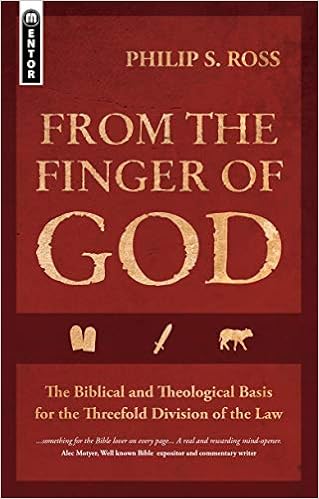
The following notes are from a March 2010 address delivered by Philip S. Ross. He also published a book on the same topic.

As with my other posts, here's the bird's eye view on all the posts in this series:
  1. Introduction
  2. Five Old Testament presuppositions that shape the New Testament's understanding of law
  3. Jesus and the Gospels
  4. The Apostolic Interpretation of the law in the Book of Acts
  5. The Epistles of the Apostles
  6. Conclusion
  7. Sabbath Extracts
----------------

Ross wants to conclude by considering the most prominent example of a single commandment cited in the context of a ethical exhortation: Ephesians 6:1 - 3. (pg. 341)

Ephesians 6:1 - 3, in Ross' opinion which he seeks to prove, is difficult to interpret in any other way than as an immediate call for obedience to the fifth commandment. (pg, 341)

It is interesting to how two contributors to From Sabbath to Lord's Day deal with Ephesians 6:1 - 3 because From Sabbath to Lord's Day is an anti-Sabbatarian manifesto. (pg, 341)

De Lacey, for example, is at pains to distance the call for children to obey their parents as coming from the Decalogue. (pg. 341)

His fellow contributor, Andrew Lincoln, is equally keen to disentangle Paul from the ten words claiming that the Apostles appeal is to a 'general sense of what was fitting and right.' (pg. 341)

When it comes to the promise in the commandment 'it is more likely to have been penned by a Jewish Christian follower.' (pg.342)

What choice does he (Lincoln) have? If the Sabbath is dismissed on the basis that Christ has fulfilled the concept of rites tied up with the Sabbath, if the Sabbath is more already than not yet then the promise in Ephesians 6 should not by there. (pg.344)

Even assuming a high degree of typology in the fourth commandment it is the same basic theme that is explicit in the fifth [commandment]. (pg. 344)

This promise (of the fifth commandment) is there (in Ephesians), because Paul sees its fulfillment as sufficiently not yet. That the promise and the moral law that accompanies it is still binding. (pg. 345)

In an article on penal substitution, Don Carson says that recent works on the subject have shown 'that historic Christian confessionalism will not roll over and play dead.' [Apparently, the Gospel Coalition's web site no longer hosts Carson's original post; however, there are number of blogs that do, so I have chosen to link to one of those blogs] (pg. 353)

If Hugh Martin's link between a person's view of the distinctiveness of the moral law and the view of how to understand the Atonement is correct then the threefold division of the law does not, and should not, roll over and die either if the source of Christian confessionalism is Scripture. (pgs. 352 - 353)

----------------

That's it, the end of Ross' case for the Biblical and Theological Basis for the Threefold Division of the Law. Many members of the Westminster Assembly around the 1630s and 40s made similar defenses of the Threefold Division in there day, here's a list of some of the ones that I thought were the most helpful in understanding the proof texts and the wording of the Confession of Faith. However, I am not entirely done with Ross' book, or the lecture. I have purposefully left out Ross' two specific defenses in his speech about the the doctrine of the Sabbath and chosen to put those in the next post in this series. I'll explain my reasoning in that post. Ross also has a few comments in his book that are very interesting in light of the controversy around the doctrine of the Two Kingdom's that I want to share and comment upon.

Sunday, March 23, 2014

The Marrow, Romans 3, and multiple Laws?

On the night of March the 5th, the Wednesday night bible study that I am a part of took up Romans chapter 3. Quite separately also I have been rereading The Marrow of Modern Divinity by Edward Fisher first written in 1645 then updated in 1648 with a second part and finally in 1726 Thomas Boston added extensive explanatory notes to the volume to increase its helpfulness to the church of Scotland in his day, and as I hope to demonstrate in this post Boston's notes can also help the church today. The text has been helpfully reformatted by Christian Focus Publications in 2009, or can be read and downloaded through the Chapel Library for free. The note I am summering is found on pages 48 - 50 of the Christian Focus Publications edition.

What follows are my notes so that I could helpfully bring some issues that Paul deals with in Romans 3 to my bible study group.

Notes on Thomas Boston's Note about "the Law of Works", "the Law of Faith", and "the Law of Christ".

Relevant texts: Romans 3:27 ("law of works", "law of faith"); 1 Corinthians 9:21, Galatians 6:2 ("law of Christ").

Meaning of the terms under consideration: Boston gives the following definitions for the three phrase under consideration according to their biblical and systematic usage throughout the Bible:
  • Law of Works - The law of the Ten Commandments, as the Covenant of Works.
  • Law of Faith - The gospel, or the covenant of grace.
  • Law of Christ - The same law of the Ten Commandments, but as a rule of life.
Now that we have our terms down, all from the two biblical texts by the way, and that we have some definitions of these three terms we should ask how they relate to each other and how do they differ from each other. This is one way that Boston, and Fisher, really help.

The use of the term "law".

The term "law" is not used by Paul in these two passages in the same sense in all three instance where the term "law" is used. The "law of faith" is not used in the sense of a law to be obeyed. The "law of faith" is not a properly a preceptive - meaning "instructive" - law. Boston argues the Paul uses the phrase only in imitation of the Jews manner of speaking, who had the law continually in their mouths.

The term "law" as used in the phrases "law of works" and "law of Christ" is used in both phrases to mean preceptive law, but their is a difference, but the terms "law" is used in the same sense with both of these laws.

"The law of Works" vs. "the Law of Faith".

Paul says in Romans 3:27:
Then what becomes of our boasting? It is excluded. By what kind of law? By a law of works? No, but by the law of faith.
From this statement by Paul, Boston concludes that in the case of Romans 3 where Paul is speaking of his hearers justification before God, Paul states these two laws in opposition to each other.

Boston's Proof: Paul says that the "law of works" says that anyone who keeps it can boast of their ability to keep it; but, the "law of grace" does not allow for any boasting, because by the "law of grace" the sinner is justified before God.

The "law of works" is the law to be done, that one might be saved if they follow it; whereas, the "law of faith" is the law to be believed, that one may be saved.

Similarity between "the law of Works" and "the law of Faith".

Boston really doesn't address any similarities between "the law of Works" and "the law of Faith" in his note, but I can think of one: they both come from God.

"The law of Works" and "the law of Christ".

"The law of works" and "the law of Christ" are in substance one law. That shared substance is called "the moral law". The phrase "moral law" is defined in  all three documents that make up the Westminster Standards in the following places: the Westminster Confession 19.3; the Westminster Shorter Catechism questions 40 - 41; and in the Westminster Larger Catechism questions 92 - 98. For the purposes of this post, I will only quote the question and answer for question 93 of the Larger Catechism, which says,
Q. 93. What is the moral law?
A. The moral law is the declaration of the will of God to mankind, directing and binding every one to personal, perfect, and perpetual conformity and obedience thereunto, in the frame and disposition of the whole man, soul and body, and in performance of all those duties of holiness and righteousness which he oweth to God and man: promising life upon the fulfilling, and threatening death upon the breach of it.
According to Boston, "the law of Christ" is not a new, proper, preceptive law, but the old (a.k.a. moral), proper preceptive law, which was from the beginning, under a new accidental form. The word "accidental" is being used by Boston in a philosophical Aristotelian sense and means that the form of 'the law of Christ' is not the same as the nature of the law.

Therefore, Boston is teaching that the moral law is the nature of the one law that God has given to his creatures. However, from this one law (or property) there are two accidental forms. One form is known in Scripture as "the law of works". The other accidental form is known as "the law of Christ". These two forms point back to the moral law, which is the same property.

Regardless of the form that moral law takes the following points are in common:
  • The law is perfect.
  • Sin is any want of conformity unto, or transgression of the moral law.
  • All commands of God are comprehended under the one moral law, particularly:
    • The command to repent is common to all including pagans to turn from sin to God.
    • The command to believe in Christ.
The obligation of the law of the Ten Commandments is not weakened by the believer's taking the moral law as "the law of Christ", and not as "the law of works". The sovereign authority of God the Creator in whatever means He uses to give the moral law unto humanity is not weakened by the difference in the forms.
This understanding is in direct conflict with the movement known as the New Covenant Theology movement, which teach that "the law of works" and "the law of Christ" are not only different in their forms, but also different in their substance. In this regard, Boston and Fisher are also very important to 21st-century Covenant Theology.

"The law of Works" vs. "the law of Christ".

"The law of Works" is a covenant of works. Whereas, "the law of Christ" is a rule of life to believers. The law stands under different forms to those who are in a state of union with Christ by faith, and those who are not united with Christ by faith who are still under the covenant of works.

As a result, the following points can be said of those are believers by their union with Christ, which cannot be said of those under the covenant of works by not being united with Christ:
  1. Believers are dead to the law of works.
  2. "The law of Christ" is an "easy yoke", and a "light burden".
Boston says that the distinction, relating to the moral law (or Ten Commandments), is that as "the law of works" the Ten Commandments came from an absolute God out of Christ unto sinners. Whereas, "the law of Christ" is the Ten Commandments coming from an absolute God in Christ unto sinners.

"The law of Christ" vs. "the law of Faith".

The distinction between "the law of Faith" and "the law of Christ" is that "the law of Christ" severs "the law of Faith".

Relating these three "laws" to each other

In conclusion, "the law of Works" is the law to be done, that one might be saved if they follow it; "the law of Faith" is the law to be believed, that one may be saved; "the law of Christ" is the law of the Savior, binding His saved people to acts of obedience (Gal. 3:12; Acts 16:31).

Every person is under "the law of works" by nature; but by taking the benefit of "the law of faith", by believing in the Lord Jesus Christ, they are set free from "the law of works", and brought under "the law of Christ" (Matt. 11:28-29).

Monday, March 10, 2014

The G3N3S1S Debate: A Minor Point Which Was A Missed Opportunity

I finished reading The Genesis Debate edited by David G. Hagopian and published in 2001 by Crux Press. I actually bought this book probably almost ten years ago, but didn't read it until now because I didn't necessarily like the context under which I bought it. However, a few years ago, when I started working for Wal-Mart I decided that one good use of my hour long lunch break would be to read the books I have purchased before buying new ones. It has resulted into a pretty good use of my time. Furthermore, at some point I decided that some of my books fall into similar topical categories, so I decided that would make more sense than just randomly picking a book the night that I need to have a new book. My current category is books that are edited by a general editor. I have worked through books that are collection of essays written "In honor of ..." usually a retired theologian or some other reason. The essays typically on very different topics that may be related to the person's professional career, or something else. The best collected writings volume, from an editing standpoint, that I've read so far has been Always Reformed: Essays in Honor of W. Robert Godfrey. The reason why I enjoyed in was because each author told the reader why he wrote the essay in relation to Dr. Godfrey. I did, however, also enjoy The Faith Once Delivered: Essays in Honor of Wayne R. Spear because of particularly the RP contributions to the volume.

Back to the book pictured. It was on my "books with an editor" list and once I noticed that it was on Westminster Philadelphia's reading list, I decided I should get to my debate books. I wouldn't call what follows a review as much as one or two observations. I may write more about the book later, but I wanted to put the idea's that follow out there and then add if I feel like adding.

The first point is, how do you read a debate book? In the case of this book it has the following structure:
  • Forward
  • Introduction
  • Position 1
    • Position 1's main paper
    • Position 2's response
    • Position 3's response
    • Position 1's reply
  • Position 2
    • Position 2's main paper
    • Position 1's response
    • Position 3's response
    • Position 2's reply
  • Position 3
    • Position 3's main paper
    • Position 1's response
    • Position 2's response
    • Position 3's reply
  • Conclusion
  • Index
How do you go about reading it? Do you just plow through one view's entire section and then do it again for two more times; or, do you try to read the main papers of the three views then all the responses then all the replies?

The later approach is what I largely tried to do, because the main papers are ideally written at the same time by the different groups without any kind of input from the other groups about what they are actually writing for this particular volume. I figured it would be safe to read the response papers along with the replies, but I found out after reading Position 1's reply that the reply papers actually are each group's final word after all the responses have been shared.

The second point is actually where the title came from of this post. The Lee Irons with Meredith G. Kline team represent The Framework View and are Reformed theologians. In addition, the J. Ligon Duncan III and David W. Hall team represent the 24-Hour View and are also Reformed theologians. Dr. Kline is now dead, but when he was alive he was very groundbreaking, to say the least, in some of his writings about Covenant Theology in addition to introducing the English speaking world to the Framework View. What was interesting, for me, was how the Framework team explained their view of Genesis 1 in opposition to both the 24-Hour View and the Day-Age View. On page 218, the team says,
Consequently, adherents of those views lose sight of the covenantal and theological burden of the [Creation] narrative.
What's so interesting about this quote is the idea of a covenantal narrative to Genesis 1. Then, on pages 181 and 182 the Framework View in responding to the Day-Age View and their Science-Driven Approach to the Text says the following on page 181:
The Bible was given, rather, as the covenant revelation of God to His people that they might be made wise unto salvation through faith in Christ Jesus (2 Tim. 3:15). The creation account functions as a prologue to the book of Genesis, indeed to all the canonical Scriptures, laying the presuppositional foundations concerning the doctrine of creation and God's eschtological purpose for the cosmos with man as central to that purpose.
They go on page 182 to say,
Unbridled concordism, on the other hand, errs by obscuring the covenantal and eschatological thrust of the text in the process of treating it as a series of anticipations of future scientific discoveries.
Finally on page 117, in a footnote the 24-Hour View team in their reply says the following,
We reiterate, however, our disagreement with framework interpreters who view Genesis as primarily eschatological and covenantal. Genesis has long been correctly understood as protological and covenantal. To illustrate the point, consider Revelation. Merely asserting or citing a few journal articles claiming that Revelation is protological instead of eschatological (as the Church has read for years) does not make it so.
This point of covenantal aspects to creation, protological and eschatological discussions are a big deal to people who agree with the Framework View. Therefore, I would have like to have seen more dialog on this issue between the various views besides a few scattered references that only vaguely address the issues of covenant and creation; protology and creation; and eschatology and creation.

It's not just the second noun in either phrase that interests me - either "protological", or "eschatological". It's the idea of "covenantal". What do the Irons with Kline team mean by "covenantal"? What bearing might that have on the WCF 7.1 in relation to 7.2? What does the Duncan and Hall team mean by "covenantal"? Do they mean the same thing or something different?

Here's my point, within the Reformed world we are currently having a debate about a doctrine called Republication. An aspect of this debate seems to center around if  WCF 7.1 and 7.2 must mean that God only speaks to His creatures through a covenant; or, if covenant is the primary way, but not the exclusive way God communicates with His creature. The text of WCF 7.1 and 7.2 is,
The distance between God and the creature is so great, that although reasonable creatures do owe obedience unto Him as their Creator, yet they could never have any fruition of Him as their blessedness and reward, but by some voluntary condescension on God's part, which He has been pleased to express by way of covenant.
The first covenant made with man was a covenant of works, wherein life was promised to Adam; and in him to his posterity, upon condition of perfect and personal obedience.
The question is, what is the relationship between the "voluntary condescension" of 7.1 with "The first covenant made with man was a covenant of works"? It seems that one side of the debate is arguing that the "voluntary condescension" has to be exclusively the covenant of works. Whereas, on the other side, they are saying that God's "voluntary condescension" includes the moral law which was communicated to humanity before he was given the first covenant which was the covenant of works. The covenant of works was the "Besides this law written in their hearts, they received a command, not to eat of the tree of the knowledge of good and evil; ..." of WCF 4.2.

The wrong question in this debate is "Was anything republished on Sinai?" The correct question is, "What was republished on Sinai?" Was "it", the Covenant of Works (CoW) "in some sense", which is what one side wants to contend. Or, was "it", the moral law, which was written in their hearts before the CoW?

Another place in the WCF that we need to consider is chapter 19 section 1 - 3, which says,
God gave to Adam a law, as a covenant of works, by which He bound him and all his posterity, to personal, entire, exact, and perpetual obedience, promised life upon the fulfilling, and threatened death upon the breach of it, and endued him with power and ability to keep it. This law, after his fall, continued to be a perfect rule of righteousness; and, as such, was delivered by God upon Mount Sinai, in ten commandments, and written in two tables: the first four commandments containing our duty towards God; and the other six, our duty to man. Besides this law, commonly called moral, God was pleased to give to the people of Israel, as a church under age, ceremonial laws, containing several typical ordinances, partly of worship, prefiguring Christ, His graces, actions, sufferings, and benefits; and partly, holding forth divers instructions of moral duties. All which ceremonial laws are now abrogated, under the New Testament.
The side that contends that the CoW was republished in some sense, makes the argument that the law given to Adam was the CoW, and since according to 7.2 the first covenant made with man was the CoW it must therefore, be the case that the CoW was republished on Mt. Sinai in some sense. This carries the meaning of saying, first covenant is identical to the law given by God that is written about in 19.1.

However, the side that says it was the pre-CoW moral law points to the fact that 19.1 says "God gave to Adam a law, as a covenant of works, ..." and then the rest of section 1 describes the law - which hasn't been named yet - as a CoW. The beginning section II resumes describing how "this [still unnamed] law" functions after the fall and talks about how it "was delivered by God upon Mount Sinai, in ten commandments, ...". At the beginning of section 3 the unnamed law finally receives a name which is " ... commonly called moral ...." The moral law was also referred to in 4.2 as the "... law written in their hearts ...." So, the Confession is teaching, under this interpretation, that the law given to man by God is similar but not identical with CoW and it is named the moral law.

Now you maybe wondering what is has to do with the book and the four quotes from the book under consideration. I'm going to speculate that the Irons with Kline team are arguing in the Genesis debate book for the same particular understanding of WCF 7.1 - 7.2 and 19.1 - 19.2 that the Republication of the CoW people are arguing for in today's Republication debate.

I'm still gathering information. Oh well, another topic for another day.

On a related note, it seems Dr. J.V. Fesko's Last Things First book gets into this Eschatology and the book of Genesis relationship from a Framework perspective. However, the book is not a debate book so the dialogue still goes without comment.

Now, on to Three Views on the Millennium and Beyond!