Showing posts with label Judicial Law. Show all posts

Monday, March 23, 2015

A Few Additional Thoughts About the Threefold Division of the Law

Dr. C.J. Williams, Old Testament Professor at RPTS, demonstrates the Threefold Division of the Law in the Old Testament by pointing to Leviticus 19. For example, let's look at verses 4-10:
4 Do not turn to idols or make for yourselves any gods of cast metal: I am the Lord your God. 5 “When you offer a sacrifice of peace offerings to the Lord, you shall offer it so that you may be accepted. 6 It shall be eaten the same day you offer it or on the day after, and anything left over until the third day shall be burned up with fire. 7 If it is eaten at all on the third day, it is tainted; it will not be accepted, 8 and everyone who eats it shall bear his iniquity, because he has profaned what is holy to the Lord, and that person shall be cut off from his people. 9 “When you reap the harvest of your land, you shall not reap your field right up to its edge, neither shall you gather the gleanings after your harvest. 10 And you shall not strip your vineyard bare, neither shall you gather the fallen grapes of your vineyard. You shall leave them for the poor and for the sojourner: I am the Lord your God."
In verse 4, we have a restatement of the second commandment of the moral law. In verses 5-10, we then see the commandment applied to the state of Israel in two slightly different ways. Verses 5-8, instruct the people how to apply the second commandment through the ceremonial system that God gave His people to show them Christ. Verses 9-10, then, show how the second commandment applies to the civil society of Israel before Christ's coming (Genesis 49:10).

----------------

 Here's a brief original restatement of the three categories of law that makeup the Threefold Division:
Moral—God's standard for all the people of the world at all times which is written on every person's heart as a part of the image of God (Genesis 1:26; 9:6; Romans 2:15-16).
Ceremonial—God's requirement for sin to be dealt with that pictures Christ's satisfaction for our sins before Christ came, died, and rose again.
Civil—God's application of the moral law to a special people before Christ's first coming.
I think this is a helpful short summary for the following three reasons:
  1. Both the ceremonial and civil laws had different purposes in God's redemptive history when they were revealed
  2. They were both instituted at different times: the ceremonial law was given to Adam and Eve in the Garden after they sinned to prefigure Christ; the civil laws were given to Israel through Moses after the Ten Commandments were republished to the entire nation of Israel in Exodus 21:1-22:29
  3. Different events in redemptive history marked the end of these two different laws: the ceremonial law was abrogated upon Christ's death as demonstrated by the temple veil being torn in two (Matthew 27:51); the civil law ended when Christ came (Genesis 49:10). Jesus is the Shiloh that Jacob was prophesying to Judah about. Christ took the scepter from Judah and now has it with Him in heaven
----------------

For more information about the Threefold Division start with part one of Phillip Ross' lecture about the Division.

Monday, June 16, 2014

The Threefold Division of the Law: Part 5 - The Epistles of the Apostles

In part four we began looking at what, if anything, changes after the rending of the veil once Jesus died on the cross with a focus on God's Law? We considered on that post the Book of Acts, paying attention to Luke's quoting of the Decalogue and the Apostolic decree of Acts 15. We found out that Luke's references to the Decalogue were in harmony with the Ten Commandments still being valid, and that the Apostolic decree does not give of new way of understanding the Decalogue but it does give us a example of Christian behavior.

The current post is about how the Apostles in their writings to various churches understood and applied God's Law to those particular saints. Of course, even though the Apostles were addressing particular concerns at a particular time we must remember that "[a]ll Scripture is breathed out by God and profitable for teaching, for reproof, for correction, and for training in righteousness, that that man of God my be competent, equipped for every good work" (II Timothy 3:16-17). In addition, we must remember that we are living in the same age as the saints who Paul, Peter, James, Jude, the author of Hebrews, and John were addressing. The issues are still relevant for today's church, because their writings were primarily addressing the spiritual issues of their day in light of Jesus' death, resurrection, and ascension. In this part of Ross' address we will see the threads of the previous four parts come together to clearly demonstrate that the Threefold Division is the Apostolic teaching of the entire Bible.

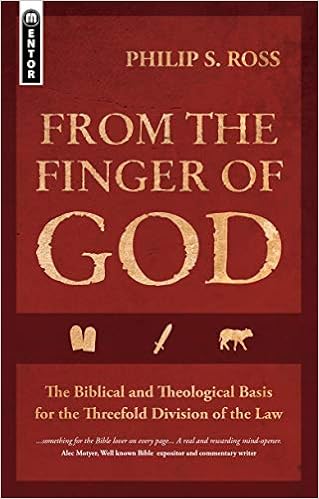
As a general reminder, these notes that I took are based on Philip S. Ross' March 2010 address to a Presbytery. Later on that same year, Christian Focus Publications published a book length treatment of Ross' research into the Threefold Division of the Law. This is part five of a seven part series.

Here's how I have broken down Ross' address into seven parts:
  1. Introduction
  2. Five Old Testament presuppositions that shape the New Testament's understanding of law
  3. Jesus and the Gospels
  4. The Apostolic Interpretation of the law in the Book of Acts
  5. The Epistles of the Apostles
  6. Conclusion
  7. Sabbath Extracts
----------------

Some passages that are relevant to the three categories of the threefold division. (pg. 266)

The study of Paul the law is an area of interminable debate, but much of those debates aren't directly relevant to this precise issue. (pg. 265)

The New Perspectives on Paul challenges the centrality of moral law in confessional soteriology more than it challenges the details of the threefold division. (pg. 266)

Beginning with ceremonial law, which the confession speaks of as 'typical ordinances' and 'moral duties', there are solid grounds to say that Hebrews 9 makes a purposeful and unavoidable demarcation of cultic laws. (pgs. 266 - 267)

This is not a demarcation, as certain scholars claim, that Hebrews imposes on the law but one that's derived from the law. (pgs. 266 - 267)

From the ceremonial law's first deliverance to Moses, they were intended to be shadows that proclaimed the existence of heavenly things and good things to come; the reality of Christ. (pgs. 267 - 275)

The same vocabulary emerges in Colossians 2:16 - 17, where Ross rejects the view arising from the hypothetical Colossian heresy that this passage refers to extra-Mosaic practices. The use of cult prostitutes, for example, can hardly be a shadow of things to come. (pgs. 273 - 275)

Rather the food and drink in view envisages all the dietary laws of the Old Testament (OT) and the OT usage itself suggests that 'Sabbaths' in that context serves as shorthand for the activities of those days and not the day itself. (pgs. 276 - 278)

The verses in Colossians 2:14 - 15 and Ephesians 2:14 - 18 speak of a wall of separation and of the breaking down of ordinances. (pgs. 279 - 280)

Commentators will argue that these two passages either refer to expansions of the law or to the law as a whole. (pgs. 280 - 284)

However, the law as a whole did not divide and why would God need to abolish man made laws at all?

Ephesians 2 and Colossians 2 may emphasize different things, but both deal with the laws of separation, which have gone with the rent veil. (pg. 284)

The veil was rent because of what Peter tells us about in 1 Peter 1:19 'the sacrifice of the lamb without blemish'. (pgs. 290 - 292)

Many theologians, following German theologians, dismiss the idea of vicarious suffering, rejecting any link between Peter and Leviticus, or arguing that in the Leviticus passage there is no idea of the transference of guilt to the goat. (pgs. 287 - 288)

Place taking is, however, central to Leviticus and to Isaiah 53, the lens through which Peter reads Leviticus, and if Jesus is a lamb without blemish his fulfillment of ceremonial law must depend on moral fulfillment. (pgs. 288 - 291)

For Peter, as for Matthew, Christ's fulfillment is moral, soteriological, and eschatological. (pg. 286)

As said earlier, the confessional approach to ceremonial law was not so crude that they failed to recognize that it also spoke of moral duties. (pg. 292)

These, 'moral duties', are the implied moral demands of ceremonial law that we see, for example, in 1 Corinthians 5 which calls on Christians to be what they are: the unleavened bread symbolizing discontinuity and a break with the past. (pgs. 292 - 293)

In such cases, Paul preserves inviolate the core significance of the ritual law while maintaining it is not binding. (pg. 295)

What the threefold division calls judicial, or civil, laws exist almost by default in the Epistles. (pg. 296)

But do they (the Epistles) support the idea that God always intended those laws (judicial) to have temporal standing? (pgs. 296 -298)

The mere fact that the Apostles called for Christians to submit themselves to secular authorities suggests as much, although that does not mean they (judicial laws) are irrelevant. (pgs. 298 - 299)

Hebrews shows us that although the penalties may have expired, they still speak. (pg. 299)

Paul's reference to oxen, 1 Corinthians 9:8 - 10, shows that the general equity of the law still applies. (pg. 300)

For God does not care about oxen, which is why Paul's point depends ultimately on the Decalogue substructure that undergirds the quotation Deuteronomy. (pgs. 304 - 306)

In that context, in Deuteronomy, the themes of integrity and contentment unite the ninth and the tenth commandments. (pg. 303) [As an aside from Ross, for a moment,  this would be numbered the eighth, ninth, and tenth commandments in both the Lutheran and Roman Catholic churches. Both Lutherans and Roman Catholics along with others Christians throughout the centuries have separated the tenth commandment into two commandments numbered nine and ten. The Reformed tradition along with other Christians throughout the centuries have maintained a slightly different numbering of the Ten Commandment which means that Ross is talking about the commandment to not lie and to not covet.]

We would also think of the two witness rule quoted in 2 Corinthians 13 and 1 Timothy 5. (pgs. 304 - 306)

It is a straightforward application of Mosaic equity, but it does not demand literal application of the law since it (the two witness rule) too depends on the substructure of Deuteronomy. (pgs. 305 - 306)

Deuteronomy at the point of being quoted is concerned with the preservation of life. (pg. 305)

Such examples indicate that the Westminster Confession's 35 words on judicial law do not comprise an imposition upon Scripture, but reflection of biblical teaching. (pg. 308)

For many Christians the threefold division's most controversial claim is that the moral law, the Decalogue, is an ever binding perfect rule of righteousness and an obligation, which for Christians, is strengthened by Christ in the Gospels. (pg. 308)

When you think of Epistolary passages that support this (the Decalogue as an ever binding rule of righteousness) you might mention 1 Timothy 1:8 - 11; Romans 13:8 - 10; or James 2:8 - 11, and you would be right to do so. (pg. 341)

Despite the reluctance of someone like Douglas Moo to see royal law as a specific reference to the Mosaic law. (pg. 336)

Perhaps all that such reluctance shows is that by the time we come to the Epistles, whatever our position, the interpretive frameworks that we have developed play a decisive part in our exegetical conclusions.

In the Apostolic illusions to the Shema in 1 Corinthians 8 or James 2:19; in the call to love our neighbor in Romans 13 or Galatians 5 we hear an echo of Christ's voice, we hear Apostolic agreement with the principal that the two greatest commandments are a précis (meaning: 'a type of summary of abridgment) of the Decalogue. (pgs. 334 - 341)

For some interpreters, any notion of Apostolic agreement with the law is unthinkable - Paul was schizophrenic at best, about as constant in his affections for Moses as was Saul for David. (pgs. 308 - 318)

According to Heikki Räisänen, Paul's view of the law is 'full of difficulties and inconsistencies'. (pg. 309)

Ironically, Räisänen is so convinced that the Mosaic law consists of different elements that he thinks the threefold division handles the material better than Paul (pgs. 309 - 310)

A Dutch Reformed minster, T.E. Van Spanje, has produced a lengthy answer to Räisänen's charge of theological schizophrenia, but we should not be afraid to see tension in Paul's attitude to the law. (pg. 310)

If his (Paul's) view of divine revelation is rooted in the Old Testament we should expect tension, but that's not the same as inconsistency.

The idea that divine revelation may bring blessing or curse, brokenness or hardness, life or death, weaves its way from the Pentateuch through the Psalms and Prophets into the Gospels where the same word that cuts off every dead branch and prunes every live branch and weaves its way into the Epistles. (pgs. 311 - 313)

In 2 Corinthians 3, the law brings a deadly holocaust to the Jewish people that cannot be ended unless the life giving Spirit intervenes (pg. 313)

It is no negative commentary on the law, but recognition of the law's impotence to bring life and lasting glory.

The tension continues in the new order, the law will still kill you if you read it with a veil and new covenant ministry that may be the fragrance of life to some is the odor of death to others - it produces its own holocaust. (pg. 314)

Paul is not the only one to be charged with hostility to the law. (pg. 314)

In the eyes of Michael Morrison, the author of Hebrews has no place for the law at all since law in Hebrews quotation of Jeremiah 31:33 found in Hebrews 8:10 and 10:16 should be understood in the widest possible sense as instruction. (pgs. 314 - 315)

Jeremiah, however, will not let Morrison off with the charge (of the law having no place in the book of Hebrews) so easily. (pg. 315)

When the prophet speaks of 'My law' the context is suggestive of Sinai and Jeremiah 31:33 is, Ross believes, addressing the same commandments as at Sinai. (pgs. 315 - 316)

These 'ten words' are the only laws that God inscribes. (pg. 316)

Hebrews is not talking about a redrafted morality. That is not what makes the New Covenant 'New'. (pg. 316)

It is not 'new' because the New Covenant believers' obedience is qualitatively superior to Abrams'; it is all about Jesus Christ. (pg. 317)

This covenant is better because it is enacted upon better promises, not necessarily those promises) contained within it (new covenant), but those promises made to Christ, 'You are a priest forever', God will not change His mind, Christ's priesthood will not fail. (pg. 317)

All the circumcised hearts in the cloud of witnesses, every law inscribed heart in which the Father makes His home is only so because of our Mediator. (pg. 318)

Far from rendering obsolete the laws inscribed in stone His all eclipsing priesthood makes them a lively script that will never pass away. (pg. 318)

Part of the argument in the WCF for ever-binding moral law is that this law is ineffably inscribed on human hearts. (pg. 318)

Romans 2:15, which speaks of Gentiles who have the work of the law written on their hearts, is a key passage. (pg. 318)

But what Gentile hearts?

'Not any Gentile hears,' says N.T. Wright, Jewett, and Gathercole, 'Paul is talking about Gentile Christians'. (pg. 318)

Gathercole's defense of this view is the most comprehensive, but Ross believes is seems inconceivable that there could have been Gentile Christians who were, as Gathercole says, 'actually not hearers of Torah at all'. (pgs. 319 - 320)

Just how did these Christians manage to avoid the Psalms, the Prophets, the Sermon on the Mount, and debates about the law? (pg. 320)

Why should the idea that all people, in some sense, do what the law requires have been foreign to Paul?

Surely, in view of the Pentateuch's assumptions about the law, that the laws of Sinai were self-understood from the beginning, it would have been natural for him (Paul) to think like that.

In fact, the suggestion from Akio Ito that Paul may have been alluding to Deuteronomy 30:14 may support that point, especially if Matthew Henry was right to see in the text of Deuteronomy a reference to 'the law of nature, which would have been found in every man's heart, and every man's mouth, if he would but have attended to it.' (pg. 322)

So Paul, then is reflecting Scripture-wide presuppositions about the Decalogue. (pg. 323)

Paul is, as John Murray says, answering 'the question arising from verse 12, namely: If the Gentiles are without the law, how can they be regarded as having sinned?' (pg. 323)

How else can we make sense of verses 15 - 16 of Romans 2? (pgs. 323 - 324)

It is not Gentile Christians who will be in turmoil on that day, but unbelievers, who having suppressed the truth find exposed upon their hearts an inscription of the law that reason could not erase and darkness could not hide. (pg. 324)

On this understanding of Romans, the opening section of chapter 19 of the WCF provides a coherent expression of Apostolic teaching. (pg. 324)

When that day comes when God judges the secrets of men's hearts by what standard will He judge? On what basis will men be convicted of their sin? What is sin?

Strangely enough, you might get a more conservative definition of 'sin' from a lexicographer than a theologian.

While the Oxford English Dictionary happily defines 'sin' as 'transgression of the divine law' some NT scholars prefer the generality of 'evil' or 'iniquity'. (pg. 325)

Even when the passage involved is 1 John 3:4. which defines 'sin' as transgression of the law, or lawlessness, Stephen Smalley wants to argue that the connection between sin and lawbreaking in the OT is not strong. (pgs. 325, 327)

None of the attempts to separate lawlessness from law are convincing. Especially when the alternative definition of sin that these writers generally propose, such as, 'opposing God' describe things that are transgressions of the law anyway. (pgs. 328 - 329)

Not only does John define sin as lawbreaking; James 2:8 - 12 indirectly defines sin as transgression of law from the Decalogue, or the summarizing great commandments. (pg. 329)

Sin is not a roughly defined problem.

Righteousness is not a fluctuating ideal.

The great Day of judgement will be according to the self-understood norms of the Decalogue, and that is an implicit assumption in Romans 2 and elsewhere.

When Romans 1 meets a litany of iniquities with unvarying response of judgement none of those death-deserving deeds go beyond established or plausible applications of the Decalogue. (pg. 332)

The only lawgiver and judge employs no double standard.

----------------

So, there you have it. The threefold division is biblical and comes to full expression in the Epistles. However, it is important to note all the threads that begun in Genesis up through Acts in the previous four parts that lead to the full revelation of how we need to understand God's law. The next post, on this topic, will be a much shorter conclusion of the entire address. This part covered chapter seven in Ross' book, which is 85 pages.

Sunday, March 2, 2014

Theonomy vs. the Westminster Confession of Faith

For the past seven weeks I have been reading David McKay's book The Bond of Love, which I would recommend for anybody who's thinking of going to seminary or just wants to know how the Bible fits together. Today I reached Chapter 8 which is about The Way of Holiness. The last section pages 190 - 193 is about the law and society and talks about Theonomy and questions if its teachings are scriptural and confessional.

Professor McKay says "No!" to Theonomy and helpfully shows how a Theonomic interpretation of the Westminster Confession of Faith 19.4 makes that section have no actual meaning in a chapter end note numbered 60 on page 196. Professor McKay writes,
Theonomists who appeal to the Confession tend to interpret 'general equity' in such a way (i.e. embracing the detail of the laws) that they in effect reverse the Confession's statements about the laws having 'expired' and their 'not obligating any'.
The Confession says at 19.4,
To them also, as a body politic, He gave sundry judicial laws, which expired together with the State of that people; not obliging any other now, further than the general equity thereof may require.
So what is Professor McKay actually suggesting in his end note? Well here's how we should read the section if Theonomists had their way (according to McKay):
To them also, as a body politic, He gave sundry judicial laws, which though they expired together with the State of that people; the general equity thereof requires obligation of all.
The changed words are in italics, and the meaning of this altered WCF is clearly different than what the Confession actually says. Though what's not so clear is why section four would have existed if the writers were Theonomic? I'll get into the question of if Theonomy is biblical in a later series of posts, but my point for this post is to ask if it's what the RPCNA, or any other church confessing the Westminster Standards actually clearly teaches or can allow? My argument, and the argument of Professor McKay, is an emphatic, "NO!"

Furthermore, over at The Confessional Outhouse, they have a helpful post (Doing Justice to Equity), which suggests the following change to WCF 19.4 as faithful to the original intent of the Standards,
To them also, as a body politic, He gave sundry judicial laws, which expired together with the State of that people; not obliging any other now, further than the Natural Law thereof may require.
Now I realize the phrase "Natural Law" is can be a bit tricky to figure out. I also don't want to leave the impression that I agree with everything that's promoted at The Confessional Outhouse, but if we could agree that by the phrase "natural law" we mean only the Ten Commandments, also called the moral law (WCF 19.3, WLC Q. 93), and don't confuse the Ten Commandments with the Covenant of Works either, which was added to the moral law (WCF 4.2), we have pretty clear modern statement.

Sinclair Ferguson in his chapter, "An Assembly of Theonomists? The Teaching of the Westminster Divines on the Law of God" published in Theonomy: A Reformed Critique, on page 330 offers a slightly different rewording of 19.4 than McKay which is also helpful:
The Mosaic law has actually expired minimally: it remains obligatory and must be applied maximally.

I'm looking forward to having a book review series on Theonomy: A Reformed Critique soon, but it is interesting to note the publication date is 1990. Therefore, for at least over 20 years Ferguson has argued that it would be more honest to modify the Confession and hold to Theonomy than to have a secret meaning to 19.4 and then have to explain what the Confession "actually" must mean.
 
I am suggesting is that the term "general equity" had a long social context which, at least in America, is not easily understood currently. I actually plan to address the term "general equity" in a later post, but for now my best suggestion on understanding section four is,
To them also, as a body politic, He gave sundry judicial laws, which expired together with the State of that people; not obliging any other now, further than the moral law thereof may require.
This suggestion actually keeps all the terms within the confession because section three defines the moral law. Thanks must go to my dad, Chris Stockwell, for reminding me about how Professor McKay's chapter end note exactly changes the wording of WCF 19.4.

Monday, February 24, 2014

Important dates in The Westminster Assembly and Judicial Law articles by Coldwell and Winzer

Over the past five years I have been subscribing to The Confessional Presbyterian journal (CPJ) and finding out how much more I desire to find out about my Presbyterian heritage. Every journal is filled with articles, original translations of usually writings that have never been available in English, a Psalm to set to an original meter, and then book reviews. It's really been a great reading experience, and it has also helped me learn more about being a Reformed Presbyterian (RP) because a fair amount of the articles have come from members on pastors of various RP churches, and most of their editors are RPs.

Over the past number of years I have become more convinced that a teaching called Theonomy is a harmful and dangerous teaching because it misunderstands God's Law at every possible point - I'll demonstrate proof for this claim in a later post. In 1998, however, the General Assembly of the Free Church in Scotland produced a report titled, Theonomy and the Confession of Faith, which declared,
... that the teachings commonly known as Theonomy or Reconstructionism contradict the Confession of Faith and are inconsistent with Biblical doctrine. It is also essential that the Assembly communicate that declaration to the Church and the grounds on which that judgement has been made. To this end the Committee is recommending that this section of the Report together with the relevant part of the Deliverance be circulated to all Presbyteries and Kirk Sessions.
My church's first pastor was a Theonomist, and more pertinently when he left some of the members that still remain alive and in my church still believe that Theonomy is biblical and the solution to societies social ills. As far as I currently know, the RPCNA hasn't issued a statement for or against Theonomy as a Synod. It has, for the most part only lost its influence. Two of the most important works for Theonomy was R.J. Rushdoony's The Institutes of Biblical Law which was published in 1973 and then Greg L. Bahnsen's Theonomy in Christian Ethics in 1977. More importantly, and parts of this narrative is speculative, from an RP perspective some of the Theonomic voices sounded very similar to the Mediatorial Kingship of Christ over the nations doctrine which is a distinctive that the Reformed Presbyterian Church worldwide has held to since the mid-to-late 17th century, in various ways. However, there are very important distinctions that either were not deemed important or were ignored at the time for the sake of the "culture wars", which I'll get into at another time.

All of the above was setting the context for what I'm about to explain. One of the claims of Theonomy is that their position has historical precedence before Rushdoony and Bahnsen. Additionally, since Dr. Bahnsen was also minster in the Orthodox Presbyterian Church he needed to explain how Theonomy did not conflict with Westminster Confession of Faith (WCF) 19.2-4, which presents the Threefold Division of the Law as follows:
II. This law, after his fall, continued to be a perfect rule of righteousness; and, as such, was delivered by God upon Mount Sinai, in ten commandments, and written in two tables: the first four commandments containing our duty towards God; and the other six, our duty to man.
III. Besides this law, commonly called moral, God was pleased to give to the people of Israel, as a church under age, ceremonial laws, containing several typical ordinances, partly of worship, prefiguring Christ, His graces, actions, sufferings, and benefits; and partly, holding forth divers instructions of moral duties. All which ceremonial laws are now abrogated, under the New Testament.
IV. To them also, as a body politic, He gave sundry judicial laws, which expired together with the State of that people; not obliging under any now, further than the general equity thereof may require.
I shortly hope to provide a defense of the Threefold Division of the Law in a future post, but for the purposes of this post we should assume that the Threefold Division comes from the Bible instead of being read into the Bible.  Anyway, the CPJ in its fifth volume (its an annual journal, by the way) published two articles totaling nearly 90 pages about The Westminster Assembly and Judicial Law by Chris Coldwell and Matthew Winzer. Chris Coldwell compiled in the first article which is all data available from the start of the Assembly through the completion of chapters 19, 20, and 23 of the WCF with a focus on any material that can still be currently found about the subject of judicial law from a member of the Assembly connected with work on the ninth proposition of Article 7 of the Thirty-Nine Articles and chapters 19, 20, and 23 of the WCF.  Just this article alone is 52 pages! Matthew Winzer then provides a detailed analysis article about the first article. Lane Keister in the sixth volume called these two articles "The best treatment of this phrase ['general equity']" on page 205 footnote 4 in his review of Joseph C. Morecraft, III's Authentic Christianity: An Exposition of the Theology and Ethics of the Westminster Larger Catechism.

While Mr. Coldwell and Rev. Winzer are to be commended for their hard work in putting all this data together and then presenting analysis, the thought of reading 90 pages for most people interested in this discussion might be a bit too big to actually read. Therefore, when I went though the two articles for the second time last year I created a "cheat sheet", or a document which helps provide some focus on all the great material found in those two articles to whet the appetite for reading the rest of the articles.  Which is presented below:

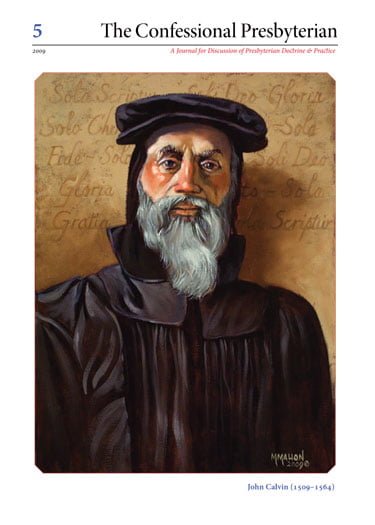
Important dates in The Westminster Assembly & the Judicial Law Chronology article by Chris Coldwell as appears in The Confessional Presbyterian 5 (2009)

All the dates are important in Coldwell’s chronology, but since there are so many listed dates and events it is important to narrow down the list for brevity:
May 1, 1645 (pgs. 27 - 29) - A selection of Daniel Cawdrey and Herbert Palmer's book Sabbatum Redivivum: or, the Christian Sabbath vindicated is provides a lot of detail about the Threefold Division 
November 24, 1645 (pgs. 33, 34) – A work against the Brownists by Robert Baillie is reproduced. See Rev. Matthew Winzer’s Analysis article pages 70, 72, 88, and author’s conclusion on 322 for more information on the importance of Baillie’s work against the Brownists

March 26, 1646 (pg. 37) – Coldwell quotes from session 610 Christian Liberty Report about how WCF 20.1 was worded to include Christian’s being free from both the Ceremonial and Judicial Law

October 12, 1646 (pgs. 41 – 44) – Selections of a very helpful sermon preached before some members of the Assembly by Anthony Burgess is printed giving an exegetical explanation of the threefold division of the law of Moses

December 2, 1646 (pgs. 45 – 47) – Selections are printed in the article from Jus Divinum about the difference between two types of commands given by God: Immediate or Mediate; Moral commands and positive commands is another distinction. In addition, a summary statement by William Gouge preaching on Hebrews 7:12 about judicial law is reproduced

December 4, 1646 (pg. 47) – The Minutes of the Assembly record Mr. Gillespie’s request for the alteration of the wording of WCF 23.1 from “Christ” to “God”. See Winzer’s Analysis on pages 74 – 77 (the section titled, “The spheres of nature and grace”) for Winzer’s implications of this change

December 7, 1646 (pgs. 48, 49) – Coldwell reports on the finalized wording of WCF 20 and gives some comments about 20.1 omitting “Judicial Law” from what it was in the minutes on March 26. Coldwell also, in the printed copy, wrongly refers the reader back to March 27 instead of March 26 for original wording. As of writing this – January 09, 2013 – the CPJ has not published an errata about this mistake. Is the March 26 date correct and Coldwell’s reference on December 7 wrong? Is the later reference correct and the chronology as printed wrong? Is Coldwell referring to something else listed under March 27? Mr. Coldwell responded the same day and said that he will look into the error

April 29, 1647 (pgs, 50, 51) – WCF 19.4 is reproduced with Scripture proofs and the margins reads “… Gen. 49.10. with 1 Pet. 2. 13, 14. …”

March 8, 1647/48 (pgs. 53 – 55) – Coldwell prints some excepts from a work by Francis Cheynell which is arguing for Magistrates punishing heretics on the basis of equity between the Moral Law in both Testaments
Now I realize that this assumes you have access to the two articles in question, but the point of this exercise is to encourage you to read the articles. The evidence strongly proves that Theonomy was not an orthodox position held by the writers of the Confession, and that the closest 17th century equivalent to the 20th century Theonomic movement was soundly rejected by the Assembly.