Showing posts with label EPCEW. Show all posts

Monday, May 19, 2014

The Threefold Division of the Law: Part 3 - Jesus and the Gospels

In part 2, we sketched out five presuppositions that run throughout the entire Old Testament (OT) that point the law given through Moses as not being an uniform united body of law. Ross concluded the second section by contending that if we don't see these distinctions that we will not, and cannot, make proper sense of the teachings of Christ in the four Gospels, in the Apostolic events in the Book of Acts and the Epistles written by the Apostles when they write about the law.

In this part we will focus on the words of Jesus as found in the four Gospel writings and try to understand how what Jesus says about the law and does during His first coming further develops the five observations made about the OT law.

These notes are based on an address that Phil Ross delivered to the Evangelical Presbyterian Church in England and Wales in March 2010.

Here's where we are in this series of posts relative to where we have been and where we are going:
  1. Introduction
  2. Five Old Testament presuppositions that shape the New Testament's understanding of law
  3. Jesus and the Gospels
  4. The Apostolic Interpretation of the law in the Book of Acts
  5. The Epistles of the Apostles
  6. Conclusion
  7. Sabbath Extracts
----------------

Ross wants to look at the teaching of Christ and the Apostles concerning the law in two parts divided chronologically by the veil of the temple that was torn in two (pg. 187):
  1. What may we conclude from the Gospels? - From the words and deeds of Jesus up to the point where the veil was torn.
  2. What, if anything, changes after the rending of the veil? - What do the Apostles and their Epistles have to say to all this?
We will in this post address the first question and then over the course of following two posts Ross will address his second question.

Jesus' subjecting himself to the law was basic to his humiliation.

One passage matters above all others when it comes to discussing Jesus' attitude to the law, namely Matthew 5.

Some say we should take the word commonly translated 'abolish' in a absolute sense. (pgs. 195 - 197)

Others use the word commonly translated 'fulfill' to determine that 'abolish' means anything but abolish. (pgs. 197 - 199)

When translators/interpreters focus on the lexical definition of 'fulfill' it generally leads them to seeing Jesus' fulfillment of the law and the prophets in the following three ways (pgs. 201 - 202):
  1. Eschatological - He fulfills the law by his teaching.
  2. Soteriological - He fulfills the law by bringing salvation.
  3. Moral - He fulfills the law by doing what the law commands.
Ross doesn't want to suggest totally disregarding the lexica, but contends that we will understand Jesus' words when we read them with the church, in the context of Matthew as a whole, and with the OT background in view. (pg. 199)

Pope Leo the Great and John Calvin may not have had much in common, but they both thought it was proper to connect the sermon on the mount with Jeremiah's new covenant prophecy. (pg. 199)

Their case is strengthened if we also accept that Jesus fulfilling the law and the prophets in Matthew 5:17 is a piece of his fulfillment of all righteousness in Matthew 3:50. (pgs. 199 - 200)

We might hear echos of this relationship when we line up the voice that says 'This is my beloved Son' with the same voice in Jeremiah 31:20 saying 'Ephraim my beloved Son'. May we not then see Jesus standing with his people, and in their place, 'here's the beloved Son that Israel failed to be. (pg. 200)

Read Matthew 5 in that context and we may then see Jesus' fulfillment of the law as eschatological, soteriological, and moral. (pg. 202)

To illustrate the relationship between the elements in Matthew 5 and Jeremiah 31, Ross wants to call attention to the following four components in Jeremiah's prophecy. (pg. 203)
  1. 'I will put my law within them' - According to Deuteronomy 6:4 - 9 the law was always meant to be internalized. Jesus promotes this intention as he calls for obedience to the great commandment, he promotes it in his exposition of the law throughout Matthew 5, and He fulfills it by exemplifying in his own life what it means to obey the law and be the obedient Son par excellence (meaning 'the best of its kind'). (pgs. 203 - 204)
  2. The promise, 'I will be their God, and they shall be my people.' That theme permeates Matthew from beginning to end. Matthew 1:23, '... God with us.' We know that the Shekinah who dwelt in the bush and in the tabernacle now dwells in the flesh and fleshy blood. Immanuel's closing promise is, 'I am with you always.' Christ's being with his people in fulfillment of the law and the prophets is the dominant idea, but moral fulfillment can't be excluded from that. His instruction, 'teach them all that I've commanded you' presupposes ongoing obedience as an indispensable concomitant to God with us. (pgs. 204 - 206)
  3. 'They shall all know me', is sometimes linked with Matthew 23:8 - 10 where Jesus says, 'You have one teacher'. We can hear in that passage a precise echo of the shama. Only one teacher fulfills Jeremiah's prophecy; he is the one who is one who will teach the New Covenant community. There is also a connection between Jeremiah 31:25 - 26 and Jesus' invitation to the laboring and heavy laden to come for rest (Matthew 11:28). He delivers the rest promised in the law and the prophets to those whom the Father reveals Jesus and to whom Jesus reveals the Father. (pgs. 206 - 211)
  4. 'For I will forgive their iniquity', is the absolutely indispensable (Ross uses the term, 'sine qua non') promise of the first few promises in Jeremiah 31. Note the preceding three. There's not much question that Matthew 26:27 - 28 recalls this. 'Drink of it, all of you.' The 'all' recalling the 'all' of Jeremiah 31:34 as Matthew once again draws several OT threads together to show that forgiveness of sin and God's presence are conjoined in Jesus. If Jeremiah is in the background, then sin is transgression of the Decalogue because that's generally how Jeremiah defines 'transgression'. (pgs. 211 - 214)
If the sermon on the mount introduced new law then spoke of forgiveness in relation to the old law, how could Matthew's notion of atonement be coherent? Sin would be a moving target. (pg. 215)

The point is to say that for Matthew, Jesus' fulfillment of the law and prophets is eschatological, soteriological, and moral. He is a mighty savior, whose assumptions about the law he shares with the prophets, whose full assumptions land on the Pentateuch. (pgs. 214 - 215)

So Jesus leaves untouched the embryonic framework that saw some laws as a 'pattern'; some to be obeyed 'in the land'; but the Decalogue as the controlling influence. (pg. 215)

When Jesus says, 'not a jot or a tittle shall pass away', his statement is in harmony with the framework because it only makes sense if we recognize that the law had built in limitations. (pgs. 215 - 220)

Even before the entry into Cana, they had the mana laws, which were of temporal jurisdiction/duration. Yet these laws remained but did not bind in the same way they abide as memorial and foretoken. (pgs. 218 - 219)

Everything that Jesus says about the law is in continuity with the intent of the law, and Ross rejects outright the universal description of what follows in Matthew 5:21 - 48 as the antithesis. (pgs. 220 - 236)

Despite all the arguments that Jesus is overturning the law in these verses, its demonstrable that everything Jesus says reflects a correct and proper understanding of the laws; his views of hatred, lust, divorce, oaths, the lex talionis - law of retaliation -, and love for enemies do not reflect abrogation of the law, but co-ordination with the law. (pgs. 236 - 237)

What was Jesus' attitude to things that were not of the weightier matters of the law? (pgs. 173 - 174)

One person wants to say that because Jesus touched a leper He made himself unclean and therefore held the purity laws in contempt, while another wants to defend him against accusations of uncleanness at all costs. (pgs. 174 - 177)

So was Jesus ever unclean? Well, of course he was. What Jew who ever sucked at his mother's breast was not unclean? But, so what? (pg. 178)

The law makes no straightforward equation between guilt and ceremonial uncleanness. (pg. 178)

So matters of:
  1. The woman bleeding who touched Jesus (Mark 5:27) is simply not a issue. (pgs. 174 - 177)
  2. Mark doesn't introduce us to an antinomian Jesus when he records Jesus' comments in Mark 7, 'nothing that goes into a man can defile a man'. Perhaps Jesus is reflecting creational norms: Nothing is intrinsically unclean. The Levitical law concurs - eating unclean foods could not itself defile. Jesus' statement is in continuity with the law. Looking back, Mark makes the kind of statement he should have made about the Sabbath if the anti-Sabbatarians are correct that the Sabbath ought to not be part of a Christian's life. (pgs. 179 - 187)
When we see Jesus at the end of his earthly life it's instructive to think about these events in the light of Leviticus 20:24 - 26. There the Lord separates Israel to himself, separates certain foods to uncleanness as a sign of Israel's separation to a God whose separation was marked by the temple veil. (pgs. 184 - 187)

Then when the veil is torn in two, it signifies not the departure of the Shekinah, as some argue. It signifies that the separation has ended. (pgs. 189 - 190)

Viewing this event through the lens of Isaiah 64, God has rent the heavens and come down, and the rent veil proclaims that from this point onwards no symbolic uncleanness can separate them from Emmanuel. (pg. 190)

In the Gospels we meet a Savior who lived in conformity with the law. He taught us to obey it in its own terms. Fulfilled its shadows. Evangelists confirm, rather than overturn, the presuppositions outlined from the Pentateuch. They do not abort the embryonic form of the threefold division that appears in the OT. (pgs. 190 - 191)

----------------

A lot more material this week than in the last post. Ross is summarizing chapters four and five in his book, which is 93 pages. In our next post in this series we will consider how the Apostles interpreted the law, as recorded in the book of Acts. We will start to develop a better idea about what actually changed in the church after the rending of the temple veil.

Sunday, May 4, 2014

The Threefold Division of the Law: Part 1 - Introduction

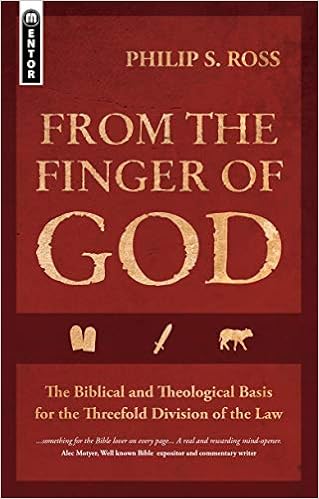
In November of 2010, Christian Focus Publications released a book by Philip S. Ross titled From the Finger of God: The Biblical and Theological Basis for the Threefold Division of the Law. It is 426 pages long and is a treasure to read if you have ever tried to defend the Westminster Confession of Faith's 19th chapter (WCF) which explains God's Law as containing a tri-partite division of the law. Ross' book goes through the entire Bible (Biblical Theology) to show that the way our Father's in the Faith understood the Law of God was a careful reflection of Scripture, instead of a imposition on Scripture (Systematic Theology).

Before the book was released, however, in March of 2010 Mr. Ross gave an address to Evangelical Presbyterian Church in England and Wales (EPCEW) on the same topic which is about an hour long. I discovered the book because I was reading through the Marrow of Modern Divinity and actually dealing with this exact issue in my church with a Theonomist who was leading a Sunday School class where he made it very clear that WCF 19.4 was wrong to teach:
To them also, as a body politic, He gave sundry judicial laws, which expired together with the State of that people; not obliging under any now, further than the general equity thereof may require.
At the time I hadn't discovered Professor McKay's book or his brilliant footnote on this topic. Therefore, I 'dug in my heals' and ordered the book and proceeded to read it, along with my pastor. What we found was great, well-researched material, that provided more than what we needed along with a whole lot of other material that addressed other contemporary issues about the Law of God, but in a different way than either of us had expected. Which, in hindsight, is a good experience even through at first it was a bit disappointing for my part.

As I was working through the book I also was trying to dig up other materials (press interviews, reviews, etc.) to see what other people were thinking about the book and to maybe find a more compact way to present 426 pages of research in a shorter time span, and that's how I found the lecture.

I haven't directly spoken with this dear Brother in Christ about Ross' book, but I'm slowly working up to addressing the matter in another forum. The great part about the address is that Ross covers his entire book in an abbreviated form with a slightly different structure. I have spent the last few months returning to the lecture for the purpose of jotting down notes and doing dictation of the lecture, so that I could make the fruits of Ross' study more accessible.

I have chosen to break up those notes into six main parts with one additional part on Ross' thoughts on the Sabbath. I think Ross' arguments for the Sabbath are good and I understand why he spends time in both the book and the lecture to address the issue; nevertheless, the key point being discussed in the first six posts the primary concerned to present Ross' arguments for the Threefold Division of the Law. I will in the final post explain my reasons for separating these closely related issues. This post will be updated as I post additional parts. The parts are:
  1. Introduction
  2. Five Old Testament presuppositions that shape the New Testament's understanding of law
  3. Jesus and the Gospels
  4. The Apostolic Interpretation of the law in the Book of Acts
  5. The Epistles of the Apostles
  6. Conclusion
  7. Sabbath Extracts
The posts will follow the general format of a statement that Ross makes in his lecture/my thoughts about how to express that statement and the relevant page numbers in Ross' book where Ross either makes a similar statements. As I found out, the address can provide some insight in the differences between writing a book and presenting a speech. Without further ado, here's Ross' introduction.

----------------

The threefold division is the division of biblical law into (pg.2):
  1. Moral - The Ten Commandments
  2. Civil (or Judicial) - Those laws that were given for civil government
  3. Ceremonial - The laws that governed sacrifice
Do people consider the confession a garment or a straightjacket?

Nearly half of the Shorter Catechism's 107 questions deal with the demands and consequences of ever binding moral law. (pg. 6)

From the beginning law was was written on the heart of man. (pg. 6)

Sin is any want of conformity unto or transgression of any law of God given as a rule to the reasonable creature. (pg. 6)

The Westminster doctrine of the threefold division of the law is a reiteration of catholic doctrine. It's not uniquely Eastern or Western; Catholic or Protestant; conservative or liberal; Patristic or Puritan; Thomist or Calvinist, or anything else. It has been expounded, maintained, and defended by some of the most prominent theologians in the history of the church. (pg. 1)

Having subjected the threefold division of the law to biblical scrutiny like any other doctrine, it is remarkable how simplistic the dismissals of the threefold division are. (pgs. 5, 7)

Two examples are Tom Wells and Jason Meyer.

Tom Wells in his book (co-authored with Fred Zaspel) New Covenant Theology on page 72 writes that biblical evidence to support the Puritan approach to the Decalogue 'was always wanting'. He goes on to write the following on page 74 (pg. 8):
As evidence for the wider sweeping conclusion that everything moral is comprehended is one of these ten commands, both the Larger and Smaller [sic] Catechism offer just three verses, Matthew 19:17, 18, 19. This is, surely, much too narrow a base from which to draw such a comprehensive conclusion. Further than that, assuming that Matthew 19 contains the best evidence for this opinion, we must note that it was not available to OT [Old Testament] believers at all.
Ross contends that Wells' seems to imagine that the divines took a very simple approach to proof texting. (pg. 8)

The Westminster Divines were, however, more sophisticated than grasping for texts that might prove their point. This is why the first edition of the Confession contained no proof texts. The reluctant Assembly was not concerned about 'being unable to support the proposition of the Confession by Scripture' but because they realized 'that a complete presentation of Scripture proof would have required a volume'. In this case, it is Wells' approach that is most obviously wanting. (pg. 8)

Jason Meyer in his book The End of the Law on page 282 writes (pgs. 8 - 9):
The NT [New Testament] itself does not make these three distinctions, and no one living under the law of Moses seriously thought they could pick which parts were binding and which were optional. God's law comes as a set with no substitutions. Therefore, exegetes should not read the three distinctions into NT texts that speak of the law as a singular entity. Furthermore, one will find it challenging to divide all laws into three neat, watertight compartments.
Meyer's takes the orthodox view for two thousand years and writes it off in seventy-five words. However, Meyer's comments should make one question if he has ever read the confessional explanations of the threefold division. (pg. 9)

The Confession's teaching in 19.3 shows the the oft-repeated claim that the threefold division divides 'all laws into three watertight compartments' is false. The section says, of the ceremonial laws, that they contain 'several typical ordinances, partly of worship, prefiguring Christ ... and partly of divers instructions of moral duties'. (pg. 9)

Many who reject the threefold division do so because they do not believe it to be biblical. But what does it mean to be 'biblical'? (pg. 37)

For some, the meaning 'to be biblical' might be rooted in certain presuppositions of biblical theology (BT) as an academic discipline.

Whatever they - professor, pastor, etc. - claim BT is and wherever they make those claims, BT is almost universally occupied with the task of being a descriptive discipline. (pg. 46)

Telling us what biblical passages supposedly meant within a predetermined, literary, or canonical context never moving beyond some conjectured historical setting, and never saying anything to the present. (pgs. 46 - 47)

From the perspective of BT, Meyer's theology appears silent when he says 'that no one living under the law of Moses seriously thought they could pick which parts were binding and which were optional'.

That sounds, continues Ross, like an accurate description of how things were for those living under the Mosaic law; a description that tells us what it meant. But it's a superficial analysis.

Ross contends that it's a superficial analysis because Meyer would have to try to persuade Amos, Jeremiah, or Isaiah of the truth of his [Meyer's] claim that there were not distinctions in the law delivered through Moses.

It is a hopeless enterprise to come to any historical doctrine and to expect the doctrine to comply with the self-authenticating scriptures of academic BT.

Should a Christian interpreter actually come to the Pentateuch or the Prophets without ever thinking about the Trinity or Jesus Christ, as two distinct natures in one person forever, they are probably more ignorant than brilliant; we simply cannot reformat our brains and come to any conclusions through that way, and nor should we. There is a pattern of sound words to which we should hold fast. (pgs. 48 - 49)

This is not the only problem with critiquing the threefold division from an exclusively BT paradigm. To do so is also anachronistic. Even if we allow that BT was brought forth by J.P. Gabler in 1787 this still leaves almost 1800 years of theological study and biblical interpretation that did not operate with a clinical dichotomy between systematic and biblical theology, or 'what the scriptures meant' and 'what the scriptures mean'. (pgs. 35, 41, 49 - 50)

Engaging in any meaningful consideration of this doctrine means we cannot ignore the way that its exponents down through the centuries read the Bible. The field of this type of study is known as the history of exegesis. (pgs. 34 - 35)

At a basic level this means we assume what was an unsurprising dogma for the early church - that is, the unity and inerrancy of the text. (pg. 40)

For Justin Martyr the word of God was infallible and immutable. (pg. 35)

Ross will provide some of the reasons why we may have confidence that the framework for biblical law found in chapter 19 of our Confession is derived from the Scripture as opposed to Meyer's claim that the division is read into the Scripture.

Ross intends to deal with the basic categories of moral, ceremonial and judicial law.

----------------

Next time we will look at the Five OT presuppositions that shape the NTs understanding of law.