Showing posts with label David McKay. Show all posts

Tuesday, March 17, 2015

Jesus' Authority as God and Jesus' Authority as Mediator: Symington

For several years I have been trying to understand the history of the doctrine of the Mediatorial Kingship of Christ. One issue that continues to crop of in the literature is how to understand Christ in relation to the Church and Christ in relation to the created order.

This distinction was important during the time of the Westminster Assembly (1643-1653), the killing times in Scotland (1660-1688), and in the Reformed Presbyterian Church's witness though writers such as William Symington.

I hope in a future post to address this distinction as the Westminster Assembly was confronted with the issue.

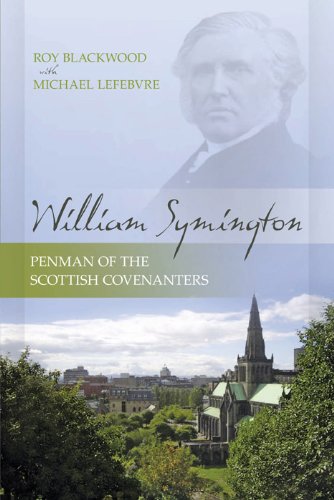
More recently, this distinction has appeared, throughout the years, in the debate over Two Kingdom theology. Dr. Darryl Hart and Dr. R. Scott Clark have been redirecting any opposition at Two Kingdom theology to an essay written by Dr. David McKay in The Faith Once Delivered: Essays in Honor of Dr. Wayne R. Spear. I intend to write a future post about how to understand Dr. McKay's essay in the future, but for now I want to highlight a very helpful, modern day explanation of this distinction that Drs. Blackwood and LeFebvre give in their book William Symington: Penman of the Scottish Covenanters on pages 210-212:
Before examining the main content of Symington's work, one important clarification should be made. It is a matter of clarification which Symington sought to establish in the opening pages of his book [ed., Messiah the Prince]. Specifically, we must have clearly fixed in mind a distinction between Jesus' authority as God—an authority which He always enjoyed over all things—and His authority as our Savior. By His very nature, Jesus always was God. To bring about our salvation, however, Jesus had to become a man. It is in Jesus' becoming a man that He took up the responsibilities and prerogatives of a Priest, a Prophet, and a King. We should have it clearly in mind that Symington was writing, in this book, about the royal authority Jesus obtained as our Incarnate Savior. This is an aspect of His authority distinct from that which He always enjoyed as the Creator God.
This might seem a confusing distinction to make, but it is a biblical distinction that needs to be upheld.Just as it is hard to comprehend how Jesus can be both God and man, similarly it is difficult to comprehend how Jesus can be at once both eternally sovereign (as Creator) and yet also to have needed to obtain sovereignty (as Savior). Yet such distinctions are taught to us by Scripture, and are important to have in mind as we approach Symington's book. ...
[T]he same Jesus, who as Creator always held sovereignty over us, now takes on mediatorial kingship as well for the purposes of our salvation.
In the case of Jesus, we might speak of the first kind of authority—His eternal sovereignty as God—as His natural dominion. It was Jesus who made all things, and having made everything, Jesus naturally owns all things. Simply because of who Jesus is (His nature), He has sovereign authority over everything. Paul wrote about this kind of authority held by Jesus in his epistle to the Colossians:
For by him were all things created, that are in heaven, and that are in earth, visible and invisible, whether they be thrones, or dominions, or principalities, or powers: all things were created by him, and for him: and he is before all things, and by him all things consist (Col.1:16-17; cf. Ps. 24:1-2).
As the Creator God, Jesus always had absolute authority over all things. Just as there was never a time when He was not God, there was never a time when Jesus was not King, in this sense. Symington refers to this authority of Jesus the Creator God as His essential, or what we here have termed His natural dominion.
The second king of authority Jesus held, however, is something which He had to obtain as part of His work of salvation. It is what Symington calls His mediatorial dominion. As a man, Jesus took "the form of a servant" (Phil. 2:7). In respect to His humanity, Jesus was not (at first) revealed as a king, but a servant. Nevertheless, from that position of servanthood, Jesus went on to be exalted to a throne: "Wherefore God also hath highly exalted him, and given him a name which is above every name" (Phil. 2:9).
Peter also preached about this authority Jesus received as our incarnate Savior in Acts 2. Using one of David's Psalms (Ps. 110) as a preaching text, Peter proclaimed,
Therefore being a prophet, and knowing that God had sworn with an oath to him, that of the fruit of his loins, according to the flesh, he would raise up Christ to sit on his throne...David...saith himself [of Jesus], The Lord said unto my Lord, Sit thou on my right hand, until I make thy foes thy footstool. Therefore let all the house of Israel know assuredly, that God hath made the same Jesus, whom ye have crucified, both Lord and Christ (Acts 2:30-36; cf., Isa. 9:6).
Jesus was exalted to a throne and endowed with titles of sovereignty. Peter is clear to indicate these privileges as being "new" acquisitions—authority ascribed to Jesus at a specific point in time and in specific connection with His work as our Savior. This is a second kind of authority obtained by Jesus in specific connection with His work of salvation. [A]lthough Jesus already held natural authority over the creation, in His love He went further to obtain for Himself mediatorial authority for the specific purpose of guaranteeing the effectiveness of our redemption.
Drs. Blackwood and LeFebvre's reference to Symington's establishment of this distinction in the opening pages of Messiah the Prince must be a reference to pages 4-5:
The sovereign authority of Christ may be viewed either as necessary, or as official. Viewing him as God, it is necessary, inherent, and underived: viewing him as Mediator, it is official and delegated. It is the latter of these we are now to contemplate. The subject of our present inquiry is, the MEDIATORIAL DOMINION of the Son; not that which essentially belongs to him as God, but that with which, by the authoritative act of the Father, he has been officially invested as the Messiah. It is that government, in short, which was laid upon his shoulders—that power which was given unto him in heaven and in earth.
It is also helpful, when addressing this distinction, to note that Symington had to defend Christ's mediatorial authority (as Drs. Blackwood and LeFebvre use "authority" instead of Symington older term "dominion") over the Nations against contemporaries in Symington's time who contended that Christ only had natural dominion over the Nations. Symington's lengthy defense of his position can be found on pages 192-230 of the edition of Messiah the Prince that I have linked to earlier in this post.

Sunday, May 4, 2014

The Threefold Division of the Law: Part 1 - Introduction

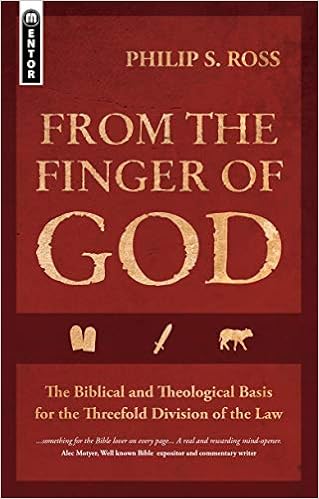
In November of 2010, Christian Focus Publications released a book by Philip S. Ross titled From the Finger of God: The Biblical and Theological Basis for the Threefold Division of the Law. It is 426 pages long and is a treasure to read if you have ever tried to defend the Westminster Confession of Faith's 19th chapter (WCF) which explains God's Law as containing a tri-partite division of the law. Ross' book goes through the entire Bible (Biblical Theology) to show that the way our Father's in the Faith understood the Law of God was a careful reflection of Scripture, instead of a imposition on Scripture (Systematic Theology).

Before the book was released, however, in March of 2010 Mr. Ross gave an address to Evangelical Presbyterian Church in England and Wales (EPCEW) on the same topic which is about an hour long. I discovered the book because I was reading through the Marrow of Modern Divinity and actually dealing with this exact issue in my church with a Theonomist who was leading a Sunday School class where he made it very clear that WCF 19.4 was wrong to teach:
To them also, as a body politic, He gave sundry judicial laws, which expired together with the State of that people; not obliging under any now, further than the general equity thereof may require.
At the time I hadn't discovered Professor McKay's book or his brilliant footnote on this topic. Therefore, I 'dug in my heals' and ordered the book and proceeded to read it, along with my pastor. What we found was great, well-researched material, that provided more than what we needed along with a whole lot of other material that addressed other contemporary issues about the Law of God, but in a different way than either of us had expected. Which, in hindsight, is a good experience even through at first it was a bit disappointing for my part.

As I was working through the book I also was trying to dig up other materials (press interviews, reviews, etc.) to see what other people were thinking about the book and to maybe find a more compact way to present 426 pages of research in a shorter time span, and that's how I found the lecture.

I haven't directly spoken with this dear Brother in Christ about Ross' book, but I'm slowly working up to addressing the matter in another forum. The great part about the address is that Ross covers his entire book in an abbreviated form with a slightly different structure. I have spent the last few months returning to the lecture for the purpose of jotting down notes and doing dictation of the lecture, so that I could make the fruits of Ross' study more accessible.

I have chosen to break up those notes into six main parts with one additional part on Ross' thoughts on the Sabbath. I think Ross' arguments for the Sabbath are good and I understand why he spends time in both the book and the lecture to address the issue; nevertheless, the key point being discussed in the first six posts the primary concerned to present Ross' arguments for the Threefold Division of the Law. I will in the final post explain my reasons for separating these closely related issues. This post will be updated as I post additional parts. The parts are:
  1. Introduction
  2. Five Old Testament presuppositions that shape the New Testament's understanding of law
  3. Jesus and the Gospels
  4. The Apostolic Interpretation of the law in the Book of Acts
  5. The Epistles of the Apostles
  6. Conclusion
  7. Sabbath Extracts
The posts will follow the general format of a statement that Ross makes in his lecture/my thoughts about how to express that statement and the relevant page numbers in Ross' book where Ross either makes a similar statements. As I found out, the address can provide some insight in the differences between writing a book and presenting a speech. Without further ado, here's Ross' introduction.

----------------

The threefold division is the division of biblical law into (pg.2):
  1. Moral - The Ten Commandments
  2. Civil (or Judicial) - Those laws that were given for civil government
  3. Ceremonial - The laws that governed sacrifice
Do people consider the confession a garment or a straightjacket?

Nearly half of the Shorter Catechism's 107 questions deal with the demands and consequences of ever binding moral law. (pg. 6)

From the beginning law was was written on the heart of man. (pg. 6)

Sin is any want of conformity unto or transgression of any law of God given as a rule to the reasonable creature. (pg. 6)

The Westminster doctrine of the threefold division of the law is a reiteration of catholic doctrine. It's not uniquely Eastern or Western; Catholic or Protestant; conservative or liberal; Patristic or Puritan; Thomist or Calvinist, or anything else. It has been expounded, maintained, and defended by some of the most prominent theologians in the history of the church. (pg. 1)

Having subjected the threefold division of the law to biblical scrutiny like any other doctrine, it is remarkable how simplistic the dismissals of the threefold division are. (pgs. 5, 7)

Two examples are Tom Wells and Jason Meyer.

Tom Wells in his book (co-authored with Fred Zaspel) New Covenant Theology on page 72 writes that biblical evidence to support the Puritan approach to the Decalogue 'was always wanting'. He goes on to write the following on page 74 (pg. 8):
As evidence for the wider sweeping conclusion that everything moral is comprehended is one of these ten commands, both the Larger and Smaller [sic] Catechism offer just three verses, Matthew 19:17, 18, 19. This is, surely, much too narrow a base from which to draw such a comprehensive conclusion. Further than that, assuming that Matthew 19 contains the best evidence for this opinion, we must note that it was not available to OT [Old Testament] believers at all.
Ross contends that Wells' seems to imagine that the divines took a very simple approach to proof texting. (pg. 8)

The Westminster Divines were, however, more sophisticated than grasping for texts that might prove their point. This is why the first edition of the Confession contained no proof texts. The reluctant Assembly was not concerned about 'being unable to support the proposition of the Confession by Scripture' but because they realized 'that a complete presentation of Scripture proof would have required a volume'. In this case, it is Wells' approach that is most obviously wanting. (pg. 8)

Jason Meyer in his book The End of the Law on page 282 writes (pgs. 8 - 9):
The NT [New Testament] itself does not make these three distinctions, and no one living under the law of Moses seriously thought they could pick which parts were binding and which were optional. God's law comes as a set with no substitutions. Therefore, exegetes should not read the three distinctions into NT texts that speak of the law as a singular entity. Furthermore, one will find it challenging to divide all laws into three neat, watertight compartments.
Meyer's takes the orthodox view for two thousand years and writes it off in seventy-five words. However, Meyer's comments should make one question if he has ever read the confessional explanations of the threefold division. (pg. 9)

The Confession's teaching in 19.3 shows the the oft-repeated claim that the threefold division divides 'all laws into three watertight compartments' is false. The section says, of the ceremonial laws, that they contain 'several typical ordinances, partly of worship, prefiguring Christ ... and partly of divers instructions of moral duties'. (pg. 9)

Many who reject the threefold division do so because they do not believe it to be biblical. But what does it mean to be 'biblical'? (pg. 37)

For some, the meaning 'to be biblical' might be rooted in certain presuppositions of biblical theology (BT) as an academic discipline.

Whatever they - professor, pastor, etc. - claim BT is and wherever they make those claims, BT is almost universally occupied with the task of being a descriptive discipline. (pg. 46)

Telling us what biblical passages supposedly meant within a predetermined, literary, or canonical context never moving beyond some conjectured historical setting, and never saying anything to the present. (pgs. 46 - 47)

From the perspective of BT, Meyer's theology appears silent when he says 'that no one living under the law of Moses seriously thought they could pick which parts were binding and which were optional'.

That sounds, continues Ross, like an accurate description of how things were for those living under the Mosaic law; a description that tells us what it meant. But it's a superficial analysis.

Ross contends that it's a superficial analysis because Meyer would have to try to persuade Amos, Jeremiah, or Isaiah of the truth of his [Meyer's] claim that there were not distinctions in the law delivered through Moses.

It is a hopeless enterprise to come to any historical doctrine and to expect the doctrine to comply with the self-authenticating scriptures of academic BT.

Should a Christian interpreter actually come to the Pentateuch or the Prophets without ever thinking about the Trinity or Jesus Christ, as two distinct natures in one person forever, they are probably more ignorant than brilliant; we simply cannot reformat our brains and come to any conclusions through that way, and nor should we. There is a pattern of sound words to which we should hold fast. (pgs. 48 - 49)

This is not the only problem with critiquing the threefold division from an exclusively BT paradigm. To do so is also anachronistic. Even if we allow that BT was brought forth by J.P. Gabler in 1787 this still leaves almost 1800 years of theological study and biblical interpretation that did not operate with a clinical dichotomy between systematic and biblical theology, or 'what the scriptures meant' and 'what the scriptures mean'. (pgs. 35, 41, 49 - 50)

Engaging in any meaningful consideration of this doctrine means we cannot ignore the way that its exponents down through the centuries read the Bible. The field of this type of study is known as the history of exegesis. (pgs. 34 - 35)

At a basic level this means we assume what was an unsurprising dogma for the early church - that is, the unity and inerrancy of the text. (pg. 40)

For Justin Martyr the word of God was infallible and immutable. (pg. 35)

Ross will provide some of the reasons why we may have confidence that the framework for biblical law found in chapter 19 of our Confession is derived from the Scripture as opposed to Meyer's claim that the division is read into the Scripture.

Ross intends to deal with the basic categories of moral, ceremonial and judicial law.

----------------

Next time we will look at the Five OT presuppositions that shape the NTs understanding of law.

Monday, April 7, 2014

The Intermediate Place of People According to the Bible

I finished reading though Professor McKay's book The Bond of Love, and would recommend reading it if you already have a good grasp of systematic theology and want to read a book that can make connections between all the different parts of the Bible and help you reach some conclusions.

I've have already referred to Professor McKay's work about Theonomy in an earlier post. For this post, however, I'm going to share a bit about McKay's insights into the state between death and the resurrection.

Prof. McKay is handling the subject in the midst of chapter 11, which is about The Final Triumph, under the section titled of Death and Beyond on pages 285 - 286.

McKay makes a distinction between the Bible being chiefly concerned with the state of people after death; but, that for these two pages he will address the location of people after death. McKay cautions that there is very little from the Scriptures that we can say about this topic, but that hasn't stopped Christians and non-Christians from talking about the issue.

For example, consider the Philadelphia Cream Cheese ads that play off of a relationship between multiple people who died and what their life is like after they become angels:


Star Wars also deals with the after life in Return of the Jedi:


In Christian circles recently, we also have books like Heaven is for Real, which is more about a near-death experience but is telling us about heaven nonetheless, and older works like Dante's The Comedy. Clive James new translation is the most accessible in my opinion.

The Roman Communion speaks and teaches about Purgatory in paragraphs 1030 - 1032 for "[a]ll who die in God's grace and friendship ..." in the Catechism of the Catholic Church (1994), but the Scriptures don't speak that way about the intermediate state, and the reason why Purgatory makes sense within the Roman Communion is because the Roman Catholic Church denies the active obedience of Christ for believers.

One place McKay points us to is Revelation 6:9-10 which says:
When he opened the fifth seal, I saw under the altar the souls of those who had been slain for the word of God and for the witness they had borne. They cried out with a loud voice, "O Sovereign Lord, holy and true, how long before you will judge and avenge our blood on those who dwell on the earth?"
McKay points out that the setting for the souls under the alter is in heaven in God's presence. He then gets into a brief overview of the debated meanings about the Hebrew word Sheol and the Greek word Hades which both apply to the place of the dead.

In terms of Sheol, McKay seems to suggest that its the realm of death, a state with separate places for the ones who Christ has made righteous and the unrighteous. The unrighteous should fear entering Sheol (Psalm 73:27), but the righteous should have confidence that through death they will be with the Lord (Psalm 73:24). Sheol is not a 'geographical' place, and not an underworld.

When considering Hades, the debate does not stop. Luke 16:19-31, would indicate that Hades can refer to intermediate place of punishment for the wicked, in terms of the rich man. However, it also seems to refer to the state of death or grave in Acts 2:27:
For you will not abandon my soul to Hades, or let your Holy One see corruption.
Along with Acts 2:31:
... he foresaw and spoke about the resurrection of the Christ, that he was not abandoned to Hades, nor did his flesh see corruption.
Therefore, some diversity in meaning must be allowed.

In conclusion, though, the Scriptures are clear that there is no break in covenant fellowship between God and his people and as pointed out last week both the righteous and the unrighteous are waiting for the final reckoning spoken of, by Christ, in Matthew 25:31 - 46. The WCF in 33.1 - 3 speaks of that day in the following way:
God has appointed a day, wherein He will judge the world, in righteousness, by Jesus Christ, to whom all power and judgment is given of the Father. In which day, not only the apostate angels shall be judged, but likewise all persons that have lived upon earth shall appear before the tribunal of Christ, to give an account of their thoughts, words, and deeds; and to receive according to what they have done in the body, whether good or evil. The end of God's appointing this day is for the manifestation of the glory of His mercy, in the eternal salvation of the elect; and of His justice, in the damnation of the reprobate, who are wicked and disobedient. For then shall the righteous go into everlasting life, and receive that fulness of joy and refreshing, which shall come from the presence of the Lord; but the wicked who know not God, and obey not the Gospel of Jesus Christ, shall be cast into eternal torments, and be punished with everlasting destruction from the presence of the Lord, and from the glory of His power. As Christ would have us to be certainly persuaded that there shall be a day of judgment, both to deter all men from sin; and for the greater consolation of the godly in their adversity: so will He have that day unknown to men, that they may shake off all carnal security, and be always watchful, because they know not at what hour the Lord will come; and may be ever prepared to say, Come Lord Jesus, come quickly, Amen.

Sunday, March 2, 2014

Theonomy vs. the Westminster Confession of Faith

For the past seven weeks I have been reading David McKay's book The Bond of Love, which I would recommend for anybody who's thinking of going to seminary or just wants to know how the Bible fits together. Today I reached Chapter 8 which is about The Way of Holiness. The last section pages 190 - 193 is about the law and society and talks about Theonomy and questions if its teachings are scriptural and confessional.

Professor McKay says "No!" to Theonomy and helpfully shows how a Theonomic interpretation of the Westminster Confession of Faith 19.4 makes that section have no actual meaning in a chapter end note numbered 60 on page 196. Professor McKay writes,
Theonomists who appeal to the Confession tend to interpret 'general equity' in such a way (i.e. embracing the detail of the laws) that they in effect reverse the Confession's statements about the laws having 'expired' and their 'not obligating any'.
The Confession says at 19.4,
To them also, as a body politic, He gave sundry judicial laws, which expired together with the State of that people; not obliging any other now, further than the general equity thereof may require.
So what is Professor McKay actually suggesting in his end note? Well here's how we should read the section if Theonomists had their way (according to McKay):
To them also, as a body politic, He gave sundry judicial laws, which though they expired together with the State of that people; the general equity thereof requires obligation of all.
The changed words are in italics, and the meaning of this altered WCF is clearly different than what the Confession actually says. Though what's not so clear is why section four would have existed if the writers were Theonomic? I'll get into the question of if Theonomy is biblical in a later series of posts, but my point for this post is to ask if it's what the RPCNA, or any other church confessing the Westminster Standards actually clearly teaches or can allow? My argument, and the argument of Professor McKay, is an emphatic, "NO!"

Furthermore, over at The Confessional Outhouse, they have a helpful post (Doing Justice to Equity), which suggests the following change to WCF 19.4 as faithful to the original intent of the Standards,
To them also, as a body politic, He gave sundry judicial laws, which expired together with the State of that people; not obliging any other now, further than the Natural Law thereof may require.
Now I realize the phrase "Natural Law" is can be a bit tricky to figure out. I also don't want to leave the impression that I agree with everything that's promoted at The Confessional Outhouse, but if we could agree that by the phrase "natural law" we mean only the Ten Commandments, also called the moral law (WCF 19.3, WLC Q. 93), and don't confuse the Ten Commandments with the Covenant of Works either, which was added to the moral law (WCF 4.2), we have pretty clear modern statement.

Sinclair Ferguson in his chapter, "An Assembly of Theonomists? The Teaching of the Westminster Divines on the Law of God" published in Theonomy: A Reformed Critique, on page 330 offers a slightly different rewording of 19.4 than McKay which is also helpful:
The Mosaic law has actually expired minimally: it remains obligatory and must be applied maximally.

I'm looking forward to having a book review series on Theonomy: A Reformed Critique soon, but it is interesting to note the publication date is 1990. Therefore, for at least over 20 years Ferguson has argued that it would be more honest to modify the Confession and hold to Theonomy than to have a secret meaning to 19.4 and then have to explain what the Confession "actually" must mean.
 
I am suggesting is that the term "general equity" had a long social context which, at least in America, is not easily understood currently. I actually plan to address the term "general equity" in a later post, but for now my best suggestion on understanding section four is,
To them also, as a body politic, He gave sundry judicial laws, which expired together with the State of that people; not obliging any other now, further than the moral law thereof may require.
This suggestion actually keeps all the terms within the confession because section three defines the moral law. Thanks must go to my dad, Chris Stockwell, for reminding me about how Professor McKay's chapter end note exactly changes the wording of WCF 19.4.