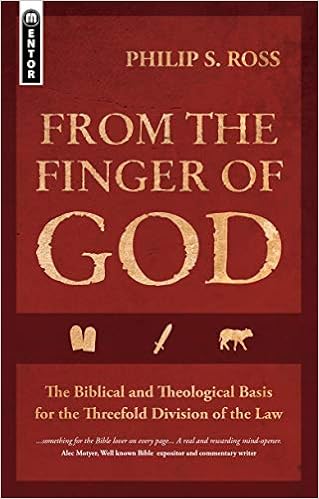
In part six, we concluded the main argument that Ross makes in his lecture and his book for why the threefold division of the should be continue to be the church's ongoing testimony of understanding the law of God.
However, I left out Ross' main two defenses of understanding Sabbath as still being the moral law, and I want to now include those sections of Ross' argument separate from the other six posts for a few reasons. The main reason being that I view Ross' examples of Christians arguing for or against the abiding validity of the Sabbath as a demonstration of the confusion that exists within the Reformed churches and the broader Christian church about how to understand all the laws that God gave in light of Christ's finished work on the cross. For me, the biggest contribution of Ross' research is about explaining that the moral, ceremonial, and judicial laws are the only possible way to understand the whole of Scripture without having to sacrifice the parts of Scripture that don't fit. Therefore, defenses of any one particular commandment, while helpful, are in my opinion raising flags to get people to pay attention.
A number of Christians, however, today have trouble with how to understand the Sabbath, and furthermore, because of that problem will not consider Ross' book in the first place because of Ross' defense of the Sabbath throughout the book and in the lecture. Phil Johnson, who pastors with John MacArthur, while reviewing Ross' book cannot get past Ross' defense throughout his book of the Sabbath because of his dispensationalism and as a result the review becomes very difficult to follow and largely unhelpful. More generally, while Tom Shreiner believes that the threefold division is biblical, the presence of a commandment about the Sabbath raises questions in his mind about how to understand the division; Justin Taylor, while commending the threefold division, nevertheless does not think it "fully works" because of the commandment about the Sabbath. My point in separating the substance (problem) from the demonstration of the problem is that the argument for the division needs to be considered before some people will consider rather or not the Sabbath applies to belevers today or it does not.
There are other books which defend the Reformed position on the Sabbath, but none of them currently include much of a defense of the threefold division, but Ross' book does both because Ross believes, and I agree, that the rejection of the Sabbath and the threefold division are linked together. Just because, however, the link exists does not mean there is only one way to defend both truths. Ross chooses to lead out his defense of the threefold division by showing where the most heat against the doctrine is currently being generated. I, however, think it might be more helpful to lay out the doctrine then show how it practically affects other doctrines. I think it is more helpful because, as has been shown, the threefold division has had many different attacks from other angles in the past, that do not only originate with a rejection or acceptance of the Sabbath.
Despite whatever differences I might have with Ross about the structure of his presentation, I do agree with Ross about the abiding validity of the Sabbath for the Christian.
- Introduction
- Five Old Testament presuppositions that shape the New Testament's understanding of law
- Jesus and the Gospels
- The Apostolic Interpretation of the law in the Book of Acts
- The Epistles of the Apostles
- Conclusion
- Sabbath Extracts
----------------
According to Tim Keller, nearly all presbyters in the PCA subscribe to the Westminster Confession of Faith (WCF) 'with only the most minor exceptions (the only common one being with regard to the Sabbath).' (pg. 5)
If, however, such an exception amounts to a wholesale rejection of the Confession's approach to the Sabbath, then Ross suspects the Westminster Divines might have thought that to call it minor was probably understatement. (pg. 5)
If the WCF were a garment, you would not want to pull this thread, unless you wanted to be altogether defrocked. (pg, 5)
Ross wonders if the reason why some people pull at this thread is because they regard the Confession as more of a straightjacket than a garment. (pg. 5)
Unbuckle the Sabbath, and as far as Reformed Theology is concerned you are well on the way to mastering theological escapology. (pg. 5)
If this sounds like overstatement to rival Keller's understatement, Ross wants to remind his listeners that biblical law, with its Sabbath, is not an easily dispensable part of our doctrinal infrastructure. (pgs. 5, 6)
You cannot perform a precision strike on the Sabbath without producing an embarrassing amount of collateral damage. (pg. 6)
You cannot strike out the Sabbath without shattering the entire category of moral law and all that depends on it. (pg. 6)
If the Shorter Catechism represents Westminster theology in its most practical form, it would seem that any expurgation of biblical law from the theological framework it expounds, should lead to its complete unraveling. (pg. 6)
----------------
The next part is from the section titled Jesus and the Gospels
----------------
One thing that does not appear in Matthew 5 is anything about Jesus' attitude to the Sabbath.
It's often assumed that Jesus disregarded the Sabbath and that the Gospel writers conveyed that.
But Ross thinks Géza Vermes is right, if the evangelists were seeking to do that 'they did a pitiful job'. (pg. 173)
Even the authors of From Sabbath to Lord's Day have to agree that Jesus did not brake the Sabbath. (pg. 167)
Ross think there is little point in going into detail with the book because of their conclusion in a summary written by Andrew Lincoln for the book (pgs. 171 - 172):
The veiled nature of Jesus' ministry accounts for the slight ambiguity in regard to His relation to the Sabbath and for the fact that for a time in the early church there were those who continued Sabbath observance while the full implications of the entry to the new age accomplished by Christ were being worked out.Ross contends that Lincoln's conclusion makes little sense. In fact, it is inexplicable considering the dates for the Gospels range from A.D. 50 - 150. How much tome did they need to work things out? (pg. 172)
If Mark clearly understood that Jesus had declared all foods clean, why did He choose to leave his readers in the dark over so fundamental an issue as the Sabbath? (pg. 172)
Until someone does better than raise the anti-Sabbatarian case from the Gospels from the 'pitifil' to the ambiguous there is little to gain be engaging in this discussion.
The evangelists represent Jesus as a Sabbath-keeper, who does not undermine the ordnance by word, action, or yet-to-be-understood personal claims. (pg. 173)
----------------
While in this section Ross does not specifically deal with the Colossians 2:14 - 15 passage which both are the given reason for Taylor and Dr. Schreiner's caveat about the threefold division Ross did address the Colossian text in part five. Since I don't want to make in seem like I'm only picking on the Gospel Coalition or Baptists, I need to also include the Lutherans' Dr. John Theodore Mueller and Dr. Francis Pieper. Both men wrote very popular and still used works on Christian Dogmatics. Near the bottom of page 213, Dr. Mueller rests his entire case on the Ten Commandments not being identified with the moral law on the sole argument of the Sabbath commandment being the ceremonial feature of the Ten Commandments. Since Dr. Mueller's one-volume work is based on Dr. Pieper's four-volume work I assume that both men agree on this argument, but have not yet verified Dr. Pieper's position in print.
Now I'm really done with the whole lecture, but I do want to ofter a bit more coverage of Ross' book in relation to some other controversies in the Reformed world. One of, which, is about a claim made by a few Westminster California professors about the application of the first four commandments to the other nations than Israel in the time of the Old Testament.
