Showing posts with label Psalm. Show all posts

Sunday, June 21, 2015

Issues to Consider about the Second/Third Commandment

One hard text to understand is the following part of the Second/Third Commandment in Exodus 20:5-6:
You shall not bow down to them or serve them, for I the Lord your God am a jealous God, visiting the iniquity of the fathers on the children to the third and the fourth generation of those who hate me, but showing steadfast love to thousands of those who love me and keep my commandments.

Roderick Lawson of Maybole (1863-1897) reprinted the Westminster Shorter Catechism along with his own explanatory notes and review questions for each Shorter Catechism question. Lawson's comment on question and answer 56 is very helpful:
Comment: The special warning here held out to us is, that although men may permit us to break this commandment with impunity, yet God will assuredly not do so. He will not fail to judge us.
Lawson makes this commandment very personal. Both the Larger and Shorter Catechism do not deal directly with verses 5-6.

In Martin Luther's Large Catechism he explained the words of the third Commandment in his concluding section about the Ten Commandments. Luther numbered the third commandment the second commandment. The following quote are marked as paragraphs 319-326:
In conclusion, however, we must repeat the text which belongs here, of which we have treated already in the First Commandment, in order that we may learn what pains God requires to the end we may learn to inculcate and practise the Ten Commandments: For I the Lord, thy God, am a jealous God, visiting the iniquity of the fathers upon the children unto the third and fourth generation of them that hate Me, and showing mercy unto thousands of them that love Me and keep My commandments. Although (as we have heard above) this appendix was primarily attached to the First Commandment, it was nevertheless [we cannot deny that it was] laid down for the sake of all the commandments, as all of them are to be referred and directed to it. Therefore I have said that this, too, should be presented to and inculcated upon the young, that they may learn and remember it, in order to see what is to urge and compel us to keep these Ten Commandments. And it is to be regarded as though this part were specially added to each, so that it inheres in, and pervades, them all. Now, there is comprehended in these words (as said before) both an angry word of threatening and a friendly promise to terrify and warn us, and, moreover, to induce and encourage us to receive and highly esteem His Word as a matter of divine earnestness, because He Himself declares how much He is concerned about it, and how rigidly He will enforce it, namely, that He will horribly and terribly punish all who despise and transgress His commandments; and again, how richly He will reward, bless, and do all good to those who hold them in high esteem, and gladly do and live according to them. Thus He demands that all our works proceed from a heart which fears and regards God alone, and from such fear avoids everything that is contrary to His will, lest it should move Him to wrath; and, on the other hand, also trusts in Him alone and from love to Him does all He wishes, because he speaks to us as friendly as a father, and offers us all grace and every good. Just this is also the meaning and true interpretation of the first and chief commandment, from which all the others must flow and proceed, so that this word: Thou shalt have no other gods before Me, in its simplest meaning states nothing else than this demand: Thou shalt fear, love, and trust in Me as thine only true God. For where there is a heart thus disposed towards God, the same has fulfilled this and all the other commandments. On the other hand, whoever fears and loves anything else in heaven and upon earth will keep neither this nor any. 325] Thus the entire Scriptures have everywhere preached and inculcated this commandment, aiming always at these two things: fear of God and trust in Him. And especially the prophet David throughout the Psalms, as when he says [Ps. 147:11]: The Lord taketh pleasure in them that fear Him, in those that hope in His mercy. As if the entire commandment were explained by one verse, as much as to say: The Lord taketh pleasure in those who have no other gods. Thus the First Commandment is to shine and impart its splendor to all the others. Therefore you must let this declaration run through all the commandments, like a hoop in a wreath, joining the end to the beginning and holding them all together, that it be continually repeated and not forgotten; as, namely, in the Second Commandment, that we fear God and do not take His name in vain for cursing, lying, deceiving, and other modes of leading men astray, or rascality, but make proper and good use of it by calling upon Him in prayer, praise, and thanksgiving, derived from love and trust according to the First Commandment. In like manner such fear, love, and trust is to urge and force us not to despise His Word, but gladly to learn, hear, and esteem it holy, and honor it.
Since we are talking about trying to understand a particular command of the moral law another good resource to look at is the Prophetic books of the Old Testament. The Prophets gave the word of the Lord to the nation of Israel during a long time of disobedience towards God, and so much of their prophesies are targeted towards how the covenant nation of Judah and the uncovenanted nation of Samaria (Willson, 64-67) were in an active state of breaking and twisting God's moral law. The tasks of the Prophets were to correctly interpret God's ten words given on Sinai so that the people's comfortable lifestyles were correctly understood as actually being uncomfortable to God. Their lives were a mess, because they have lowered God's standard so that "It's not their fault."

Three specific passages can help us understand Luther's appendix to every commandment. Jeremiah 16:10-13, Ezekiel 18, and 33:7-20. The most helpful passage is spoken through Jeremiah and says:
And when you tell this people all these words, and they say to you, "Why has the Lord pronounced all this great evil against us? What is our iniquity? What is the sin that we have committed against the Lord our God?" then you shall say to them: "Because your fathers have forsaken me, declares the Lord, and have gone after other gods and have served and worshiped them, and have forsaken me and have not kept my law, and because you have done worse than your fathers, for behold, every one of you follows his stubborn, evil will, refusing to listen to me. Therefore I will hurl you out of this land into a land that neither you nor your fathers have known, and there you shall serve other gods day and night, for I will show you no favor."
According to Jeremiah the people were correct to say that God was not judging them based on the actions of their fathers, but Jeremiah's message went further to say that the present generation of the nation of Israel had exceeded their fathers in their sinful acts.

My pastor, Dave Long, helpfully pointed out the Jeremiah passage many years ago while preaching on the Westminster Larger Catechism.

Tuesday, March 17, 2015

Jesus' Authority as God and Jesus' Authority as Mediator: Symington

For several years I have been trying to understand the history of the doctrine of the Mediatorial Kingship of Christ. One issue that continues to crop of in the literature is how to understand Christ in relation to the Church and Christ in relation to the created order.

This distinction was important during the time of the Westminster Assembly (1643-1653), the killing times in Scotland (1660-1688), and in the Reformed Presbyterian Church's witness though writers such as William Symington.

I hope in a future post to address this distinction as the Westminster Assembly was confronted with the issue.

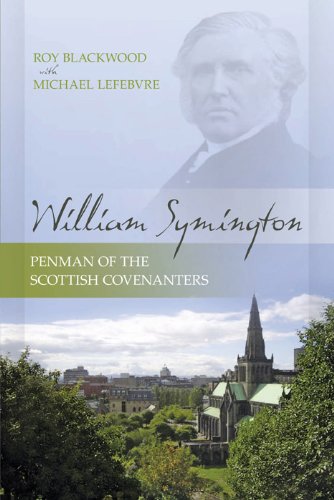
More recently, this distinction has appeared, throughout the years, in the debate over Two Kingdom theology. Dr. Darryl Hart and Dr. R. Scott Clark have been redirecting any opposition at Two Kingdom theology to an essay written by Dr. David McKay in The Faith Once Delivered: Essays in Honor of Dr. Wayne R. Spear. I intend to write a future post about how to understand Dr. McKay's essay in the future, but for now I want to highlight a very helpful, modern day explanation of this distinction that Drs. Blackwood and LeFebvre give in their book William Symington: Penman of the Scottish Covenanters on pages 210-212:
Before examining the main content of Symington's work, one important clarification should be made. It is a matter of clarification which Symington sought to establish in the opening pages of his book [ed., Messiah the Prince]. Specifically, we must have clearly fixed in mind a distinction between Jesus' authority as God—an authority which He always enjoyed over all things—and His authority as our Savior. By His very nature, Jesus always was God. To bring about our salvation, however, Jesus had to become a man. It is in Jesus' becoming a man that He took up the responsibilities and prerogatives of a Priest, a Prophet, and a King. We should have it clearly in mind that Symington was writing, in this book, about the royal authority Jesus obtained as our Incarnate Savior. This is an aspect of His authority distinct from that which He always enjoyed as the Creator God.
This might seem a confusing distinction to make, but it is a biblical distinction that needs to be upheld.Just as it is hard to comprehend how Jesus can be both God and man, similarly it is difficult to comprehend how Jesus can be at once both eternally sovereign (as Creator) and yet also to have needed to obtain sovereignty (as Savior). Yet such distinctions are taught to us by Scripture, and are important to have in mind as we approach Symington's book. ...
[T]he same Jesus, who as Creator always held sovereignty over us, now takes on mediatorial kingship as well for the purposes of our salvation.
In the case of Jesus, we might speak of the first kind of authority—His eternal sovereignty as God—as His natural dominion. It was Jesus who made all things, and having made everything, Jesus naturally owns all things. Simply because of who Jesus is (His nature), He has sovereign authority over everything. Paul wrote about this kind of authority held by Jesus in his epistle to the Colossians:
For by him were all things created, that are in heaven, and that are in earth, visible and invisible, whether they be thrones, or dominions, or principalities, or powers: all things were created by him, and for him: and he is before all things, and by him all things consist (Col.1:16-17; cf. Ps. 24:1-2).
As the Creator God, Jesus always had absolute authority over all things. Just as there was never a time when He was not God, there was never a time when Jesus was not King, in this sense. Symington refers to this authority of Jesus the Creator God as His essential, or what we here have termed His natural dominion.
The second king of authority Jesus held, however, is something which He had to obtain as part of His work of salvation. It is what Symington calls His mediatorial dominion. As a man, Jesus took "the form of a servant" (Phil. 2:7). In respect to His humanity, Jesus was not (at first) revealed as a king, but a servant. Nevertheless, from that position of servanthood, Jesus went on to be exalted to a throne: "Wherefore God also hath highly exalted him, and given him a name which is above every name" (Phil. 2:9).
Peter also preached about this authority Jesus received as our incarnate Savior in Acts 2. Using one of David's Psalms (Ps. 110) as a preaching text, Peter proclaimed,
Therefore being a prophet, and knowing that God had sworn with an oath to him, that of the fruit of his loins, according to the flesh, he would raise up Christ to sit on his throne...David...saith himself [of Jesus], The Lord said unto my Lord, Sit thou on my right hand, until I make thy foes thy footstool. Therefore let all the house of Israel know assuredly, that God hath made the same Jesus, whom ye have crucified, both Lord and Christ (Acts 2:30-36; cf., Isa. 9:6).
Jesus was exalted to a throne and endowed with titles of sovereignty. Peter is clear to indicate these privileges as being "new" acquisitions—authority ascribed to Jesus at a specific point in time and in specific connection with His work as our Savior. This is a second kind of authority obtained by Jesus in specific connection with His work of salvation. [A]lthough Jesus already held natural authority over the creation, in His love He went further to obtain for Himself mediatorial authority for the specific purpose of guaranteeing the effectiveness of our redemption.
Drs. Blackwood and LeFebvre's reference to Symington's establishment of this distinction in the opening pages of Messiah the Prince must be a reference to pages 4-5:
The sovereign authority of Christ may be viewed either as necessary, or as official. Viewing him as God, it is necessary, inherent, and underived: viewing him as Mediator, it is official and delegated. It is the latter of these we are now to contemplate. The subject of our present inquiry is, the MEDIATORIAL DOMINION of the Son; not that which essentially belongs to him as God, but that with which, by the authoritative act of the Father, he has been officially invested as the Messiah. It is that government, in short, which was laid upon his shoulders—that power which was given unto him in heaven and in earth.
It is also helpful, when addressing this distinction, to note that Symington had to defend Christ's mediatorial authority (as Drs. Blackwood and LeFebvre use "authority" instead of Symington older term "dominion") over the Nations against contemporaries in Symington's time who contended that Christ only had natural dominion over the Nations. Symington's lengthy defense of his position can be found on pages 192-230 of the edition of Messiah the Prince that I have linked to earlier in this post.